
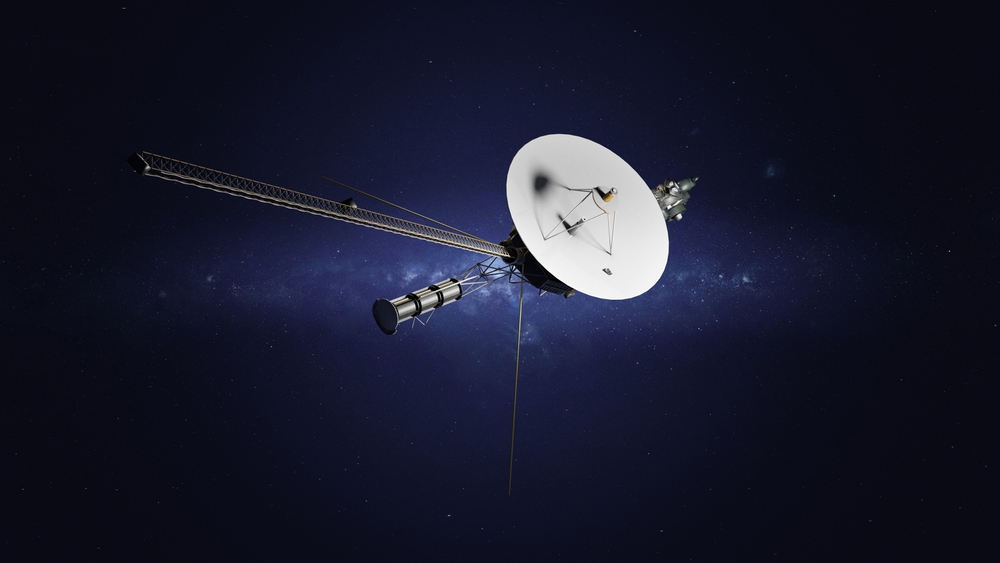
A spacecraft launched nearly 50 years ago is approaching a milestone that sounds almost impossible to comprehend. Voyager 1, which has been traveling through space since 1977, is reaching a distance so enormous that a message sent from the probe will need an entire day to reach Earth, even while traveling at the speed of light.
The milestone marks a strange moment in human history. Humanity has built machines capable of leaving the Solar System’s planetary neighborhood, but even our fastest messages still face an extraordinary journey home. Voyager 1 is now so distant that the planet it once called home will need to keep spinning for a full day before its next message can arrive.
Voyager 1 Is Approaching an Extraordinary Distance From Earth
Voyager 1 was launched on September 5, 1977, as part of NASA’s ambitious mission to explore the outer planets. Its journey was made possible by an unusual arrangement of the giant planets that allowed spacecraft to travel between them using gravity assists. Nearly five decades later, the probe remains one of humanity’s most distant and remarkable technological achievements.
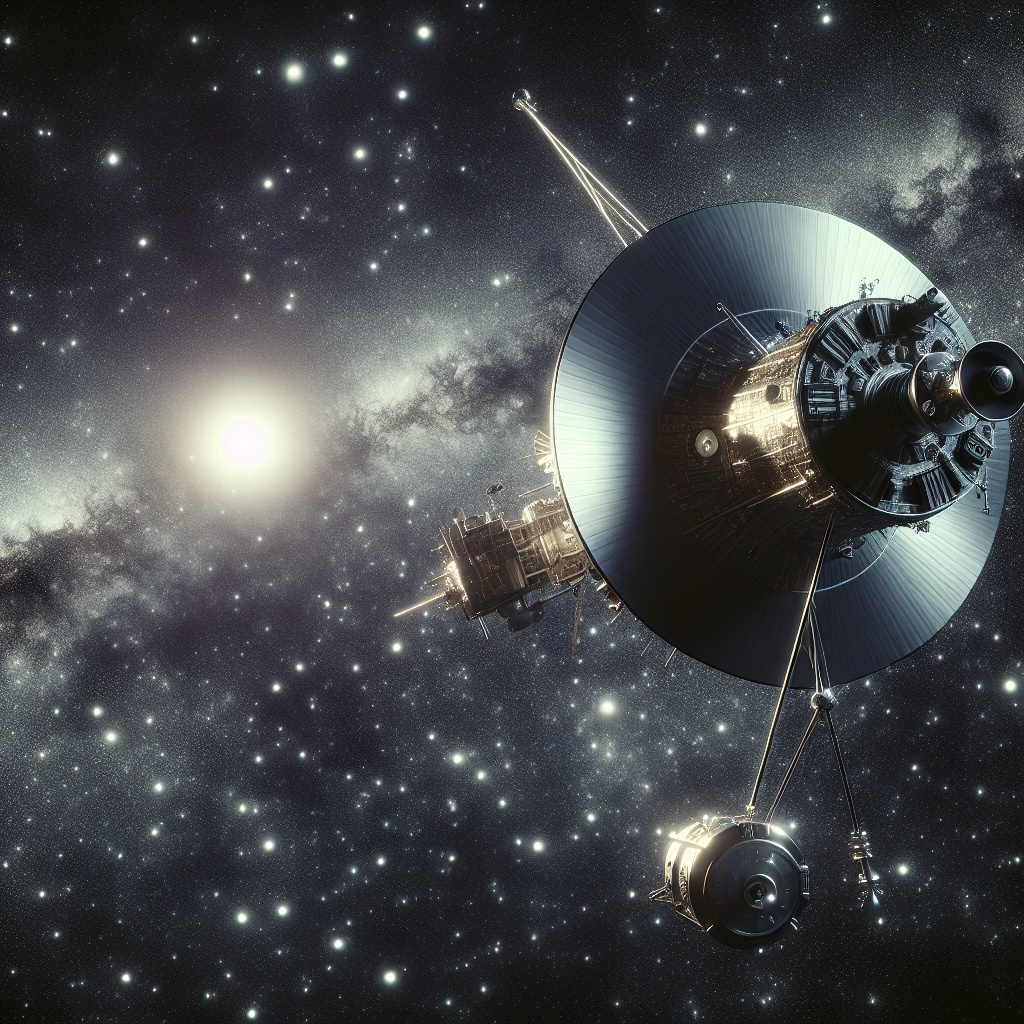
The spacecraft is approaching a distance of approximately 25.9 billion kilometers (16.1 billion miles) from Earth. At that distance, light itself needs around 24 hours to cover the gap. This means a signal transmitted from Voyager 1 cannot reach mission controllers immediately, even though radio communication travels at the fastest speed allowed by the universe.
The milestone described in the original report was projected for November 18. It represents the first time a human-made object has reached a distance from Earth equivalent to one light-day. The distinction is fascinating because a light-day measures distance rather than time. It describes how far light travels in 24 hours.
For the engineers and scientists who have followed Voyager’s journey, the distance also illustrates the extraordinary challenge of communicating with spacecraft operating far beyond Earth’s immediate neighborhood. Every instruction sent from Earth must cross the same enormous gap before reaching the probe.
The Rare Planetary Alignment That Made Voyager Possible
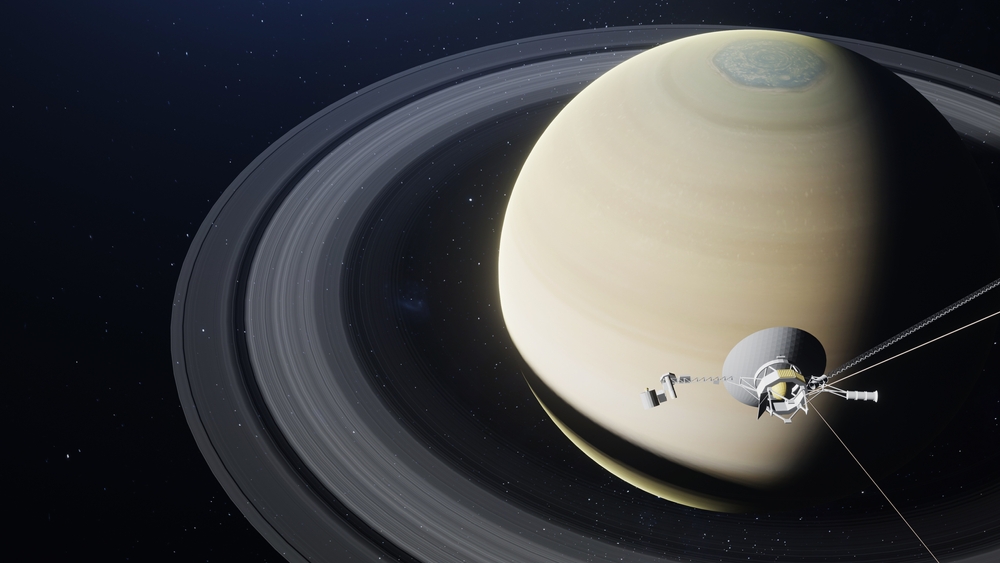
Voyager’s journey began with an opportunity that would not come around again for generations. During the late 1970s and early 1980s, Jupiter, Saturn, Uranus, and Neptune occupied a rare geometric arrangement that allowed spacecraft to visit multiple outer planets using relatively little fuel.
NASA describes the alignment as an opportunity occurring approximately once every 175 years. The arrangement allowed spacecraft following carefully calculated paths to move from one planet to another through gravitational assistance. Without this unusual configuration, reaching the outer planets would have required significantly more propellant and travel time.
The technique behind this journey is known as a gravity assist. It uses the gravitational pull of a moving planet to change a spacecraft’s speed and direction relative to the Sun. A spacecraft approaches a planet along a carefully planned trajectory, passes around it, and leaves with a different velocity.
The principle sounds simple, but the calculations are extraordinarily precise. Engineers must determine the spacecraft’s approach angle, speed, and trajectory years before the encounter. A small error can affect the entire journey, making gravity assists one of the most useful techniques in deep-space exploration.
How Gravity Assists Helped Spacecraft Travel Further
Gravity assists became an important part of planetary exploration during the early years of spaceflight. Scientists realized that a spacecraft could use a planet’s motion to gain or lose orbital energy without carrying enormous amounts of additional fuel.
Mariner 10 demonstrated the technique during its journey to Mercury. Launched in 1973, the spacecraft used Venus to adjust its trajectory and reach its destination. This helped establish gravity assistance as a practical method for exploring planets that would otherwise require more complicated propulsion systems.
Voyager 1 and Voyager 2 took advantage of the exceptional planetary alignment. Their trajectories allowed them to visit several giant planets during journeys that would have been far more difficult using conventional propulsion alone.
The technique offers several important advantages:
- Reduced fuel requirements: Spacecraft can use planetary gravity to change their trajectories without relying entirely on onboard engines.
- Longer exploration journeys: Gravity assists make distant destinations more accessible.
- Carefully controlled speed changes: Engineers can increase or decrease a spacecraft’s velocity relative to the Sun.
- More efficient mission planning: A well-timed planetary encounter can help spacecraft reach multiple destinations.
- Access to distant worlds: Missions can explore parts of the Solar System that would otherwise demand much larger propulsion systems.
Voyager’s journey remains one of the clearest demonstrations of what careful mission planning can accomplish. A rare planetary arrangement helped turn a difficult journey into an achievable mission that continues to influence how scientists plan deep-space exploration.
Nearly 50 Years Later, Voyager Is Still Sending Signals
Voyager 1 and Voyager 2 were launched in 1977, but their original missions have lasted far longer than many people would have expected. Both spacecraft have continued traveling through space long after completing their primary planetary encounters.
Voyager 1 visited Jupiter and Saturn, capturing valuable observations that expanded scientific understanding of the outer Solar System. Voyager 2 followed a different route, becoming the only spacecraft to visit Uranus and Neptune during close planetary encounters. Those observations remain important because no other spacecraft has repeated those visits.
However, keeping the probes operational has become increasingly difficult. Their power supplies are gradually declining, forcing mission teams to conserve electricity by shutting down instruments and managing available energy carefully.
The spacecraft use radioisotope thermoelectric generators, which produce electricity from heat released by the natural decay of radioactive material. Their electrical output decreases over time, placing limits on how many instruments and systems can remain active.
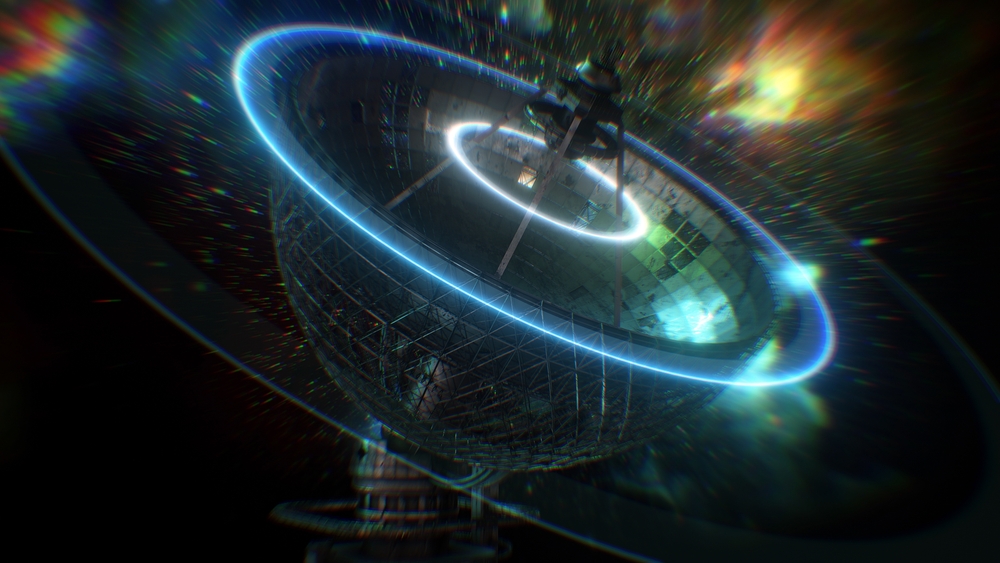
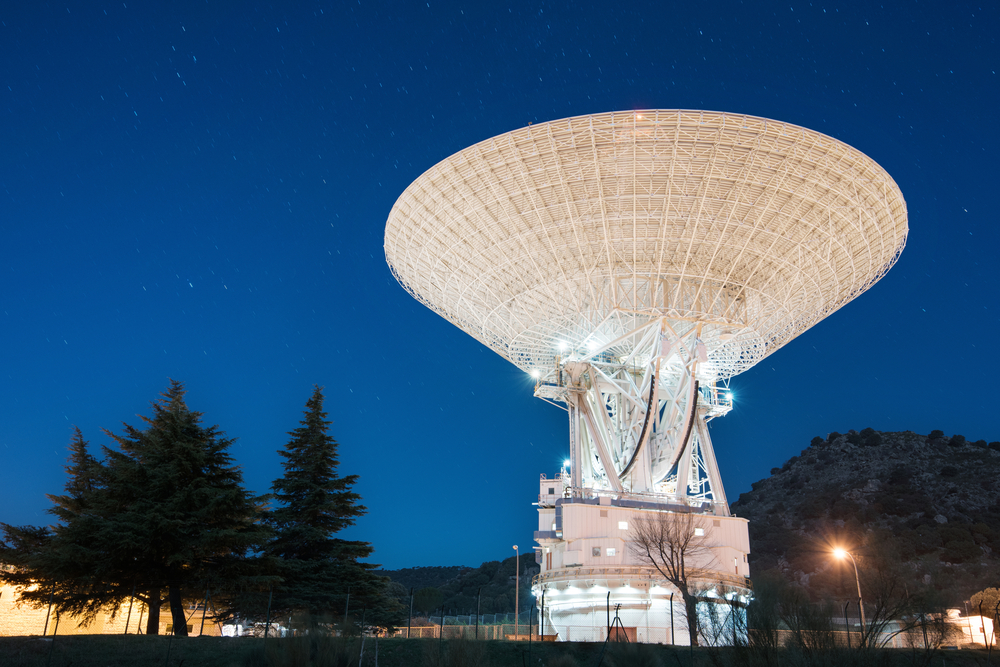
Despite these challenges, Voyager 1 continues to send scientific information across an enormous distance. The signals are weak by the time they reach Earth, requiring large antennas and sophisticated equipment to receive and interpret them.
Every successful transmission represents a remarkable engineering achievement. A machine built during the 1970s is still communicating with scientists from a distance that would have seemed almost unimaginable when it first left Earth.
What Happens When Voyager 1 Eventually Stops Working?
Voyager 1 will not operate forever. Its declining power supply means that mission controllers will eventually lose the ability to operate its remaining scientific instruments and maintain communication with the spacecraft.
Even after that happens, the probe will continue moving through space. There is no atmosphere or ordinary friction to bring it to a halt, so Voyager 1 will keep traveling along its trajectory long after its electronic systems have stopped functioning.
The spacecraft also carries one of humanity’s most unusual messages: the Golden Record. Developed as a time capsule for potential extraterrestrial discoverers, the record contains sounds, images, and musical selections intended to represent life on Earth.
Its contents include:
- Greetings recorded in multiple human languages.
- Natural sounds such as ocean waves, thunder, and birdsong.
- Musical selections from different cultures and periods.
- Images representing human life, science, and Earth’s environment.
- Information about Earth’s location and the physical characteristics of humanity.
The Golden Record was designed to communicate something about the planet and the species responsible for building the spacecraft. There is no guarantee anyone will ever discover it, but its presence gives Voyager’s mission an unusual cultural significance.
Even when its final signal disappears, the spacecraft will continue carrying that message through interstellar space.
Voyager 1 Has Another Remarkable Encounter Ahead
Voyager 1’s journey will continue long after its communication with Earth ends. NASA identifies its future direction as pointing toward a star called Gliese 445, also known as AC +79 3888, located in the constellation Ursa Minor.
The spacecraft is expected to pass approximately 1.7 light-years from the star in around 40,000 years. That is an extraordinary amount of time, especially considering that humanity has only been sending spacecraft into space for a few generations.
Gliese 445 will not be a destination in the conventional sense. Voyager 1 will not slow down to study the star or enter its planetary system. It will simply pass through the surrounding region as it continues its journey across the galaxy.
By that point, the world that launched Voyager 1 may look completely different. Languages, governments, technologies, and even the civilizations that exist on Earth could change dramatically over thousands of years.
The spacecraft will carry its Golden Record through all of it. Its journey has already outlasted the careers of the people who designed it, and it may continue long after everyone involved in its creation has disappeared.
A Message From Voyager Takes an Entire Day to Arrive
The one-light-day milestone offers a striking way to understand just how vast space really is. Humans can build increasingly sophisticated spacecraft, but the distances between stars and planets remain enormous.
Voyager 1 has spent nearly half a century traveling away from Earth, using carefully planned routes and planetary gravity to reach the distant edge of the Solar System. Yet its journey has only taken it a tiny fraction of the way toward the nearest stars.
When its final transmission eventually arrives, the signal will have crossed billions of kilometers carrying information from a machine built decades earlier. The spacecraft will then continue traveling, even when Earth can no longer hear it.
For now, Voyager 1 is still out there, sending messages across a distance that takes light an entire day to cross.
Sources:
NASA. (2026, November 19). NASA’s Voyager 1 makes history reaching one Light-Day from Earth – NASA. https://www.nasa.gov/news-release/nasas-voyager-1-makes-history-reaching-one-light-day-from-earth/