
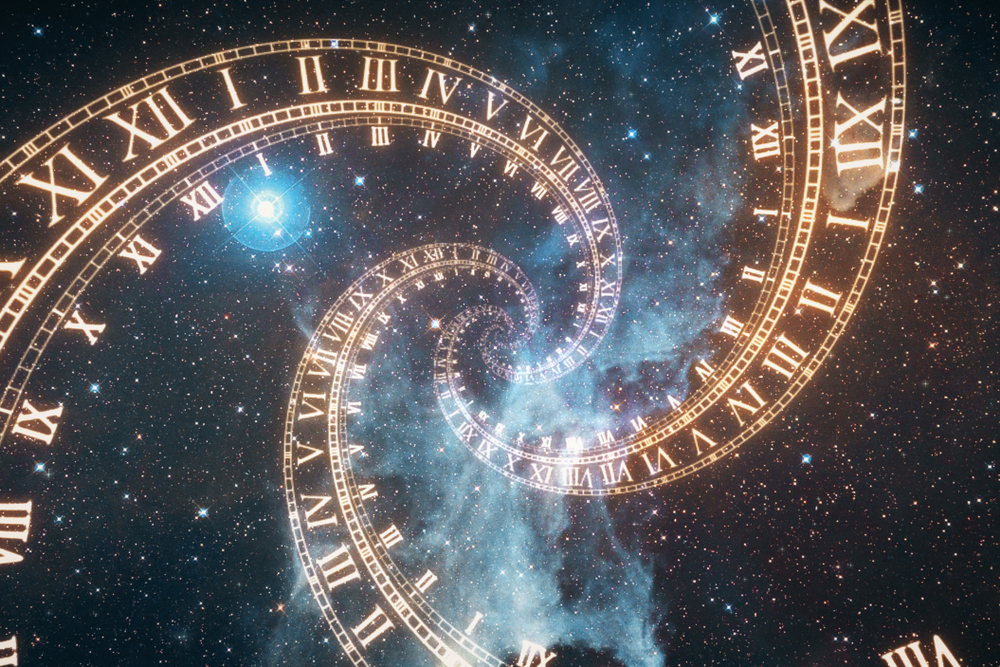
What if tomorrow has already happened somewhere in the universe? What if the biggest moments of your life, including decisions you haven’t made and experiences you haven’t lived, already exist within the structure of reality? It sounds like something from a science fiction movie, but some physicists are seriously investigating a theory that challenges how humans understand time. The idea raises unsettling questions about whether the future is already written, whether the past can be influenced by events that have yet to happen, and whether people genuinely have control over their own lives.
The controversial concept is known as the block universe, and it suggests that the past, present, and future could all exist simultaneously. Rather than time continuously moving forward, every moment could occupy its own position within a larger structure called spacetime. Researchers are also exploring a related idea called retrocausality, which proposes that future events could influence certain conditions in the past. If these interpretations are correct, they could change how scientists understand quantum physics and force people to reconsider what it means to make a choice.
Scientists Are Questioning Whether Time Actually Moves Forward
Most people experience time as a continuous progression. Yesterday has disappeared, today is unfolding, and tomorrow remains somewhere ahead. Everything from aging to the movement of planets seems to reinforce the idea that the universe moves from the past toward the future. However, the block universe interpretation challenges this familiar picture by suggesting that the passage of time might not be a fundamental feature of reality.
According to this interpretation, time is another dimension, similar to the dimensions of space. Every event has its own position within spacetime, meaning moments from the distant past and distant future could exist within the same overall structure. Emily Adlam, an assistant professor of the philosophy of quantum mechanics at Chapman University, explained the idea by saying, “There’s no flow of time in the block universe.” She added, “Time is just another dimension, like all the dimensions of space.”
This changes how people might interpret the movement of the Earth around the Sun. Imagine observing our planet at different positions in its orbit. We normally describe those observations as evidence that time has passed, but the block universe interpretation offers another explanation. The different positions could simply represent different locations along Earth’s path through spacetime. The complete orbit would form part of a larger structure, with each moment occupying its own place.
The idea has existed for more than a century, but researchers continue examining whether a version of it could help explain unresolved problems in modern physics. Its implications reach beyond scientific equations because it also challenges the assumption that the present moment is the only part of reality that genuinely exists. If every moment already occupies a position within spacetime, the future might be very different from what human experience suggests.

What If Events In The Future Could Influence The Past?
The block universe becomes even more complicated when researchers consider retrocausality. This concept explores whether future events could influence certain conditions in the past, reversing the ordinary direction of cause and effect. In everyday life, people expect a cause to happen before its consequences. A person pushes an object, and the object moves. A switch is activated, and a light turns on. Retrocausality questions whether this relationship must always work in one direction.
The idea has attracted attention because quantum mechanics contains several puzzling phenomena that are difficult to explain through familiar assumptions about time and causation. Researchers are investigating whether allowing future conditions to influence earlier hidden variables could help explain some of these unusual results. Rod Sutherland, a theoretical physicist at the University of Sydney’s Centre for Time, has challenged the conventional understanding of time, saying, “Our understanding of the flow of time is flawed.”
The suggestion becomes particularly interesting when considering how the laws of nature might operate. Instead of events unfolding through a strict sequence, some researchers are considering whether the laws governing the universe could constrain an entire history at once. Under this approach, the future and past would belong to one larger structure, with physical conditions connected across different moments. This would fundamentally change the way scientists approach causality.
However, retrocausality remains a theoretical interpretation rather than an established description of how the universe works. Researchers are still examining whether it can provide convincing explanations for quantum phenomena. The possibility is fascinating because it challenges assumptions people rarely question, but it does not establish that tomorrow can directly change something that happened yesterday.
Quantum Entanglement Could Hold An Important Clue
One of the biggest puzzles connected to this discussion involves quantum entanglement. This phenomenon occurs when two particles share a relationship that produces correlated properties, even when they are separated by enormous distances. When scientists measure the particles, their results can display correlations that challenge conventional ideas about how physical systems behave. Albert Einstein famously described the apparent phenomenon as “spooky action at a distance.”
The difficulty is understanding how these correlations arise without relying on explanations that conflict with other principles of physics. Ken Wharton, a professor of physics and astronomy at San José State University, believes assumptions about the direction of causation could be part of the problem. He explained, “When you prove there must be spooky action at a distance, you assume the future can’t possibly affect the past.” His argument suggests that changing this assumption could alter how researchers interpret certain quantum results.
Wharton has explored theoretical models in which future measurements could influence hidden variables associated with the earlier history of entangled particles. Consider two people, Alice and Bob, measuring entangled particles in different locations. Under a retrocausal interpretation, Alice’s measurement could influence a hidden variable associated with the particles’ original shared history. That variable could also affect the results associated with Bob’s measurement.
Some researchers refer to this proposed arrangement as zigzag causality because the influence would travel through different points in spacetime rather than requiring an unexplained connection across distance. Wharton describes the possibility as “spooky retrocausal action.” He also acknowledges that these ideas produce unusual consequences. The possibility that human choices could affect hidden conditions in the past sounds deeply counterintuitive, but researchers are investigating whether this could help explain why quantum physics behaves so differently from the everyday world.
Physicists Have Two Different Ways Of Understanding Retrocausality
Retrocausality does not necessarily mean that every researcher imagines the same process. Adlam identifies two broad conceptual approaches to understanding how future events could influence the past. Both challenge conventional assumptions about time, although they describe the relationship between events differently. Understanding the distinction helps explain why the subject remains an active area of theoretical discussion.
The first approach involves two separate and independent arrows of causation moving in opposite directions. One arrow travels from the past toward the future, following the familiar relationship between causes and effects. The other moves from future conditions toward earlier events. Under this interpretation, the two directions of causation coexist within the same physical description. Adlam explains that this model involves “two distinct and independent arrows of causation going in opposite directions.”
The second approach considers the laws of nature as applying to the entire history of the universe at once. Adlam compares this possibility to solving a Sudoku puzzle. The rules of the puzzle apply to the complete grid and determine whether a finished arrangement is valid. Similarly, the laws of nature could constrain all of spacetime rather than governing events through a simple sequence of independent moments.
This distinction is important because the block universe and retrocausality are connected without being identical. The block universe interpretation focuses on the nature of time and spacetime, while retrocausality explores possible relationships between events at different points in time. Adlam explains that a block universe could exist even if retrocausality turned out to be incorrect. Researchers therefore need to examine these ideas separately rather than assuming that proving one would automatically establish the other.
Why The Present Moment Could Be An Illusion
If the past, present, and future all exist within one structure, another question immediately appears. Why do people experience only one moment at a time? Human consciousness seems firmly attached to the present, while memories provide access to the past and imagination offers a glimpse of what might happen next. The block universe interpretation challenges the idea that the present has a unique position within the universe itself.
Adlam suggests that the experience of the present could be connected to an observer’s particular position in spacetime. She compares the situation to two people observing the universe from different locations. Someone viewing the cosmos from California experiences a different spatial perspective from someone observing it elsewhere. In a similar way, people existing at different moments occupy different temporal positions within the larger structure.
She describes this by imagining different versions of an observer existing at separate points in time. One version might experience October 27, while another occupies October 28. These would represent different perspectives within the same larger temporal structure. The idea challenges the assumption that only the moment people currently experience can be considered real.
This interpretation offers one possible explanation for why time feels like something that constantly moves forward, even if the underlying structure of reality does not operate that way. However, it does not completely resolve the question of why human beings experience time in such a particular manner. The relationship between consciousness, memory, and the physical structure of spacetime remains a difficult subject for researchers and philosophers.
Does This Mean Your Future Is Already Decided?
Perhaps the most unsettling implication of the block universe concerns free will. If every moment of time already exists, it raises the possibility that every decision and experience is part of a fixed history. The conversation becomes particularly uncomfortable when applied to ordinary life. Every conversation, relationship, mistake, achievement, and decision could occupy a position within spacetime, even before someone experiences it.
Adlam acknowledges that the idea raises longstanding philosophical concerns about fate and personal freedom. “One of the longstanding philosophical worries about the block universe is that everything is kind of fated and there’s no free will,” she said. If the universe already contains the complete history of every event, it becomes difficult to understand how people could genuinely choose between different possibilities.
However, the relationship between determinism and free will is more complicated than it initially appears. One philosophical position called compatibilism argues that free will can exist even if the physical laws governing the universe determine events. Under this interpretation, a person can still act freely when their desires, intentions, and goals are the causes of their actions.
Adlam explains the position by saying, “As long as I am the cause of my actions, I am acting freely.” This suggests that a decision could belong to a predetermined history while still being caused by the individual making it. The question therefore shifts from whether the future is fixed to what freedom actually means. Even if the block universe interpretation is correct, it does not automatically settle the debate about human choice.
Why Retrocausality Does Not Mean Time Travel Is Possible
The suggestion that future events could influence the past naturally raises questions about time travel. If causation can operate backward under certain theoretical conditions, could people eventually find a way to return to an earlier point in their lives? The possibility sounds tempting, particularly when considering how many people would like to change a past decision or prevent an unfortunate event.
However, the retrocausal models discussed by researchers do not provide a way to send signals into the past. Adlam explains that allowing information to travel backward freely could create serious causal paradoxes. Imagine someone returning to an earlier point in time and preventing an event that originally caused their journey. If that event never happened, the journey itself would become impossible, creating a contradiction.
For this reason, the proposed retrocausal influences are restricted to hidden variables associated with the past. These are conditions that cannot simply be used to transmit ordinary messages or instructions to an earlier moment. The distinction is essential because a theoretical influence running backward through time does not automatically create a practical method of time travel.
The idea also shows why researchers must be careful when discussing retrocausality. The possibility of future conditions influencing hidden aspects of earlier events is very different from a person physically traveling into the past. No evidence presented in the theory establishes that humans could revisit historical events or communicate with their younger selves.
The Universe Still Has Some Difficult Questions To Answer
The block universe and retrocausality remain controversial interpretations, and researchers have not established that either provides the final explanation for how reality works. Their appeal comes partly from the possibility that they could help explain unusual quantum phenomena and challenge assumptions about the nature of time. However, significant questions remain about how these ideas fit into a complete understanding of the universe.
Some of the biggest questions researchers are still considering include:
- Does time actually flow? The block universe interpretation suggests that the past, present, and future could all exist within spacetime.
- Can the future influence the past? Retrocausality explores whether future conditions could affect hidden variables associated with earlier events.
- Can quantum entanglement be explained differently? Researchers are examining whether retrocausal models could help explain unusual correlations between particles.
- Is free will compatible with a predetermined universe? Compatibilism offers one philosophical interpretation, although the debate remains unresolved.
- Could time travel ever become possible? The retrocausal models discussed here do not establish a way to send signals into the past.
Future research could provide a clearer understanding of whether these interpretations accurately describe reality or whether another explanation is needed. Adlam, Sutherland, and Wharton are exploring different aspects of the problem, but the questions surrounding time and causality remain far from settled. The possibility that an effect could precede its cause continues to challenge the assumptions that have shaped how people understand the universe.
For now, the block universe remains a theory that forces an uncomfortable question into an ordinary human experience: if the future already exists somewhere within spacetime, what exactly are people doing when they make their next decision? The answer could change how humanity understands time, but it will take much more research to establish whether the universe really works this way.
Sources:
- Adlam, E. (n.d.). Two roads to retrocausality. Chapman University Digital Commons. https://digitalcommons.chapman.edu/scs_articles/965/
- Wharton, K. (2018). A new class of retrocausal models. Entropy, 20(6), 410. https://doi.org/10.3390/e20060410