
Your cart is currently empty!
Scientists Ran a Quantum Experiment That Could Change What We Mean By Reality

For centuries, there has been one assumption almost nobody has had reason to question: if two people witness the same event, they should be able to agree on what happened. A bizarre quantum experiment involving six photons has now pushed that everyday certainty into uncomfortable territory, suggesting that two observers can arrive at facts that cannot be combined into one objective account.
Contents
show
The experiment was inspired by a thought experiment proposed by physicist Eugene Wigner in 1961. Nearly six decades later, researchers built a version of the scenario in a laboratory and found that the results violated an inequality that should hold if different observers always share the same objective facts.

A Puzzle That Started With Wigner’s Friend
Wigner’s original thought experiment was deceptively simple. Imagine a photon existing in a quantum superposition of two possible polarizations, while a friend inside a sealed laboratory measures it and records the result. The friend sees one definite outcome, but Wigner remains outside and has no access to that measurement, meaning quantum theory allows him to treat the entire laboratory, including his friend, as part of a larger unresolved quantum state.
That creates a strange situation because both observers can be applying quantum theory correctly while assigning different descriptions to the same event. Wigner originally tried to avoid the contradiction by arguing that consciousness could prevent a human observer from existing in two quantum possibilities at once. The later experiment took a different approach, treating observation as the physical extraction and storage of information rather than requiring a conscious mind.
The researchers described an observer as any physical system capable of obtaining information from another system through an interaction and storing that information in physical memory. Under that definition, the “friend” does not have to be a person. A physical system can play the role, which allowed the researchers to turn Wigner’s philosophical puzzle into something that could actually be tested.

Six Photons Turned The Thought Experiment Into A Test
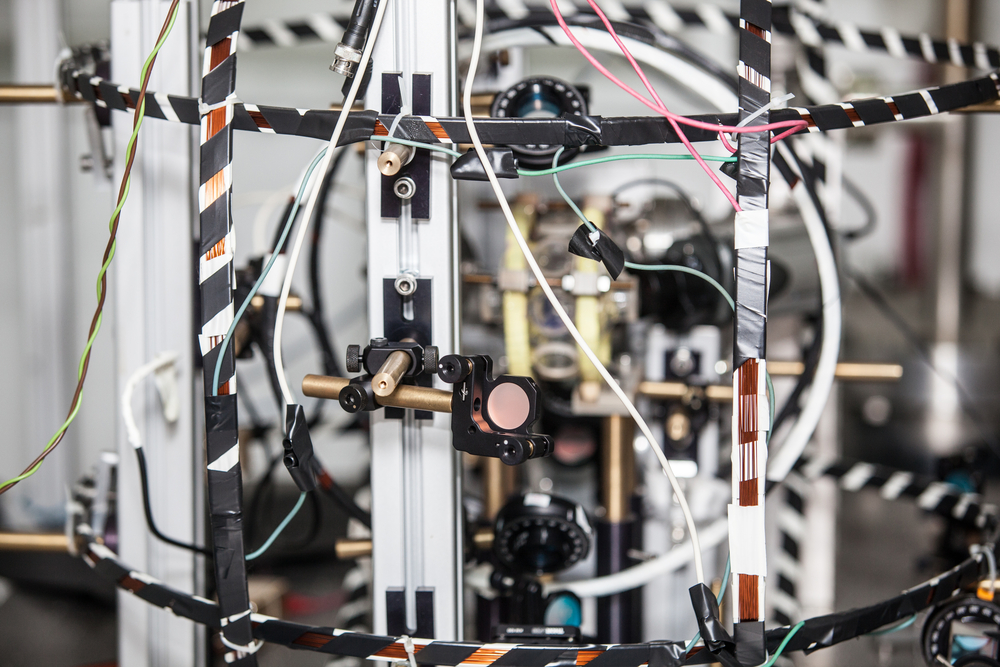
The laboratory version required more than a single photon and an imaginary friend. The researchers constructed a system involving six entangled photons, with photons acting as the physical systems that performed measurements and stored the resulting information. Two separate laboratories were represented within the experiment, with observers outside those laboratories able to make different choices about how the information should be examined.
The setup created four effective observers. Inside each laboratory, a “friend” measured a quantum system and stored the result in another photon. Outside the laboratory, an observer could either accept the friend’s recorded result as a fact or perform a larger measurement involving the friend and the system together.
That distinction is where the experiment becomes so strange. If the friend’s measurement is already an objective fact, then the outside observer should be able to incorporate it into a consistent description of what happened. If the outside observer can instead obtain information that conflicts with that supposedly objective fact, the two descriptions cannot always be reconciled.
The Experiment Produced A Five-Sigma Violation
The researchers then tested whether all of the observers’ results could fit into a single consistent set of objective probabilities. If observer-independent facts exist under the assumptions used in the experiment, the results must satisfy a Bell-type inequality. The experiment violated that inequality by around five standard deviations.
That result does not mean scientists have proved that reality is imaginary. It means the experimental results cannot be reconciled with all of the assumptions used to construct the test at the same time. The researchers identified three assumptions that are placed under pressure: free choice, locality, and the existence of observer-independent facts.
The result therefore creates an uncomfortable choice for anyone trying to preserve the conventional idea of objective reality within this particular quantum framework. At least one assumption has to give way if the experimental interpretation is accepted.
The three assumptions can be described simply:
- Free choice: The observers are allowed to independently choose which measurements they perform.
- Locality: Events in one location cannot instantly influence the relevant events in another location.
- Observer-independent facts: A measurement produces a fact that exists independently of who observes or records it.
Reality May Depend On Who Is Looking
One possible response is to preserve objective facts by giving a particular observer access to the complete quantum description. Some interpretations of quantum mechanics, including versions associated with many-worlds ideas, can be understood in ways that avoid forcing every observer to share a single classical account of events.
Another possibility is far more uncomfortable. Facts could be fundamentally tied to the observer who experiences or records them. Quantum Bayesian approaches, for example, place an agent’s actions and experiences at the center of the theory rather than treating every measurement outcome as an observer-independent property existing in exactly the same way for everyone.
That opens the door to a bizarre possibility: two observers could have descriptions of an event that are individually valid but cannot be merged into one universally agreed account. The researchers explicitly described this as the possibility that different observers could “irreconcilably disagree about what happened in an experiment.”
The idea sounds almost like science fiction, but the experiment does not establish that everyday human beings regularly experience contradictory realities. It exposes a problem within the assumptions used to describe quantum systems and observers.
The Biggest Problem Is The “Friend” Itself
There is an obvious weakness in the experiment. The friend inside Wigner’s original laboratory was supposed to be a person, complete with a conscious experience of measuring the photon. The laboratory experiment instead used photons as physical memories and observers.
That substitution matters. A photon carrying information is not a human being who sees an outcome, thinks about it, remembers it, and can later report what happened. The researchers acknowledged this objection and defended their approach by defining an observer in physical terms rather than psychological ones.
There are also experimental limitations. The researchers relied on assumptions including fair sampling and considered loopholes involving whether the measurements actually read the intended memories. They also acknowledged that completely closing every loophole would be considerably more difficult than doing so in standard Bell tests.
Those limitations mean the experiment should not be turned into a claim that scientists have discovered that human reality is fake. The more precise conclusion is stranger and more useful: quantum mechanics creates circumstances in which the ordinary idea of one shared set of facts becomes difficult to maintain.
A Different Interpretation Says Nobody Contradicted Anyone
There is another way to approach the paradox that avoids abandoning objective facts altogether. Some physicists have argued that Wigner and his friend may simply be describing different physical systems, rather than making contradictory claims about exactly the same thing.
From that perspective, Wigner is describing the friend, the measured quantum system, and the surrounding laboratory as one larger system. The friend, meanwhile, is describing the smaller quantum system that was directly measured. Their accounts can differ because they are not assigning quantum states to identical collections of objects.
This interpretation removes some of the philosophical tension, but it does not make the experiment irrelevant. The entire point of the Wigner’s Friend scenario is that quantum mechanics allows observers to occupy different informational positions, and deciding how those descriptions should relate remains a major interpretive problem.
The disagreement therefore shifts from “Does reality exist?” to a more precise question: what exactly qualifies as a fact in quantum mechanics, and when should one observer’s measurement become a fact for someone else?
Your Everyday Reality Is Still Safe
There is one reassuring detail buried beneath all the quantum weirdness. The experiment does not suggest that people sitting around a kitchen table are secretly living in incompatible realities or that your memories can suddenly become different facts depending on who asks about them.
The researchers themselves noted that facts experienced in the macroscopic world appear to remain safe. The unresolved problem concerns how quantum theory can accommodate subjective facts at the fundamental level, especially when different observers are allowed to treat physical systems as observers themselves.
Quantum mechanics does not provide an obvious dividing line between information stored in a tiny photon and information stored in a much larger physical system. That raises another question about whether increasing the size or complexity of the observer actually solves the underlying problem.
The researchers therefore stopped short of claiming that the experiment settles the nature of reality. Instead, it showed that a thought experiment that once existed only on paper can now be translated into a real physical test, complete with measurable results.
A 1961 Thought Experiment Finally Met The Laboratory
Wigner’s puzzle survived for decades because it exposed something deeply uncomfortable about quantum theory without offering an easy way to test it. The later experiment changed that by replacing the imaginary laboratory with entangled photons and testing whether the observers’ facts could coexist inside one consistent description.
The result did not prove that reality is an illusion. It showed that at least one familiar assumption about observers, measurements, locality, or objective facts cannot comfortably coexist with the experimental result under the stated conditions.
That leaves physics with a problem that is much harder to dismiss than a philosophical thought experiment. If two observers can each hold a valid description of an event that cannot be reconciled with the other’s description, then the simple idea of one universal quantum fact may need another look.