
Your cart is currently empty!
A 1999 Ruling Let Disabled Americans Stay Home. Rebecca Anger Fears It’s Ending
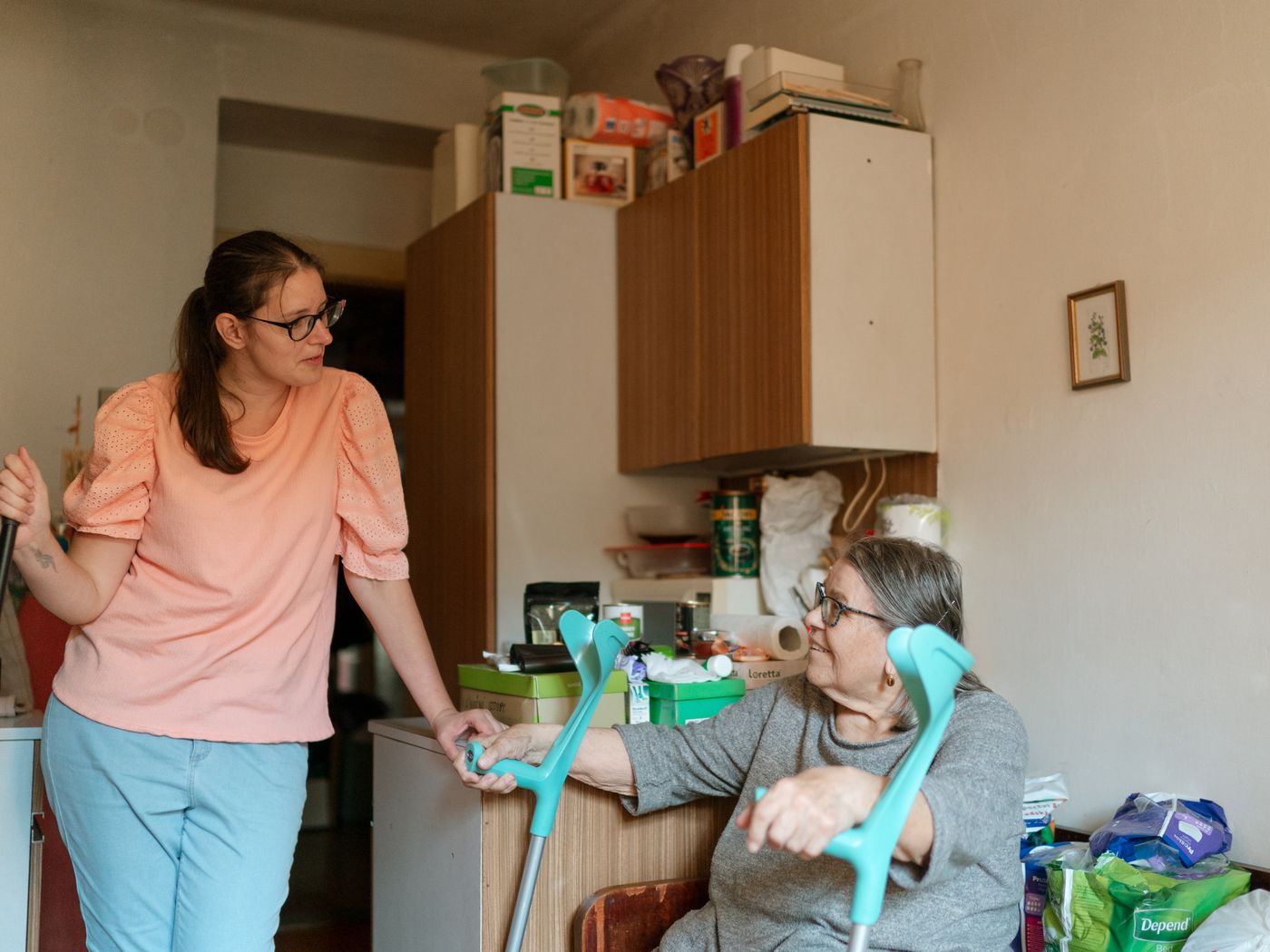
Rebecca Anger has built the kind of life that most people would recognize as a quiet success. She is 41, married, and living in a condo that looks out over Lake Michigan, a few blocks from Wrigley Field. She and her husband spend their free time cheering on the Cubs, going to concerts, and traveling when they can. During the week she practices law, representing vulnerable Chicagoans fighting to hold onto their homes.
Contents
show
By any ordinary measure, she has arrived at exactly the place she spent years working toward. A career with purpose, a home of her own, a partner to share it with. The specifics are unremarkable in the best possible way, which is precisely the point.
And yet a question has begun to shadow all of it, one that grows louder with each passing month. What happens to that life if the people who lift her out of bed each morning, who bathe and dress and feed her, one day stop showing up? Over the past year, Rebecca has watched a series of decisions in Washington and in statehouses across the country that make that question feel less like anxiety and more like a forecast.
The Morning Routine That Makes Everything Possible
To understand what is at stake, it helps to sit inside a single hour of Rebecca’s day. On a recent Monday around eight in the morning, she heard a key turn in her front door, and one of her longtime aides, Christine O’Connor, let herself in. Over the next hour, O’Connor moved through a sequence the two of them have repeated so many times that it barely requires words anymore. She lifted Rebecca from the bed into her power wheelchair, slipped a blouse over her head, brushed her teeth, braided her hair, gave her medicine, and fed her scrambled eggs.
That routine is the foundation beneath everything Rebecca has achieved. She was paralyzed from the neck down at the age of 7 and retains only limited use of her left hand, enough to move a computer mouse or swipe a phone screen, but not enough to raise a glass of water to her mouth. Her husband, Greg, has cerebral palsy and uses a wheelchair himself. He can help with some things, but he cannot safely carry her. So the work falls to a rotating cast of caregivers, paid $19.50 an hour through Medicaid, and O’Connor, who has been with her for eleven years, is among the most trusted.
When a Shift Doesn’t Happen

The arrangement works until it doesn’t, and Rebecca knows exactly how thin the margin is.
If a caregiver fails to arrive for a shift, she can be left stranded in bed for hours, unable to eat, drink, or use the bathroom until someone comes. It has happened to her before, and the memory of it never fully recedes. Finding people willing to do demanding, intimate physical work for barely more than minimum wage is difficult in the best of times, and the home-care field has long been plagued by shortages and turnover. Every year brings a fresh round of worry about state budgets and whether the support holding her life together will survive the next round of cuts.
That baseline unease has always been part of the deal. What has changed over the past twelve months is that the worry has acquired specific, concrete shapes.
A Year of Mounting Threats

Three developments in particular have unsettled Rebecca, and they arrived in sequence, each one raising the stakes of the last.
The first was the sweeping domestic policy law that President Trump championed, which is projected to reduce federal Medicaid spending by close to a trillion dollars over the coming decade, the largest cut to the country’s healthcare safety net in its history. The law does not directly eliminate home-care services, but those services are optional under federal rules, and experts widely expect that many states, facing enormous budget shortfalls, will trim them to save money.
The second was a shift in rhetoric. Beginning in the spring, Rebecca noticed a message spreading through conservative circles that framed Medicaid home-care programs as wasteful, unnecessary, and riddled with fraud. To her ear, that framing sounded like the preparation of a justification for cuts still to come.
The third and most alarming blow was a Justice Department memo that reversed the federal government’s long-standing reading of a landmark Supreme Court decision, one that for more than a quarter century had required states to let disabled people receive care in their own communities rather than pushing them into institutions. The federal government, the memo signaled, would no longer stand behind that right.
The Trump administration has maintained that it is not targeting disabled people. Officials have described the Medicaid reductions and the focus on fraud as efforts to protect programs from waste and abuse while preserving services for those who genuinely need them. The White House declined to comment for the reporting this account is drawn from and referred questions to the Justice Department, which did not respond.
What the 1999 Decision Promised
The Supreme Court case at the center of all this affirmed, in 1999, that disabled Americans have the right to live in their communities rather than being confined to facilities. For Rebecca and millions like her, that ruling was not an abstraction. It was the legal architecture that made an independent life possible.
It also arrived as one piece of a much longer arc. Rebecca was born a few years after the Reagan administration established the Medicaid programs that fund home- and community-based care. She was paralyzed shortly after the Americans with Disabilities Act extended civil rights protections to disabled people in 1990. And she reached high school just as the 1999 decision cemented the right to community living. Her entire life has run parallel to four decades of national progress toward disability independence.
The opinion in that case was written by Justice Ruth Bader Ginsburg. A pop-art portrait of Ginsburg now hangs above Rebecca’s desk, a quiet acknowledgment that she lives, quite literally, in the world that ruling built.
August 2, 1992: The Dividing Line
For Rebecca’s family, everything divides into before and after a single summer afternoon. She was 7 years old, the oldest of four children, and had spent much of that summer riding a pink-tasseled bicycle through the safe, tree-lined streets of Deerfield, a suburb north of Chicago. Her mother had taken her to a birthday party at the neighborhood pool. On the walk home, Rebecca mentioned that her neck felt sore. Her parents, assuming she might be coming down with something, sent her downstairs to rest.
When they woke her an hour later, she looked at her own motionless hand lying beside her and asked whose arm it was. Her father reached to sit her up, and she flopped back, limp. For a moment her parents wondered whether their attention-seeking eldest was putting them on. She told them, calmly and with certainty, that she could not move. What followed was a blur of being carried to the car, wheeled through an emergency room, struggling for breath, and then nothing.
A One-in-a-Million Diagnosis

What had happened inside her body was extraordinarily rare. Having recently fought off a virus, Rebecca’s immune system made a catastrophic error and began attacking her own spinal cord, a condition called transverse myelitis that strikes perhaps one person in a million each year.
White blood cells and inflammatory proteins flooded into her spine, destroying the nerve fibers that carry signals between the brain and the body. One function after another collapsed, sensation, movement, breathing, like circuit breakers tripping in rapid succession. By the time doctors grasped what they were confronting, the chance to reverse the damage had already passed. She woke two days later with a ventilator breathing for her, aware of her surroundings but unable to move, a mind sealed inside a body that no longer answered.
Doctors warned that she might never breathe on her own again. Her father refused to accept it, and within weeks she was breathing independently. When the doctors then predicted she would never live a normal life, her parents rejected that too.
The Family Philosophy That Shaped Her
After nearly three months at a Chicago rehabilitation institute, Rebecca went home to relearn a world in which she now needed help with almost everything, and her parents, Matt and Christie Wylie, set about refusing to let the injury shrink her future.
Before she returned to school, they made a video explaining her disability to her classmates. Her mother pushed back against efforts to separate her from other children. Her father engineered ways for her to keep participating in ordinary childhood, including rigging up a voice-activated squirt gun so she could join neighborhood water fights. If her siblings had chores, so did she. If they went to camp or sleepovers or on family vacations, her parents found a way for her to go as well. Their conviction was straightforward: the injury had changed how she moved through the world, not what she was entitled to expect from it.
Building an Independent Life, Against the System’s Limits

That conviction carried her a long way, though never without friction from the very programs that made her independence possible.
In 2003 she enrolled at the University of Missouri, nearly 400 miles from home, having turned down a closer school that housed all its disabled students in a single dormitory. At Missouri she lived in a regular dorm and used an Illinois program to pay fellow students to help her through each day. The early stretch tested everyone. One caregiver quit almost immediately. Another, whom she considered a friend, quietly stole thousands of dollars using her debit card. A third simply failed to show up one morning, leaving her stuck in bed for hours. She made it work anyway, studying visual arts and learning to draw with a device held in her mouth.
She graduated, returned to the Chicago area, and started a graphic design business, then pushed further, enrolling at Loyola University’s law school. She emerged with a law degree, a staggering student loan balance, and a drawn-out fight to secure the testing accommodations she needed before finally passing the bar.
The Poverty Trap Built Into the Rules
Yet the same system that enabled all of it also boxed her in. To retain her Medicaid coverage, Illinois barred her from holding more than $17,500 in assets. She could work, but she could never save, never set aside money for a down payment or a retirement account. Staying eligible meant staying poor.
The constraint reached even into her marriage. Before she and Greg wed in 2016, they had to consult a lawyer to make sure his savings wouldn’t push her over the asset limit, a bureaucratic hurdle as routine for disabled couples as choosing a venue. They bought their condo near Wrigley with help from family and went to work together at a legal-services nonprofit, he as a paralegal and she as a supervising attorney, assembling piece by piece the future her parents had always insisted was possible.
The Fear Beneath the Life

That future now sits on uncertain ground. Illinois anticipates losing tens of billions of dollars over the next decade as the federal cuts take hold, and Rebecca has already run through the ways states might respond, from lowering caregiver wages in an already depleted workforce, to tightening eligibility, to ending home-care programs outright, encouraged by the federal government’s new posture.
When she imagines that outcome, her thoughts return to one of her first memories after becoming paralyzed. Lying in a hospital bed at 7, her breathing tube would sometimes come loose and set off an alarm, and even then she understood that if no one came, she would die. It was her earliest lesson in what it means to depend completely on other people, and it lingers beneath even the happiest parts of her life.
There is a part of that reality she wishes more people grasped, which is that it could happen to anyone. A car crash, a fall, a stroke, a virus. Nothing she did caused it, and nothing could have prevented it, and she will need care for the rest of her life. The question she keeps returning to is simply who bears responsibility for paying for that care.
Her parents, approaching retirement, would step in if it came to that, but she wants that life neither for them nor for herself. She also bristles at being called an inspiration, because the label obscures what she considers the real story. The life she built did not spring from some singular personal heroism. It rested on choices the government made, and could just as easily unmake. In a more just society, she argues, a life like hers would not strike anyone as remarkable at all. It would simply be ordinary.
Americans with Disabilities Act, big beautiful bill, caregivers, Chicago, chronic illness, community living, disability advocacy, disability rights, disabled Americans, healthcare policy, Home Care, Illinois Medicaid, Independent Living, institutionalization, Medicaid cuts, Medicaid home-based services, Olmstead decision, Rebecca Anger, Ruth Bader Ginsburg, transverse myelitis