
Your cart is currently empty!
An American Student Went to a Taiwan ER Without Insurance. His $80 Bill Went Viral.
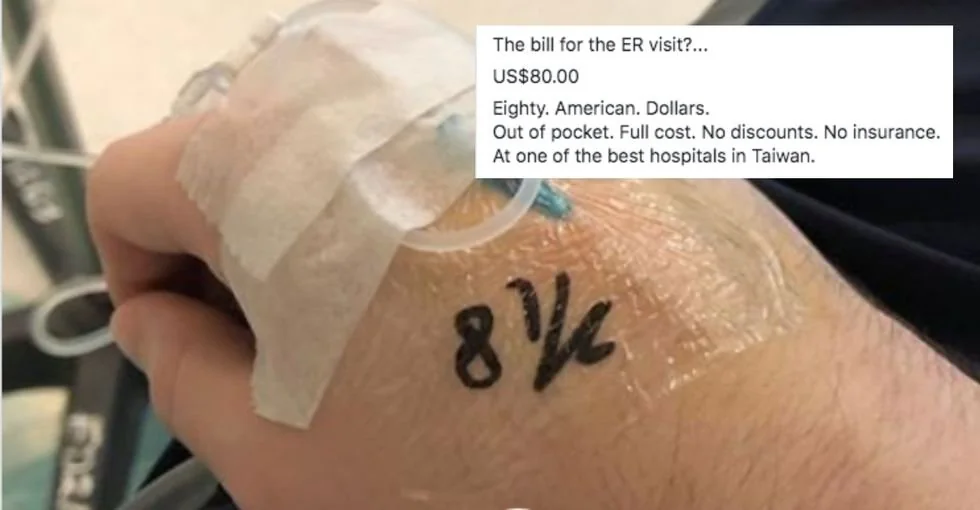
Kevin Bozeat had one plan when he arrived in Taiwan: finish his degree and go home. A medical emergency was not part of it, and neither was a healthcare bill that would stop people in their tracks, not for how high it was, but for how startlingly low it turned out to be.
Contents
show
When his symptoms landed him in a Taiwanese emergency room, uninsured and bracing for the worst, he had no idea what to expect. What he got was an experience so far removed from the American norm that he felt compelled to write about it, and more than 200,000 people felt equally compelled to share it.
A Stomach Bug, a Foreign Country, and a Rising Sense of Dread
It started with a stomachache. Bozeat, 25 years old at the time, was studying in Taiwan when the pain arrived. He went home to rest. Hours later, he was vomiting without relief, unable to keep water down. Rest was no longer going to cut it.
Going to a hospital abroad without insurance, in a country whose healthcare system he knew nothing about, was not a prospect he welcomed. His US insurance had lapsed. He hadn’t lived in Taiwan long enough to qualify for the country’s National Health Insurance (NHI), a single-payer system open to residents after six months in the country or upon receiving a work permit. As a student several months short of that threshold, he was uninsured and on his own.
His Taiwanese roommate called a taxi. They headed to NTU Hospital. Bozeat prepared for the worst.
Inside the ER: Faster Than He Expected

What met him at the doors of NTU Hospital bore no resemblance to the experience he had feared. “I was immediately checked-in by an English speaking nurse. Within 20 minutes I was given IV fluids and antiemetics. They took blood tests and did an ultrasound to ensure it wasn’t gallstones or appendicitis.” Kevin said.
Doctors diagnosed him with a severe case of Acute Viral Gastroenteritis, a stomach flu that had gotten well out of hand. After about three hours on an IV, the nausea cleared, and his stomach began to settle. He left with a prescription for antiemetics and pain medication. A few days later, he had recovered.
By any clinical standard, it had been a clean, well-run ER visit. English-speaking staff. Fast diagnostics. A clear diagnosis and a workable path to recovery. For an uninsured American in a foreign country, any one of those things alone would have been a relief. But then came the bill.
$80. No Insurance. No Discounts. Full Cost.
Bozeat paid $80 USD. Out of pocket. No insurance backstop. No negotiated rate. Full, undiscounted cost at one of the best hospitals in Taiwan.
For an American audience, that number demands a point of comparison. An ER visit for a bee sting in the United States can cost upward of $12,000. A routine admission and discharge for a stomach complaint, even for a patient with coverage, can push into hundreds or thousands of dollars. Bozeat knew that. Most Americans do.
He titled his Facebook post “The Horrors of Socialized Medicine: A First Hand Experience,” a heading chosen with clear, knowing irony. Within days, the post had 120,000 likes and 210,000 shares. It caught the eye of the Washington Post, which cited his story in a February 2017 report amid an intensifying national debate on healthcare reform.
“This could have easily cost me hundreds or even thousands in the US without insurance. But here in Taiwan, I was able to receive speedy, quality care comparable to what I would have gotten in a US hospital for a relatively small amount of money.” he wrote.
That comparison was what sent the post into orbit. Same quality of care, a fraction of the cost.
Breaking Down Taiwan’s NHI

For readers who had never heard of Taiwan’s healthcare model, Bozeat offered a plain-language breakdown inside the post itself. Taiwan’s National Health Insurance system operates as a single-payer program. All citizens and permanent foreign residents must enroll. No one can opt out based on employment status or financial standing. Nobody goes uninsured. Nobody faces bankruptcy from a medical bill.
Bozeat also walked through the monthly premium formula, which came out to roughly $70.53 per month for a single employed adult earning $60,000 per year. That number cut through a fair amount of the argument that universal healthcare would require crushing taxes.
Taiwan also keeps its overall healthcare spending well below American levels. Data from the journal Health Affairs, cited in the Washington Post’s coverage of Bozeat’s story, put Taiwan’s healthcare expenditure at about 6.1 percent of GDP in 2017. Over the same period, the United States spent about 17.2 percent. Taiwan covered everyone for less than half the economic outlay.
What Bozeat Said Beyond the Bill
In a follow-up post on February 24, Bozeat was careful to set the record straight. NHI was not perfect. Not all services fell under full coverage. He had one good experience and acknowledged that others had difficult ones within the same system. What he did not walk back was the principle behind it.
He was quoting Taiwan’s Ministry of Health and Welfare directly from its English-language brochure. Every citizen and permanent foreign resident must enroll in NHI. Employment status creates no gap in coverage. A job loss does not translate into a loss of care.
Among the people Bozeat had spoken to, he had yet to meet a Taiwanese person who was not satisfied with the system. Expats agreed, including those who had come from countries with their own universal healthcare programs.
Taiwan’s Healthcare Beyond Its Borders

Bozeat’s post drew attention to Taiwan’s domestic healthcare model. What it couldn’t fully capture was how much Taiwan had already contributed to global health beyond its own borders.
Taiwan’s International Healthcare Training Center, established in 2002, trains about 1,500 health professionals every year from 65 countries and territories. Its Global Medical Instruments Support and Service Program, launched in 2005, has delivered over 5,400 pieces of equipment to medical institutions across 33 countries. Through the Global Cooperation and Training Framework (GCTF), a joint program with the United States, Taiwan has run targeted workshops on health threats, including the Zika virus, dengue fever, and Enterovirus.
During the SARS outbreak and the Ebola pandemic, Taiwan contributed both medical expertise and financial resources to international response efforts. Yang-Ming University and Taipei Veterans General Hospital have also launched a joint cancer research lab with the US National Cancer Institute, with a focus on lung cancer, a leading cause of cancer mortality in both countries. Taiwan has been offering its citizens subsidized screening for breast, cervical, colorectal, and oral cavity cancers since 2010.
For a country with that record, the barrier to doing more is not expertise. It is politics.
Since 2017, China has blocked Taiwan from participating in the World Health Assembly (WHA), the decision-making body of the World Health Organization (WHO). Taiwan’s Minister of Health and Welfare, Chen Shih-chung, has made the country’s position clear: Taiwan’s experience in disease control and universal health coverage could help strengthen global medical development, and Taiwan stands ready to share it. That offer has remained sidelined at the international level, not because the knowledge is lacking, but because a political dispute has decided so.
WHO’s own founding charter states that access to the highest attainable standard of health is a fundamental right of every person, without distinction of race, religion, political belief, or social condition. Taiwan’s continued exclusion from the WHA sits uneasily against that stated principle.
One Post, One Bill, One Larger Question
Kevin Bozeat went to a foreign emergency room alone, uninsured, and anxious about what it would cost him. He left with a diagnosis, a prescription, and a receipt for $80. He wrote about it on Facebook, partly from relief and partly from disbelief, and something about the gap between what he paid and what he knew he would have paid at home struck a chord that more than 200,000 people felt moved to pass along.
Journalists wrote about it. Policymakers and commentators picked it up during a period when the American healthcare debate was running hot.
Bozeat never claimed to have answered what the United States should do about healthcare. He offered an experience, one specific night in Taipei, one stomach flu, one $80 bill. What readers made of that number was always going to depend on who they were and what they already believed.
But the post has circulated for years, and people are still sharing it. Whatever one thinks of the policy questions underneath it, a 25-year-old American student accidentally made one of the most talked-about cases in recent memory by looking at how other countries handle the basics. He just needed a stomach bug to do it.