
Your cart is currently empty!
The First Climate Driven Hybrid Jay Emerging in the Wild
In the warm suburbs just outside San Antonio, a quiet backyard sighting in 2023 became the spark for a scientific discovery that few biologists expected to witness in real time. A bird that looked somewhat like a blue jay and somewhat like a green jay appeared at a homeowner’s feeder, blending traits from both species in a way that puzzled even seasoned birdwatchers. What followed was a two-year investigation that would ultimately reveal something remarkable. This bird, later nicknamed the grue jay, appears to be the first documented wild hybrid of these two species whose lineages split roughly 7 million years ago.
Contents
show
For biologists, this single bird represents far more than a quirky natural anomaly. It stands as a living indicator of how human influenced environmental change can reshape the ranges, behaviors, and interactions of wildlife. As rising temperatures continue to shift species habitats, once separate lineages are meeting in ways rarely observed historically. The result, in this case, was a hybrid that scientists believe was made possible by climate-driven range expansions.
This article brings together information from multiple scientific reports and interviews to explore what makes this hybrid unique, what it reveals about changing ecosystems, and what its existence can tell us about the broader impacts of climate change on biodiversity.
The Discovery in a Texas Backyard
In late May 2023, local resident Donna Currey posted photographs of an unusual bird to a Facebook birdwatching group. The bird had a blue jay like tail and back, but it also had distinct facial markings more reminiscent of a green jay. The unusual blend of colors and features quickly caught the attention of Brian Stokes, a graduate student at the University of Texas at Austin who studies green jays.
Stokes contacted Currey and arranged a visit. During his first attempt to capture the bird using mist nets, it proved elusive. On the following day, however, he managed to net the bird long enough to examine it, take photographs, record vocalizations, and extract a small blood sample for genetic testing. Before releasing it, he placed a band on its leg so it could be identified in the future.
The bird then vanished from public view for two years. No confirmed sightings occurred in 2024, and Stokes and his colleagues wondered whether it had survived. Then, in June 2025, the bird reappeared in Currey’s backyard. This return confirmed not only its survival but its continued presence within the same general location, which was important for researchers studying hybrid viability in the wild.
What Makes This Bird a Hybrid
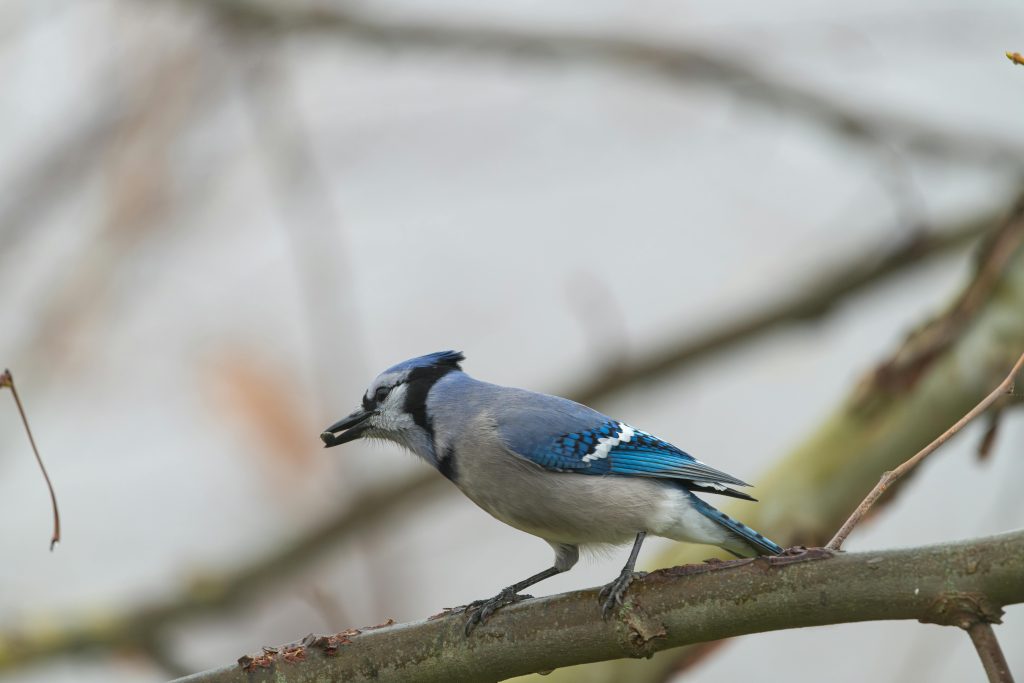
Several physical features immediately suggested a hybrid origin. Scientists described the bird as having a slightly paler blue coloration compared with a typical blue jay. It also had the black facial mask and nasal tufts commonly seen in green jays. Its underparts lacked the yellow tones present in many green jays, indicating a mixed inheritance pattern.
Beyond coloration, the bird’s behavior offered additional clues. Stokes reported that the bird produced a combination of calls associated with both species. Blue jay vocalizations were present, yet it also made rattling and bill click sounds more typical of green jays. This blending of vocal repertoires suggested a hybrid individual capable of using elements of each species’ communication system.
The genetic analysis supported the visual and behavioral evidence. Researchers sequenced tens of millions of reads from the blood sample and compared them with reference genomes. The results indicated nearly equal nuclear DNA contributions from the two species. Mitochondrial DNA, inherited maternally, matched that of the green jay. This meant the bird’s mother was a green jay and the father a blue jay.
Hybridization of this kind is rare because the two species belong to different genera. Their evolutionary split occurred approximately 7 million years ago, long enough to create substantial genetic divergence. Although a hybrid had been bred in captivity in the 1960s, that individual remained the only known example until this wild hybrid was discovered.
Why the Ranges of These Jays Are Changing

Historically, the ranges of blue jays and green jays barely overlapped. Blue jays are temperate birds found throughout much of the eastern United States, extending as far west as Houston. Green jays are tropical birds found largely in Central America, Mexico, and the southernmost parts of Texas.
Over recent decades, several environmental changes have altered this separation. First, warming temperatures have allowed green jays to expand their range farther north. As winters in Texas have become milder, these tropical birds have encountered climates that previously would have been too cold for them. Meanwhile, blue jays have gradually shifted westward, influenced by changing weather patterns and human-modified landscapes.
The result is a growing zone of overlap near San Antonio. Birdwatcher checklists over the past twenty years show increasing encounters between the two species. This overlap zone is not extensive, but climate models suggest it could shift even farther north and potentially shrink in size in the coming decades as warming continues.
This hybridization event provides an example of two species being brought together by climate-driven range shifts. Stokes and his colleague Timothy Keitt noted that the hybrid likely emerged due to both species expanding their ranges at the same time, meeting in areas where they historically had not interacted.
Understanding Hybridization Between Distant Lineages

Hybridization among bird species is not unusual in general, but hybridization between species from different genera is far less common. The blue jay and green jay have significant genetic and behavioral differences. Both species are intelligent and social, often living in family groups. This social structure can create barriers to cross species mating because individuals typically identify mates based on physical and behavioral cues within their species.
That is part of what makes the discovery of this hybrid so surprising. For the two species to mate, several conditions had to align. Their ranges needed to overlap, individuals needed to be in close proximity, and the usual species recognition barriers had to break down. This breakdown may have been influenced by the low density of each species in the overlap zone, which could have limited available mates.
In this context, the hybrid event may represent an environmental story rather than a behavioral one. As the environment changes and species distributions shift, the opportunities for unexpected interactions increase. The grue jay is a visible marker of that process.
Genetic Insights From the Study

The genetic sequencing performed on the hybrid provided researchers with an uncommon opportunity to study how two distinct bird lineages combine at the molecular level. Nuclear DNA analysis showed nearly equal contributions from each species, supporting the conclusion that the hybrid was a first-generation cross. This was further confirmed by the mitochondrial DNA, which was consistent with a green jay maternal lineage.
Scientists noted that the bird resembled the captive bred hybrid from the 1960s in several notable ways. The similarity between the two individuals suggests that the traits expressed in hybrids between these two species may be relatively consistent. This consistency can help researchers identify hybrid individuals in the future and encourage more systematic searches for similar birds.
The study also revealed that hybrid jays may be more abundant than currently known. Detection requires either a keen observer familiar with both species or a lucky encounter near a populated area. Much of the overlap region has low human presence, which decreases the likelihood of hybrid sightings. The researchers emphasized that many hybrids may go unreported simply because they live in areas with fewer observers.
Climate Change as a Driver of Unexpected Outcomes

Researchers highlighted the significance of this hybrid as a potential product of climate-driven range expansion. The idea that climate change can reshape species interactions is not new, but direct evidence of hybridization caused by shifting ranges remains rare.
In this case, the hybrid offers a concrete example of how warming temperatures, altered precipitation patterns, and human land use can bring together species that have been separated for millions of years. Scientists believe the hybrid is part of a broader trend in which environmental pressures create new opportunities for interspecies interactions.
Climate models referenced in the studies suggest that the overlap zone between blue jays and green jays could change substantially in the coming decades. Current estimates place the overlap zone at around several thousand square kilometers. Within a few decades, this zone could become smaller and move northward by over 100 kilometers. Such shifts could create new areas where hybridization events might occur and eliminate others.
These predictions highlight how dynamic ranges have become under modern climate change. As shifts continue, ecologists expect more hybridization events across various species. Some hybrids may survive and reproduce, while others will remain rare and isolated cases.
The Ecological and Scientific Importance of the Hybrid
This hybrid bird serves as a valuable indicator of changing ecological conditions. It offers a real-world example of how species respond to environmental pressures and how those pressures can influence evolutionary possibilities.
The significance extends beyond ornithology. The existence of this hybrid underscores the importance of continued monitoring of species distributions, especially in regions experiencing rapid environmental change. As hybridization becomes more common, it may serve as an early sign of ecological shifts that could affect broader ecosystems.
Researchers also emphasize that hybrid species can help scientists better understand evolutionary processes. Hybrids allow researchers to study gene flow, trait inheritance, and reproductive barriers. They can reveal how traits from different species combine and how these traits influence survival. In the case of the grue jay, its appearance and survival over at least two years demonstrate that hybrids between distantly related species can be viable in the wild.
Lessons From a Backyard Observation
One striking aspect of this discovery is how it began with a single social media post. Without Donna Currey’s curiosity and willingness to share photographs, the hybrid might never have been documented. This highlights the value of community science, especially in areas where formal monitoring is limited.
Community science platforms enable researchers to gather data across wide geographic areas and time scales. Birders, in particular, contribute significantly to species distribution data, migration tracking, and rare species detection. The grue jay discovery reinforces the importance of these contributions.
It also demonstrates how easily rare species could go unnoticed. As Stokes pointed out, if this bird had visited a different backyard or moved just a short distance away, its presence might never have been reported.
The Role of Adaptation and Resilience
While the hybrid’s existence is a product of environmental change, it also reflects nature’s ability to adapt. The bird’s survival for at least two years in the wild suggests it was capable of finding food, avoiding predators, and navigating typical ecological pressures.
Researchers noted that adaptation does not always mean long-term stability. The grue jay may be a singular event, or it may indicate the beginning of more frequent hybridization as environmental pressures grow. Either way, its survival provides useful information about how species respond to new environmental challenges.
What the Future May Hold
Looking ahead, scientists see the grue jay as part of a larger pattern that will likely become more common. As species shift their ranges, ecologists expect more contact between historically separate lineages. Some interactions may lead to competition, while others could produce hybrids. The consequences will vary widely depending on the species involved.
Future research will likely focus on monitoring hybrid zones, modeling range shifts, and studying how hybridization affects species and ecosystems. These efforts may help scientists anticipate future ecological changes and identify emerging environmental challenges before they become more pronounced.
The grue jay also opens the door to new research questions. How common are hybrids between distant lineages in wild bird populations? How do hybrids behave socially within species groups? What ecological pressures influence their survival? Each of these questions provides a path for further study.
The Ecological Significance of Rare Hybrids
The grue jay stands as a unique testament to the rapid ecological changes unfolding across the planet. Its existence illustrates how shifting species ranges, driven in part by climate change, can bring together lineages that have been separated for millions of years. Although it may be only one bird, its significance radiates across ecology, evolutionary biology, and climate science.
At its core, the grue jay represents an emerging reality. As the climate continues to change, new species interactions will occur. Some may be surprising, others may be concerning, but all will help scientists better understand the complex consequences of human influenced environmental change. This unusual bird, discovered thanks to a curious homeowner and a dedicated researcher, offers a glimpse into the future of ecosystems in a warming world.