
Your cart is currently empty!
Buddhist Monks Refuse to Stop as Ice Storm Hits North Carolina During 2,300-Mile Trek
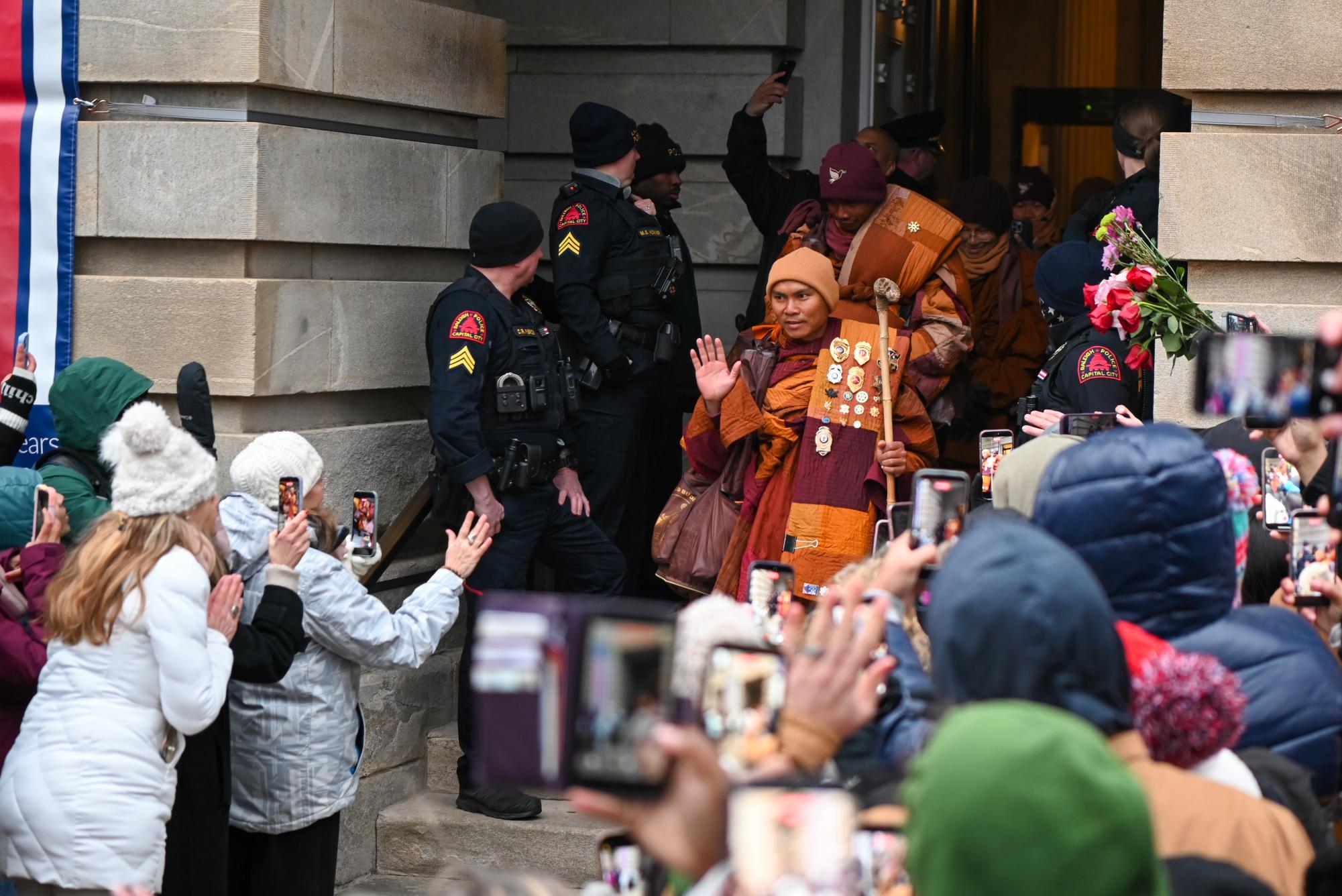
Freezing rain pelted their saffron robes. Ice coated the roads beneath their feet. Temperatures hovered at 21 degrees as sleet fell from a gray Carolina sky. Yet eighteen Buddhist monks kept walking.
Contents
show
On Sunday morning, day 92 of a journey most would consider impossible, these monastics continued their procession through Wake County, North Carolina. Some wore sneakers. Others walked in nothing but woolen socks. All of them moved forward with a singular purpose that has drawn thousands of Americans to roadsides, parking lots, and state capitols to witness something they struggle to put into words.
What began in Fort Worth, Texas, on October 26, 2025, has become a phenomenon that transcends religious boundaries and political affiliations. And as winter storms batter the Southeast, the monks show no signs of stopping.
A 2,300-Mile Prayer in Motion
Eighteen Theravada Buddhist monastics from the Huong Dao Vipassana Bhavana Center in Fort Worth set out nearly three months ago with a destination in mind. Washington, D.C., awaits them, where they plan to ask Congress to recognize Buddha’s birthday as a federal holiday. But their mission extends far beyond legislative goals.
Walk for Peace, as the pilgrimage has come to be known, spans roughly 2,300 miles across ten states. By the time the monks reached Raleigh on Saturday, they had covered approximately 1,800 miles on foot. Mid-February marks their expected arrival at the nation’s capital, weather permitting.
Along highways and through small towns, the monks walk single file, accompanied by sheriff’s department vehicles with lights flashing. A sophisticated social media operation tracks their progress in real time, and volunteers from Buddhist temples in each town they pass through assist with logistics. Yet for all the organization behind the scenes, the walk itself remains a study in simplicity.
These are strict renunciants. Each monk eats only one meal per day, and that meal must be consumed before midday. Food serves as medicine to sustain their practice, not as pleasure. Alcohol, family life, and material possessions have been renounced. Venerable Bhikkhu Pannakara serves as the only monk who speaks publicly, addressing crowds and media while his fellow monastics observe silence.
Hardship Has Marked Every Mile
Sacrifice has defined this journey from its earliest days. In November, while walking along U.S. Highway 90 near Dayton, Texas, a distracted truck driver struck one of the monks. He lost his leg and could not continue. His brothers pressed on.
Heat plagued them first. Organizers told crowds at the North Carolina State Capitol that the monks walked through 98-degree temperatures in Texas and Louisiana. Rain soaked them for six days out of nine in Louisiana alone. Now, as they push through the Carolinas, winter has arrived with force.
Even their beloved peace dog, Aloka, a pariah dog who has become a social media sensation in his own right, cannot walk with them. Leg surgery several weeks ago left him recovering in the camper that trails the procession. His social media account posted on Sunday that he was bundled up for winter weather, curious about why everything had grown so slippery, but still focused on his family and their mission.
On Sunday morning, the monks stopped along their route to pray over a woman who had waited for them in active freezing precipitation. On their Facebook page, organizers captured the moment with words that speak to the heart of their purpose.
North Carolina Opens Its Arms
Professor Levi McLaughlin of NC State’s Department of Philosophy and Religious Studies has studied Buddhism and religion in Asia for years. Even he did not expect what unfolded as the monks crossed into North Carolina.
A level of cynicism or xenophobia might have greeted Southeast Asian monastics walking along highways in the American South. It would not have been surprising. But that reception never materialized. Instead, something remarkable happened.
Crowds began gathering along roadsides near Apex on Friday. By Saturday, hundreds had become thousands. People pressed their palms together in the traditional greeting. Many bowed. Some knelt on cold pavement. Others prostrated themselves on the ground as monks passed. Tears flowed freely among strangers who had traveled from across the state and beyond.
Valerie Soldatow, a research scientist at a biotech company in Research Triangle Park, stood among those waiting. She said she was not happy with the conditions in America right now and felt peace was a good message for everyone, regardless of who spreads it.
Near Jordan Lake, a popular recreation spot, crowds swelled as monks crossed the bridge and made their way to a picnic area for lunch. Women scattered flower petals and drew the Ohm sign in chalk ahead of the monks’ arrival. People brought hand-drawn posters, incense, and every variety of flower imaginable.
Wake County claims the largest Asian population in North Carolina at around ten percent. Cary, just miles away, is twenty percent Asian. Hindu and Buddhist immigrants from Southeast Asia joined the crowds, but they represented only a fraction of those who came. Christians, atheists, and people of every background stood side by side, united by something they could feel but not quite name.
A Saturday at the State Capitol
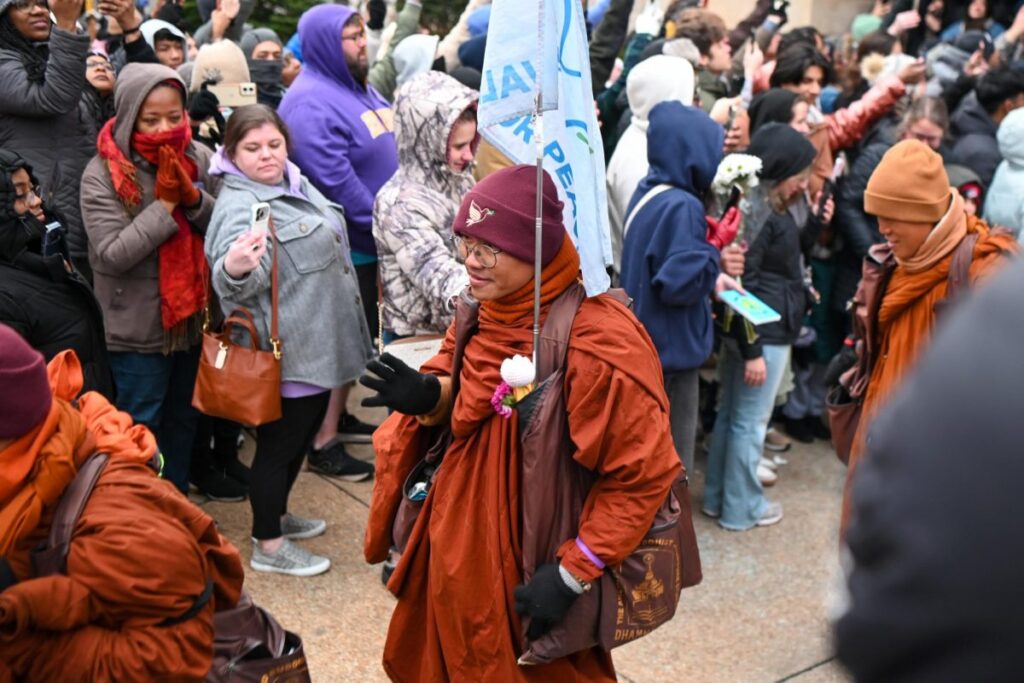
Day 91 brought the monks into downtown Raleigh under skies threatening snow. Walking up Fayetteville Street with freezing wind whipping through the corridor of buildings, some monks wore only socks on their feet. By the time they reached the North Carolina State Capitol, thousands waited.
Governor Josh Stein and Raleigh Mayor Janet Cowell stood side by side with the monks on the Capitol steps. Both leaders issued proclamations declaring January 24, 2026, as Walk for Peace Day in their respective jurisdictions. Raleigh Police Chief Rico Boyce gifted Venerable Bhikkhu Pannakara a police badge to add to his growing collection of badges and pins received during the journey.
Cowell addressed the crowd first, telling them that the monks’ commitment to peace in body and spirit reminds everyone that they, too, can make such a commitment. She spoke of inner peace radiating outward to communities and the world.
Governor Stein framed the moment against the backdrop of a divided nation. His words captured what many in the crowd had felt but could not articulate.
“We live in a time of partisan rancor and political discord. These days, people of all stripes are feeling under attack, whether it’s by what they see on social media, what’s going on in their personal lives or the number at the bottom of their grocery bill. That’s what makes your message more important than ever. It goes beyond faith or politics.”
Stein expressed hope that North Carolinians would hold onto this feeling of unity long after the monks finished their walk. He urged residents to carry the spirit forward in their own lives, caring for neighbors and seeking mutual understanding rather than division.
One Voice Speaks for Eighteen
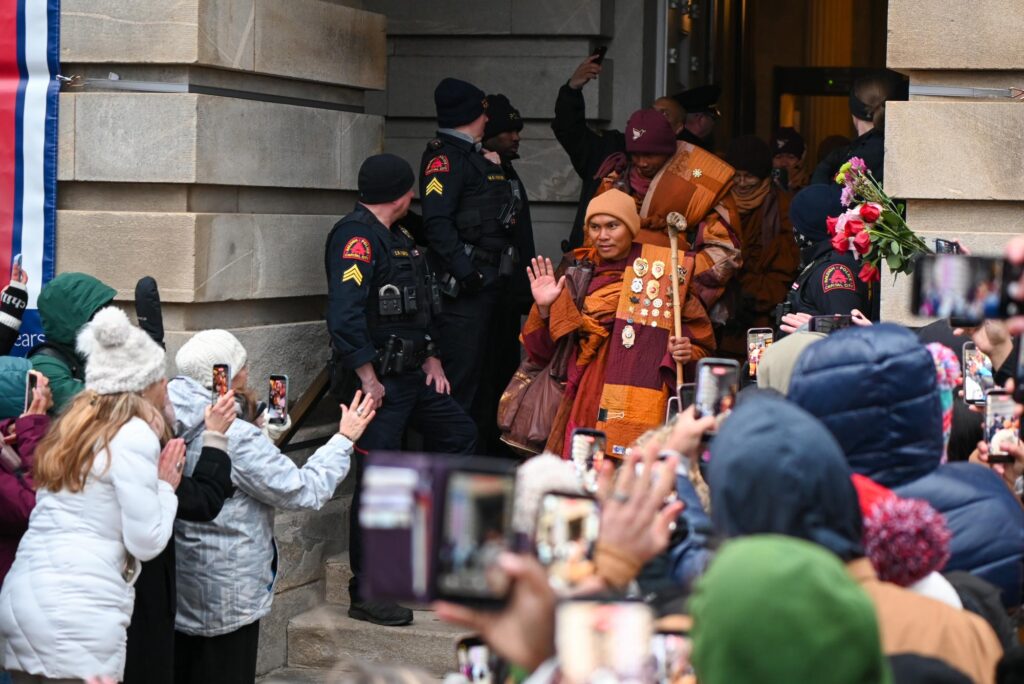
Venerable Bhikkhu Pannakara took the podium after the governor’s remarks. For nearly an hour, he addressed the crowd in his characteristic style, mixing practical advice with spiritual wisdom.
World peace, he told listeners, starts within each person. If individuals cannot have peace in their own worlds, there will be no world peace. If every family in North Carolina found peace, the entire state would be at peace.
He led attendees through a simple mindfulness meditation, asking them to follow their breath like a gatekeeper at the nostrils. Each thought that arises is a monkey mind jumping away, he explained. Gently returning attention to the present moment is the practice.
Pannakara urged everyone to adopt a daily ritual. Every morning upon waking, he said, write down one statement with pen and paper and read it aloud to the universe. Today is going to be my peaceful day. No one in the world can mess it up except ourselves. We are the only ones who can disrupt our own peace.
Near the end of his address, Pannakara offered a metaphor that seemed to resonate with everyone present. “This is not something that we brought to you, we brought it to this nation or to this world. We also practice for our own peace. And we are here just to bring the key for all of you to open that box where you have locked peace and happiness in it for a long time. And you have left it somewhere and forgotten it. We are here just to hand you the key. But the person who has to unlock it, which is yourself.”
Why Americans Are Showing Up
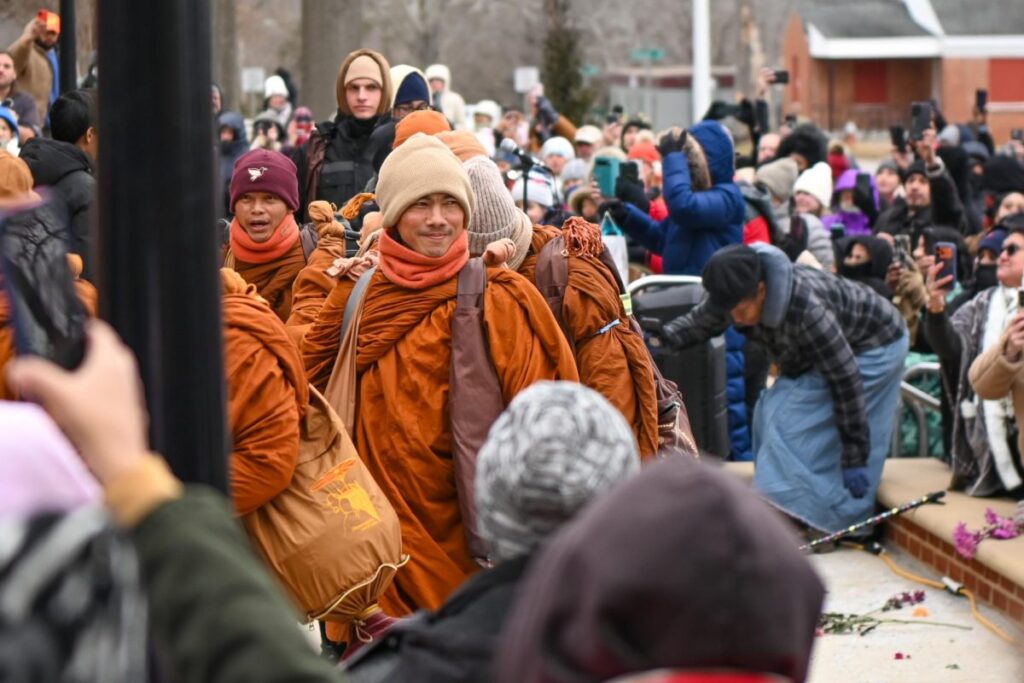
Teshin Matthew Sweger serves as guiding teacher at the North Carolina Zen Center, a Buddhist center following Japanese Zen practice in Pittsboro. He compared the monks to a story from the Buddha’s life, when the young future Buddha encountered four sights before his awakening. Old age, sickness, and death were three. A wandering mendicant was the fourth.
That fourth sign showed the Buddha there was another way of doing life, Sweger explained. A way to confront suffering, to move toward awakening and peace. These monks doing the walk serve that same purpose for Americans today. They are our own fourth sign.
American culture teaches people to grow up, get an education, get a job, pay bills. Life becomes a hamster wheel of constant motion. Seeing these monks and their centeredness shows people they do not have to be cogs in a machine. Sweger believes Americans long for that alternative because so many are overworked.
Professor McLaughlin placed the walk within a longer history of Buddhist public witness, from monks’ self-immolations during the Vietnam War to more recent sacrifices in solidarity with Tibetans. While Walk for Peace avoids naming specific policies or governments, it still responds to current political conditions. He characterized the walk itself as a political response, bringing attention to difficult conditions and the importance of peace as a guiding principle.
What has surprised McLaughlin most is how North Carolinians have received the monks. Positivity has defined every interaction. He finds it heartening in ways he did not anticipate.
What Lies Ahead
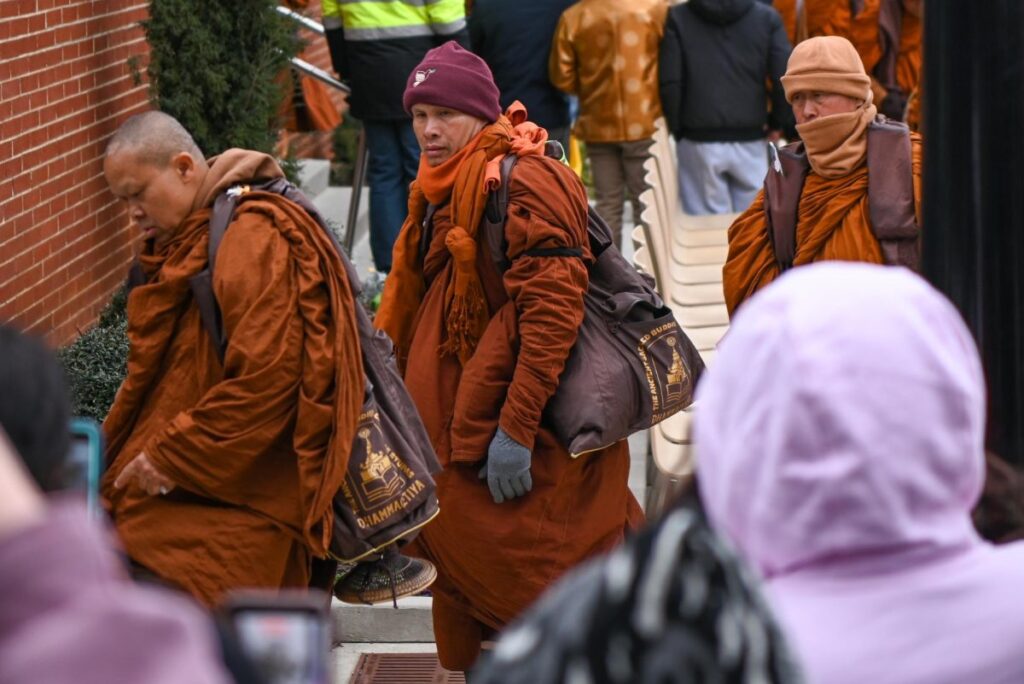
Sunday’s walk from Raleigh through Rolesville to Wake Forest continued despite the ice storm gripping central North Carolina. Organizers warned that the weather may affect the path forward, but the monks remain determined.
After leaving Wake Forest, the procession will push north toward Virginia and eventually Washington, D.C. Mid-February remains the target arrival date, though weather and road conditions will dictate the actual timeline.
Town officials in Rolesville encouraged residents to line the streets rather than join the walking procession, citing safety concerns over deteriorating road conditions. Monks take short rest breaks every ninety minutes, and community members are asked not to approach during these times. Rest periods allow for restroom access, physical recovery, and attending to immediate needs.
For those who witnessed the monks pass through North Carolina, something has shifted. An attendee at the Capitol told reporters that everyone present would take this message home to their communities. People came from everywhere, not just Raleigh.
Another attendee put it more simply. Life gets hard when everything feels like trash sometimes. But seeing these monks gives people a good reason to feel like they have to keep going.
As sleet continues to fall and ice coats Carolina roads, eighteen men in saffron robes will wake Monday morning and begin walking again. Step by step, they carry a message that thousands of Americans have proven they want to hear. Peace still finds a way.