
Your cart is currently empty!
CERN Scientists Have Successfully Turned Lead Into Gold Using Physics

The idea of turning lead into gold once lived in the minds of medieval thinkers who believed the universe held secret rules waiting to be unlocked. For centuries, alchemists devoted their lives to this pursuit, convinced that the dull, heavy metal could somehow be transformed into something rare and beautiful. Their experiments were driven by a mix of curiosity, ambition, and the promise of unimaginable wealth, yet they lacked the scientific tools needed to understand why their efforts always failed. What they were really up against was not a missing ingredient or hidden formula, but the fundamental structure of matter itself, something that would only be uncovered many centuries later.
Contents
show
Now, in a development that feels almost surreal, scientists have achieved that same transformation, but in a way that completely reshapes what the dream actually means. Inside one of the most advanced machines ever built, researchers have observed lead atoms turning into gold under highly controlled and extreme conditions. This is not a process that produces coins or jewelry, and it certainly is not a shortcut to wealth, but it is real, measurable, and grounded in physics. The ancient goal has technically been reached, yet the outcome reveals far more about the nature of the universe than it does about material riches.

The Long History Behind an Impossible Idea
For much of human history, gold was more than just a valuable metal; it carried symbolic meaning tied to power, immortality, and perfection. Lead, by contrast, was abundant and unremarkable, yet it shared a similar density, which led early thinkers to believe there might be a hidden relationship between the two. This resemblance encouraged the belief that with the right process, lead could be refined or transformed into gold, a concept that became central to the practice of alchemy. Without knowledge of atoms or subatomic particles, these early attempts were guided more by philosophy and observation than by measurable science.
As scientific understanding began to evolve, particularly during the development of modern chemistry, the limits of alchemy became clearer. Researchers discovered that elements are defined by the number of protons in their nuclei, a property that cannot be changed through ordinary chemical reactions. Lead contains 82 protons, while gold contains 79, and that difference is what makes them fundamentally distinct. No amount of heating, mixing, or reacting substances can change one into the other because chemical processes do not affect the nucleus itself.
The shift from chemistry to physics opened a new door. In the twentieth century, scientists began exploring nuclear reactions, discovering that under extreme conditions, atoms could indeed be transformed into different elements. This was not the elegant, simple transformation imagined by alchemists, but it proved that the concept was not entirely impossible. Even so, turning lead into gold remained more of a theoretical demonstration than anything practical, requiring enormous energy and producing only tiny amounts.
What makes the current discovery so fascinating is that it does not rely on forcing atoms together in the traditional sense. Instead, it reveals that under the right conditions, even a near-miss interaction can trigger a transformation. This shifts the focus from brute force to subtle interactions, showing that the universe can behave in unexpected ways when pushed to its limits.

What Happens Inside the Large Hadron Collider
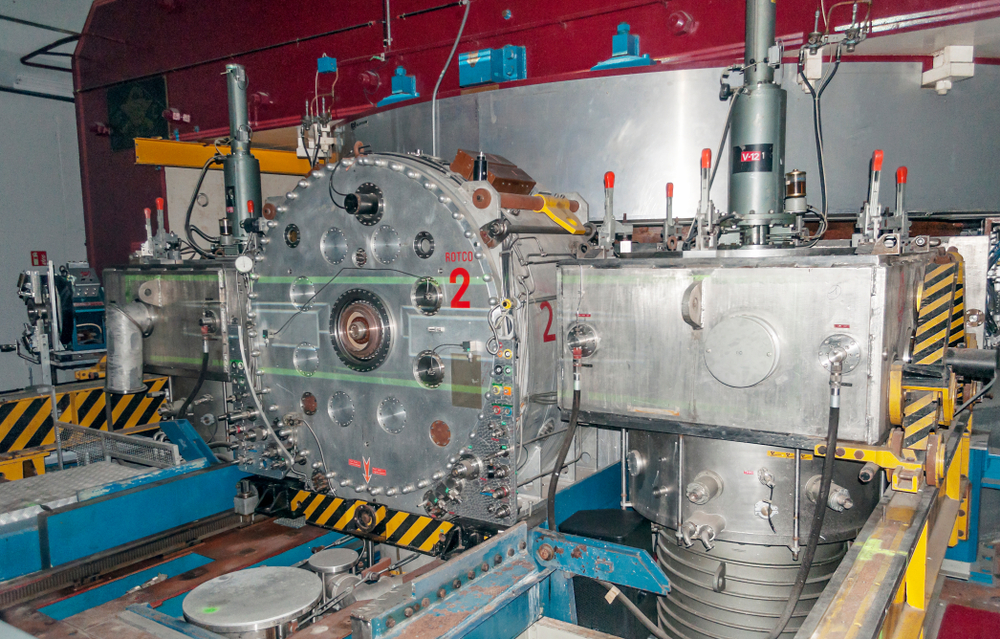
At CERN, the Large Hadron Collider accelerates lead ions to speeds that are almost identical to the speed of light, reaching about 99.999993 percent of that ultimate limit. These ions are guided into beams that travel in opposite directions before being brought close together. In many cases, the ions collide directly, creating extremely hot and dense conditions that mimic those found just moments after the Big Bang. These head-on collisions produce thousands of particles and allow scientists to study states of matter that no longer exist naturally in the universe.
However, not every interaction involves a direct collision. In fact, many of the most interesting events occur when the ions pass very close to each other without actually touching. In these near-miss situations, the electromagnetic fields surrounding the nuclei become incredibly important. Because each lead nucleus contains 82 protons, it carries a strong positive charge, and when moving at such high speeds, this charge creates an intense and highly compressed field of energy.
This field can generate a burst of photons, which are particles of light that carry energy. When these photons interact with another lead nucleus, they can disturb its internal structure in a way that causes it to eject particles. Among those particles can be protons, and if exactly three protons are removed, the identity of the element changes completely. What was once lead becomes gold, simply because its proton count has shifted from 82 to 79.
The process is both precise and rare, but it happens naturally within the environment created by the collider. Scientists are not directly manufacturing gold in a traditional sense, they are creating conditions where the laws of physics allow this transformation to occur on its own. This makes the phenomenon both remarkable and deeply informative.
Detecting Gold That Barely Exists
One of the most challenging aspects of this discovery is not creating gold, but detecting it in the first place. The gold nuclei produced in these interactions are extremely unstable and exist for only a very short period of time. They move at incredible speeds and do not remain intact long enough to form anything that could be observed with conventional tools. Instead, they quickly collide with surrounding materials or break apart into smaller particles.
To identify these fleeting events, scientists rely on highly specialized detectors. The ALICE experiment at CERN is equipped with instruments designed to capture subtle signals that would otherwise go unnoticed. Among these are zero-degree calorimeters, which can detect the emission of specific numbers of protons and neutrons during an interaction. By carefully analyzing these emissions, researchers can determine when a lead nucleus has lost exactly three protons, indicating the creation of gold.
The level of precision required for this work is extraordinary. Marco Van Leeuwen described this capability by saying, “It is impressive to see that our detectors can handle head-on collisions producing thousands of particles, while also being sensitive to collisions where only a few particles are produced at a time, enabling the study of electromagnetic ‘nuclear transmutation’ processes.” This highlights the dual nature of the experiment, where both large-scale and extremely subtle events must be observed simultaneously.
This ability to detect such rare processes is what makes the discovery significant. Without it, the transformation would remain hidden within the vast number of particle interactions occurring inside the collider. The fact that scientists can isolate and study these events marks a major step forward in experimental physics.

The Scale Sounds Impressive Until You Look Closer
At first glance, the numbers associated with this process can seem astonishing. Over a period of several years, scientists estimate that tens of billions of gold nuclei were produced during experiments at the collider. The rate of production can reach tens of thousands of nuclei per second under optimal conditions, which might suggest a surprisingly efficient process.
However, these numbers become far less impressive when translated into physical mass. Despite the large number of individual nuclei, the total amount of gold produced is incredibly small, amounting to just 29 picograms. This is such a tiny quantity that it cannot be seen, handled, or used in any meaningful way. It is many trillions of times smaller than the amount needed to create even the smallest piece of jewelry.
The fleeting nature of the gold adds another layer of limitation. Most of the nuclei exist for only about a microsecond before breaking apart or colliding with other materials. They do not accumulate or persist in any stable form. Instead, they are part of a continuous cycle of creation and destruction within the experiment.
Uliana Dmitrieva emphasized the importance of observation rather than the quantity by stating, “The analysis is the first to systematically detect and analyse the signature of gold production at the LHC experimentally.” This makes it clear that the value of the discovery lies in its scientific significance, not in its output.

Why Scientists Are Interested in This Process
The transformation of lead into gold might capture attention, but for researchers, it is only a small part of a much larger picture. The real focus is on understanding how particles and forces behave under extreme conditions. The interactions that lead to this transformation provide valuable insights into electromagnetic processes and the structure of atomic nuclei.
By studying these events, scientists can improve theoretical models that describe how nuclei respond to high-energy interactions. These models are essential for predicting how particle beams behave inside accelerators, which in turn affects the efficiency and stability of experiments. Even small improvements in understanding can lead to significant advancements in the design and operation of future colliders.
John Jowett explained the broader importance of this work by saying, “The results also test and improve theoretical models of electromagnetic dissociation which, beyond their intrinsic physics interest, are used to understand and predict beam losses that are a major limit on the performance of the LHC and future colliders.” This shows that the research has practical implications beyond the immediate discovery.
In addition to its technical benefits, the work also contributes to a deeper understanding of fundamental physics. It provides data that helps scientists explore how matter behaves at the smallest scales and under the most extreme conditions, offering insights that cannot be obtained through any other means.
A Connection to Earlier Discoveries
Although this discovery may seem entirely new, it builds on earlier observations made at other particle accelerators. Previous experiments had detected similar transformations, but they were limited by lower energy levels and less precise detection methods. As a result, those observations were less detailed and more difficult to analyze.
The current experiments benefit from higher energies and more advanced technology, allowing scientists to observe these processes with much greater clarity. This makes it possible to confirm theoretical predictions and refine existing models with a level of precision that was not previously achievable.
Jiangyong Jia highlighted this progress by stating, “The latest experiments are at higher energy, have a much higher probability of creating gold and make for much cleaner observations.” This underscores how improvements in technology continue to expand the boundaries of what can be studied and understood.
The evolution of these experiments demonstrates how scientific knowledge builds over time. Each advancement adds a new layer of detail, bringing researchers closer to a complete understanding of complex phenomena.

The Irony of Achieving an Ancient Goal
There is a certain irony in the fact that humanity has finally achieved what alchemists once dreamed of, only to find that it does not deliver the outcome they imagined. The transformation of lead into gold now requires immense energy, advanced technology, and produces only microscopic, short-lived results. It is not a pathway to wealth, but a demonstration of the principles that govern the universe.
Instead of producing treasure, the process generates knowledge. It reveals how particles interact, how forces operate at extreme scales, and how elements can change under the right conditions. The goal has been achieved, but its meaning has shifted entirely.
This shift reflects a broader change in human curiosity. Where once the focus was on material gain, it is now on understanding. The value lies not in what can be held, but in what can be learned.
Sources:
- ALICE detects the conversion of lead into gold at the LHC. (2026, April 24). CERN. https://home.cern/news/news/physics/alice-detects-conversion-lead-gold-lhc
- Li, F., Zhang, S., Sun, K., & Ma, Y. (2024). Production of light nuclei in isobaric Ru + Ru and Zr + Zr collisions at sNN=7.7–200 GeV from a multiphase transport model. Physical Review. C, 109(6). https://doi.org/10.1103/physrevc.109.064912