
Your cart is currently empty!
The Colombian Boy Who Was Known As Turtle Boy

For six years, Didier Montalvo carried a mass across his back that had grown so large it looked like a shell. In his rural Colombian village, that unusual appearance changed the way people treated him, turning a medical condition into something surrounded by fear and superstition.
Contents
show
Neighbours called him the “turtle boy.” Some believed the growth was connected to an eclipse and evil forces. Didier was kept away from school and baptism, while his family struggled to find a way to pay for the complex surgery that could change his life.
The Growth Had Been There Since Birth
Didier had congenital melanocytic nevus, a condition involving an unusually large collection of pigment-producing cells in the skin. His case was exceptionally severe, with the growth spreading across his back and around his ribs until it covered roughly 40% of his body surface.
The physical burden affected what Didier could do as a child, but the social consequences were just as painful. He had never attended school and was unable to take part in activities that other children could enjoy.
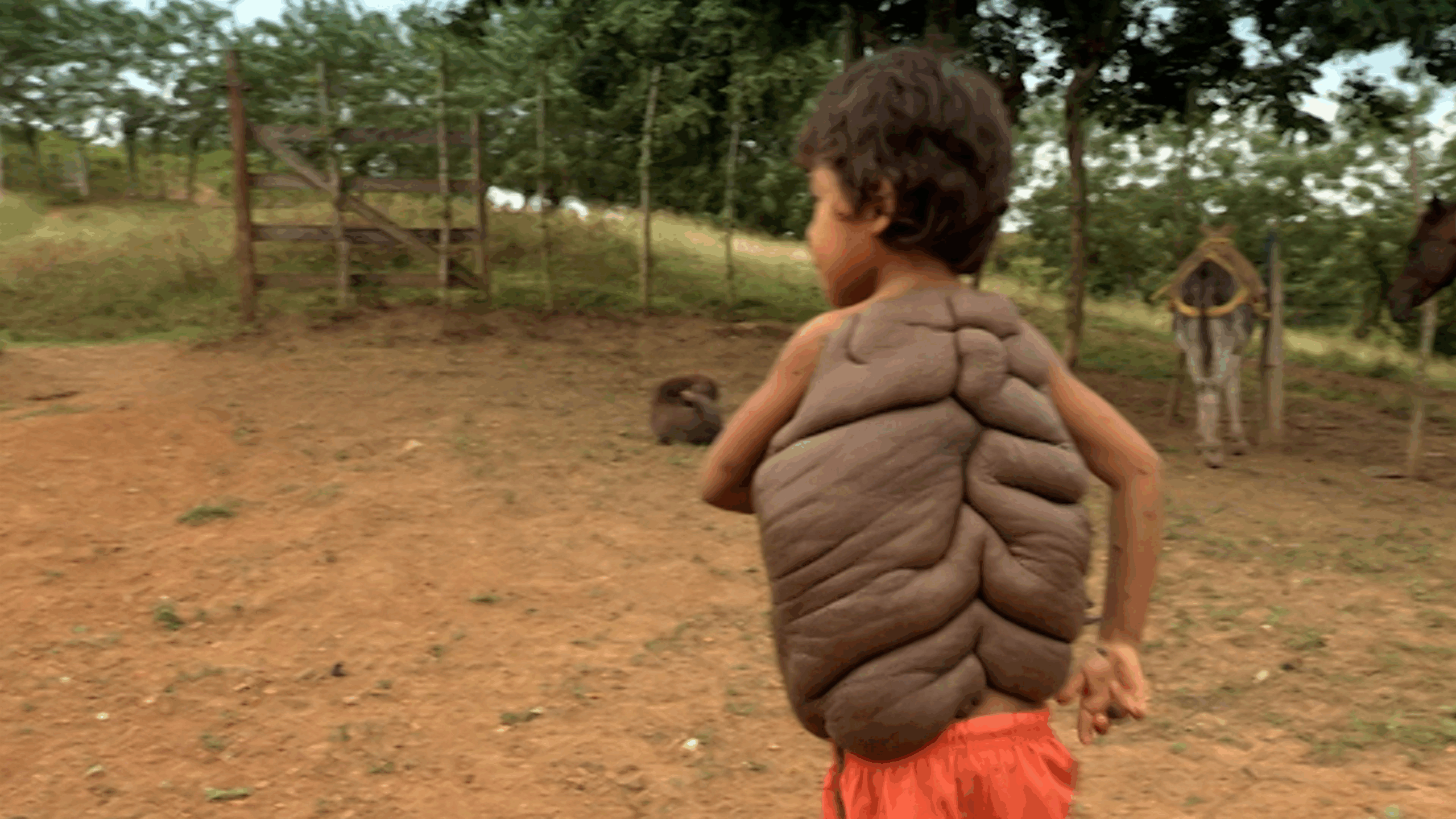
Image Credits – Prime Video @Turtleboy
“When he heard people calling him ‘Turtle boy’ he felt very sad and he would ask ‘Why do I have this?’” his mother, Luz, said.
Didier himself described the condition in painfully simple terms when speaking about his hopes for the future. “I want to grow up. But the mole won’t let me.”
Doctors Had Rarely Seen A Case Like It
Neil Bulstrode, a consultant plastic surgeon at Great Ormond Street Hospital in London, had experience treating congenital melanocytic naevi. After seeing photographs of Didier, however, he recognised that the boy’s condition was unusually extensive.
“Didier’s was the worst case I had ever seen,” Bulstrode said. “Effectively three quarters of the circumference of his body was affected.”
Bulstrode explained that many people with congenital melanocytic naevi have lesions that are much flatter and therefore easier to manage. Didier’s growth was thick, raised and extensive, making treatment considerably more complicated.
His Village Blamed An Eclipse

The medical explanation for Didier’s condition was very different from the beliefs circulating in his community. Neighbours reportedly decided that the growth had appeared because Didier had been conceived during an eclipse, while others associated his appearance with evil forces.
Those beliefs had real consequences for the child and his family. Didier’s unusual appearance became a reason for exclusion rather than something recognised as a medical condition.
His mother watched the effect that the nickname had on him while also dealing with the practical problem of finding treatment. The family lived in rural Colombia and could not afford an operation of the scale Didier required.
The situation left the boy caught between a condition he had never chosen and a community that misunderstood it.
School And Baptism Were Closed To Him
Didier had never sat inside a classroom by the time he reached six years old. He had also never been baptised, after the beliefs surrounding his condition effectively shut him out of both experiences.
For Luz, these were painful losses because they represented ordinary parts of childhood that she wanted her son to experience. She wanted Didier christened and enrolled in school, but surgery remained financially out of reach.
“He felt very bad before the surgery, it impeded him from doing a lot of the activities he enjoyed doing,” Luz said.
The growth therefore affected far more than Didier’s physical movement. It had become a barrier between him and the childhood his family wanted him to have.
One Newspaper Story Brought Help

The family eventually received an unexpected opportunity when a local newspaper published Didier’s story. People who had never met the child began donating money after learning about his condition.
The attention also reached Neil Bulstrode, who saw photographs of Didier and decided to travel to Bogotá to help.
“When I saw the pictures of Didier, one of my first feelings was that if we could remove it, we would significantly improve his quality of life,” Bulstrode said.
The British surgeon joined a team of surgeons in Bogotá and operated without charging Didier’s family. A Channel 4 documentary later followed the case and the treatment, bringing the story to an international audience.
For a family that had previously been unable to afford the necessary treatment, the newspaper story had opened a path toward surgery.
The 11-Pound Growth Required Multiple Operations
When the growth was finally removed, it weighed 11 pounds. Doctors had been concerned that a mass of this size could potentially become cancerous, although the tissue removed from Didier was found to be benign.
Congenital melanocytic nevus develops during embryonic development and is associated with a somatic mutation rather than something inherited from a parent. Large lesions can also carry an increased risk of melanoma, which was part of the medical concern surrounding Didier’s condition.
Removing such a large growth was never going to be a straightforward procedure. The treatment required Didier to undergo a series of operations as surgeons removed the affected tissue and reconstructed the areas left behind.
His Own Skin Was Used For Reconstruction
Treatment for a nevus of this size can require tissue expansion or skin grafting. In Didier’s case, surgeons carried out a series of skin grafts using tissue from his own body as part of the reconstruction.
The process was painful and required patience from a young child who had already spent years dealing with the physical limitations of the growth.
“Obviously he has had to go through a number of painful operations, but we feel it was worth it,” Bulstrode said.
The goal was bigger than simply removing the mass. The surgical team wanted to give Didier greater freedom of movement and a better quality of life.

Didier Finally Went To School
After the surgeries, the changes in Didier’s life became visible in ways that went beyond his physical appearance. He was able to start attending school, finally entering a classroom after spending his first six years outside the education system.
His mother also had him baptised, fulfilling something she had wanted for him for years. The two experiences gave Didier access to ordinary parts of childhood that had previously been denied to him.
Bulstrode later expressed satisfaction with the boy’s recovery. “It’s great to see the photos of how Didier is getting on now,” he said. “I’m really happy with how things have healed.”
The operation had removed an enormous physical burden, but the transformation also challenged the beliefs that had shaped how the village treated Didier.
What His Condition Actually Meant
Congenital melanocytic nevus can vary considerably in size and appearance, and Didier’s case represented an unusually severe example. The key facts surrounding his condition include:
- It was present from birth. The growth had been there since Didier was born and expanded as he grew.
- It was exceptionally extensive. The mass affected much of his back and ribs and covered around 40% of his body surface.
- It was not caused by his mother. The condition was linked to a somatic mutation during embryonic development.
- The removed tissue was benign. Doctors had concerns about potential cancer risk, but the mass removed from Didier was not cancerous.
- Treatment was staged. Removing the growth required multiple procedures and reconstructive treatment using skin grafts.
The medical facts also made clear how far the village’s beliefs were from the actual cause of Didier’s condition. Nothing about his appearance indicated that his mother had done something wrong or that an eclipse had caused the growth.
The Hardest Part Was Not Only The Growth
Didier’s case became internationally known because of the size of the growth on his back, but the story also revealed what can happen when poverty and superstition surround a visible medical condition.
His family could not afford the treatment. His community misunderstood his appearance. Didier was excluded from school and baptism while carrying a nickname that made him feel different from the people around him.
Medical treatment eventually changed the physical problem, but outside help was needed before that could happen. Donations gave the family access to care, while surgeons provided expertise that had previously been beyond their reach.
For Didier, the result was remarkably ordinary in the best possible sense. He could go to school, receive his baptism and take part in activities that had once been difficult.
The Boy Was Finally Given Room To Grow Up
The growth that had shaped Didier’s childhood weighed 11 pounds when it was removed, but its impact had been measured in much more than weight. It had affected his movement, education, social life and the way his community saw him.
Years later, the clearest image from the story is not the enormous mass that once covered his back. It is a child finally walking into a classroom after being kept outside it for six years.
Didier had spent his early childhood being called the “turtle boy.” After surgery, he had the chance to simply be a boy.