
Your cart is currently empty!
Woman Believes She Found Secret Clue That Reveals Who Will Win the 2026 World Cup
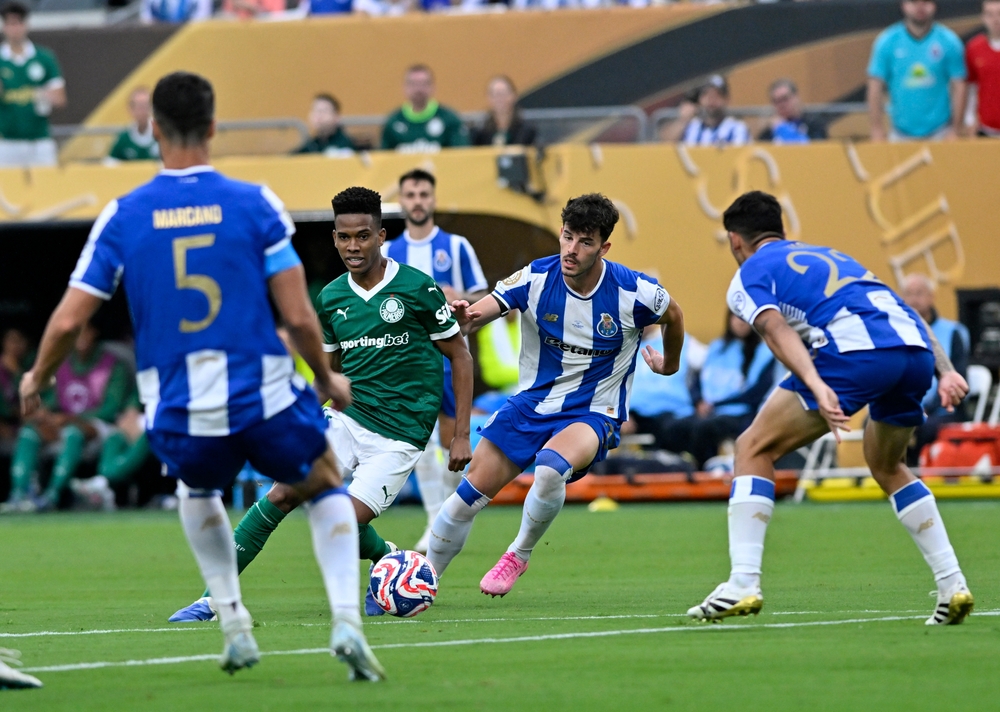
The FIFA World Cup has barely reached the knockout stage, yet thousands of fans are already convinced they know how the tournament ends. Not because of form, tactics, or statistics, but because of the colors used in FIFA’s official branding.
Contents
show
A viral social media theory claims Portugal has effectively been handed the trophy before a ball is kicked in the latter stages of the competition. The idea has spread rapidly across TikTok and Instagram, drawing millions of views and fueling fresh debate about whether football’s biggest tournament hides clues in plain sight. While there is no evidence supporting the claim, its timing has turned it into one of the World Cup’s most talked-about online discussions.
A Viral Theory Claims FIFA Already Revealed the Winner
The latest conspiracy comes from content creator Paige, whose video argues that FIFA has unknowingly, or perhaps intentionally, hinted at the 2026 World Cup champion through the tournament’s official color palette.
Her claim borrows from a long-running NFL conspiracy theory that suggests Super Bowl logos reveal the two teams destined to reach the championship game. That theory has circulated for years whenever fans notice similarities between logo colors and the uniforms of the finalists.
According to Paige, FIFA may be following a similar pattern.
“We all know the Super Bowl conspiracy,” she says in the now-viral clip. “Every year they give us the logo, and the colors of the logo happen to end up being the colors of the teams playing in the final.”
She then makes the leap that caught football fans’ attention.
“Well FIFA has a script too.”
From there, she argues that Portugal is destined to become world champions because the country’s national colors appear to match the official branding for the 2026 tournament.
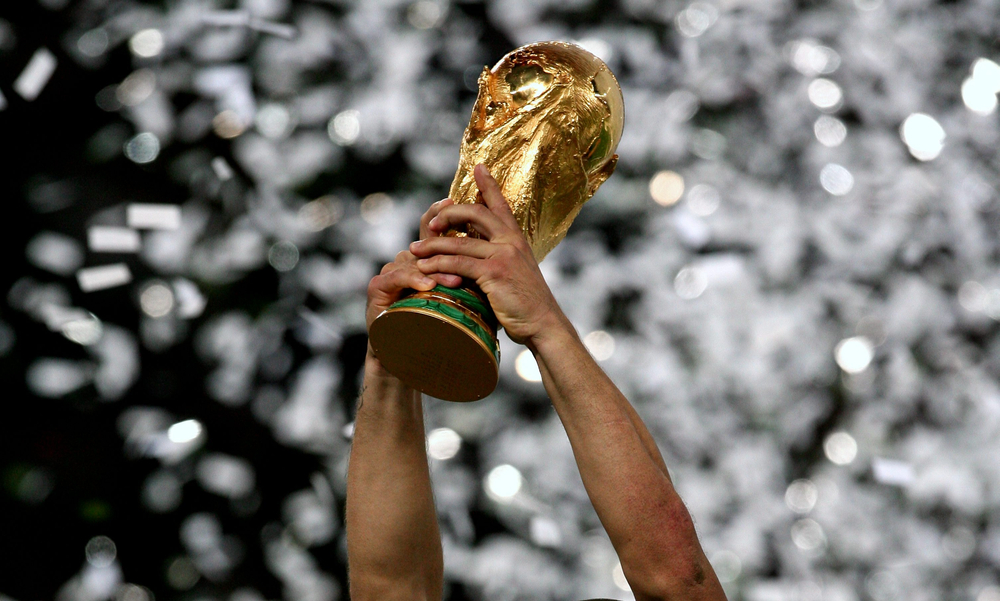
The Color Pattern That Started It All
At the center of the theory is a surprisingly simple observation.
While the main FIFA World Cup logo is black and white, each tournament also has an official branding package featuring several accent colors used across promotional material, stadium graphics, digital campaigns, and merchandise.
Paige believes those colors have quietly matched the eventual winners for several tournaments in a row.
She pointed first to the 2022 World Cup in Qatar.
According to her, Argentina’s famous sky blue and white colors closely resembled the tournament’s official branding. She then looked back at the 2018 tournament, where she believes France’s blue, white, and red also aligned with FIFA’s chosen palette.
She even traced the idea back to Germany’s triumph in 2014.
Although she admitted that comparison was “a bit of a stretch,” she argued that Germany’s red and yellow tones, along with the green used in its away kit, fit the branding closely enough to continue the pattern.
Whether coincidence or something more, the sequence was enough to convince her that another answer could be hiding in the 2026 visuals.
Why Portugal Became Her Pick
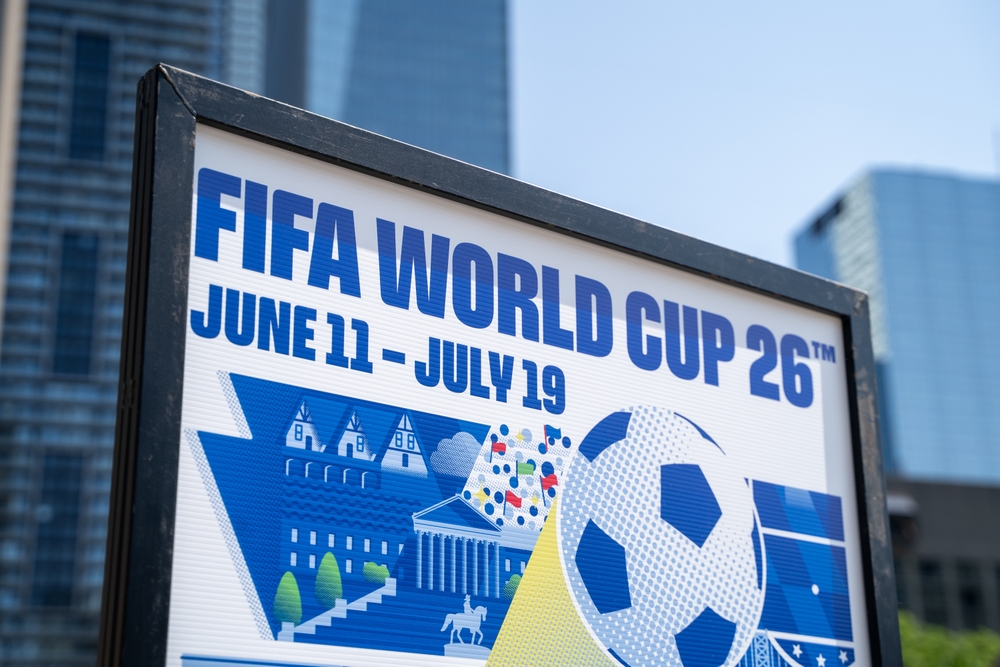
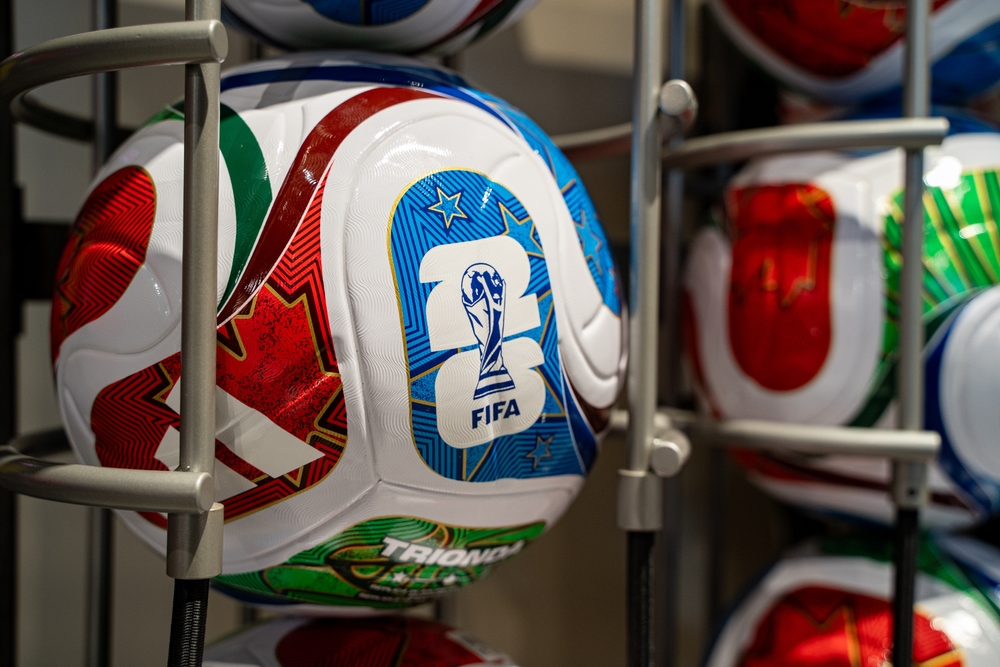
The official branding for the 2026 World Cup prominently features green, red, blue, and gray.
At first glance, Paige believed another country fit the description.
“My first thought,” she explained, “was Morocco.”
The North African nation certainly matches the green and red combination found in the branding, especially considering its national flag.
But after taking a closer look, she changed her mind.
Portugal, she argued, offered a much stronger match because its national emblem includes several blue shields positioned at the center of the country’s flag.
That detail became the deciding factor.
“The more obvious option is Portugal,” she concluded.
She finished the video with the line that quickly spread across social media.
“They wrote the script.”
The phrase instantly resonated with football fans already familiar with jokes about “scripted sports,” even though there has never been evidence that FIFA predetermines tournament results.
Even the Creator Doesn’t Fully Believe It
One reason the theory has attracted so much attention is that Paige herself has been careful not to present it as fact.
In a follow-up interview, she explained that the entire idea began out of curiosity rather than genuine belief.
She said she first became interested after noticing similarities between Super Bowl logo theories and FIFA’s branding.
“I realized FIFA has official colors so I looked at the 2022 World Cup colors and they were legitimately the same colors as Argentina,” she explained.
That discovery encouraged her to look even further back.
“I dug deeper and all the colors matching the winners actually go further than I did in the video. The 2014 cup colors and winner also align.”
Despite those observations, she repeatedly emphasized that the theory should not be taken too seriously.
“It’s really all for fun so I wouldn’t put too much stock in it, but ya never know!”
Even her confidence rating came with a sense of humor.
“But Portugal is already a top five favorite to win, so with the FIFA color theory I’d say I’m 74.3 percent confident they could win the whole thing.”
That oddly specific percentage quickly became another talking point online, with many viewers treating it as part of the joke rather than a genuine prediction.
Why Sports Conspiracy Theories Spread So Easily
Football has always produced unusual superstitions.
Supporters refuse to wash lucky shirts during winning streaks. Managers wear the same jackets for entire tournaments. Some fans even insist that sitting in the same chair during every match somehow influences the result.
The “FIFA script” theory taps into that same mindset, only on a much larger scale.
Major sporting events naturally encourage fans to search for hidden patterns. Once someone notices an apparent coincidence, it becomes surprisingly easy to connect unrelated events into what feels like a meaningful sequence.
Psychologists refer to this as pattern recognition, a normal part of human thinking that helps people make sense of uncertain situations. The same tendency explains why conspiracy theories often gain traction during high-profile events involving millions of viewers.
The World Cup provides perfect conditions for that process.
Every logo, commercial, referee decision, and controversial moment is examined by audiences across the globe. Social media accelerates the cycle even further, allowing theories to spread worldwide within hours.
Unlike complex tactical analysis, a colorful graphic requires no football expertise to understand. Anyone can compare a logo to a national flag and decide whether the similarities look convincing.
That simplicity has helped the theory travel far beyond dedicated football communities.
Portugal Already Has the Quality to Challenge
One reason Paige’s theory has found such a receptive audience is that Portugal hardly feels like an impossible choice.
Unlike predictions centered on complete outsiders, Portugal enters the tournament with genuine expectations of making a deep run. The squad combines experienced veterans with emerging stars, giving supporters legitimate reasons to believe this could finally be the nation’s year.
Portugal has spent the past decade transforming into one of international football’s most consistent teams. Winning the UEFA European Championship in 2016 and the UEFA Nations League in 2019 proved the country could succeed on football’s biggest stages.
That history makes the color theory feel just plausible enough to keep people talking.
If the prediction had pointed toward a nation with little chance of surviving the group stage, it probably would have disappeared within a day.
Instead, it landed on one of the tournament favorites.
That coincidence has blurred the line between playful speculation and genuine debate, even among fans who openly admit they do not believe the tournament is scripted.
The Timing Could Not Have Been Better
The conspiracy theory has also benefited from perfect timing.
As the World Cup enters its knockout rounds, every supporter is trying to predict how the bracket will unfold. Analysts publish projections, betting markets shift after every result, and fans create their own tournament simulations.
Paige’s theory arrived at exactly the moment people were looking for answers.
Instead of discussing expected goals, possession statistics, or defensive records, football fans suddenly found themselves comparing national flags with tournament graphics.
The idea spread rapidly because it required almost no explanation.
Anyone scrolling through social media could understand the argument within seconds.
That simplicity helped transform a lighthearted observation into one of the tournament’s biggest viral talking points.
Thousands of users began posting side-by-side comparisons of previous World Cup branding alongside the flags of Argentina, France, and Germany.
Others searched older tournaments to see whether the pattern extended even further into football history.
Some thought the similarities looked convincing.
Others argued the comparisons relied on selective interpretation.
The debate itself became part of the entertainment.
Why Hidden Pattern Theories Never Really Disappear
This is far from the first time sports fans have become fascinated by hidden clues.
Every major tournament seems to produce at least one theory suggesting that outcomes have already been decided.
Sometimes people focus on referee appointments.
Other times they analyze fixture schedules, television storylines, sponsorship campaigns, or promotional videos.
The Super Bowl logo theory remains one of the most famous examples.
For years, NFL fans have claimed the league’s championship logo subtly reveals the teams destined to reach the final. Whenever the colors appear to match, social media erupts with renewed confidence that the league follows a script.
When the colors fail to match, the theory usually fades away until the following season.
Football supporters have now borrowed that same concept.
The World Cup’s global audience makes it fertile ground for similar speculation, particularly during a tournament that attracts billions of viewers across every continent.
Large sporting events naturally generate myths because fans become emotionally invested in every possible detail.
When the stakes feel enormous, even the smallest coincidence can seem significant.
Football Rarely Follows Anyone’s Script
As entertaining as the theory may be, football has a habit of embarrassing anyone who believes they have solved it.
Every World Cup has produced stunning upsets that few experts predicted.
Tournament favorites have crashed out early.
Underdogs have reached the semifinals against overwhelming odds.
Penalty shootouts have rewritten football history within minutes.
One unexpected red card, an injury to a key player, or a goal in stoppage time can completely alter a tournament.
That unpredictability is precisely why the World Cup captures the imagination every four years.
If outcomes could be identified through branding colors, statistical models, or internet theories, football would lose much of the drama that has made it the world’s most popular sport.
Even Paige acknowledged that reality.
“With soccer you can never be too sure,” she said. “Truly anyone can win and anyone can lose.”
That may be the most accurate prediction anyone has made throughout the tournament.
Fans Are Enjoying the Joke More Than the Theory
Much of the online conversation has developed with a sense of humor rather than genuine suspicion.
Many supporters have embraced the idea because it adds another layer of entertainment to an already unpredictable competition.
Some have jokingly congratulated Portugal in advance.
Others have sarcastically declared that FIFA accidentally uploaded the “script” before deleting it.
Memes comparing tournament branding with national flags continue to circulate across TikTok, Instagram, and X, keeping the discussion alive long after the original video appeared.
Even people who reject the theory often admit they enjoy watching others search for new clues.
That playful atmosphere helps explain why the conspiracy has spread so widely.
Unlike many internet conspiracies that become hostile or politically charged, this one exists largely as shared entertainment among football fans.
Most participants understand there is no leaked FIFA document, no hidden evidence, and no proof that tournament results are predetermined.
Instead, the theory has become another example of how online communities can turn a simple observation into a worldwide conversation.
The Real Winner Will Still Be Decided on the Pitch
The coming weeks will determine whether Portugal lives up to its billing as one of the tournament favorites or joins the long list of highly rated teams eliminated before the final.
If Portugal eventually lifts the trophy, the color theory will almost certainly become one of football’s favorite internet legends. Fans will point back to the branding and claim the signs had been there all along.
If another nation wins, the conspiracy will likely become another amusing chapter in the long history of sports myths that briefly captured public imagination before fading away.
Either outcome says something about modern sports culture.
Supporters no longer experience tournaments only through television broadcasts. They also consume memes, viral videos, predictions, and online debates that become part of the event itself.
For now, the official World Cup branding remains exactly what FIFA intended it to be: a visual identity for the tournament.
Whether those colors happen to match the eventual champions is a question that only the final whistle can answer.