
Your cart is currently empty!
Researchers Construct the World’s First Fully Synthetic Cell from Scratch
A fundamental rule taught in basic biology is that life only comes from pre-existing life. Every natural organism carries a biological legacy of cellular division that stretches back to the origins of the world. Historically, the divide between inanimate chemical compounds and a functioning biological organism was treated as a hard, permanent border.
Contents
show
Recently, researchers at the University of Minnesota found a way to cross it. Moving away from the standard practice of tweaking and editing existing genetic material, a team of scientists chose to start with a completely blank slate.
The Blueprint of Synthetic Life
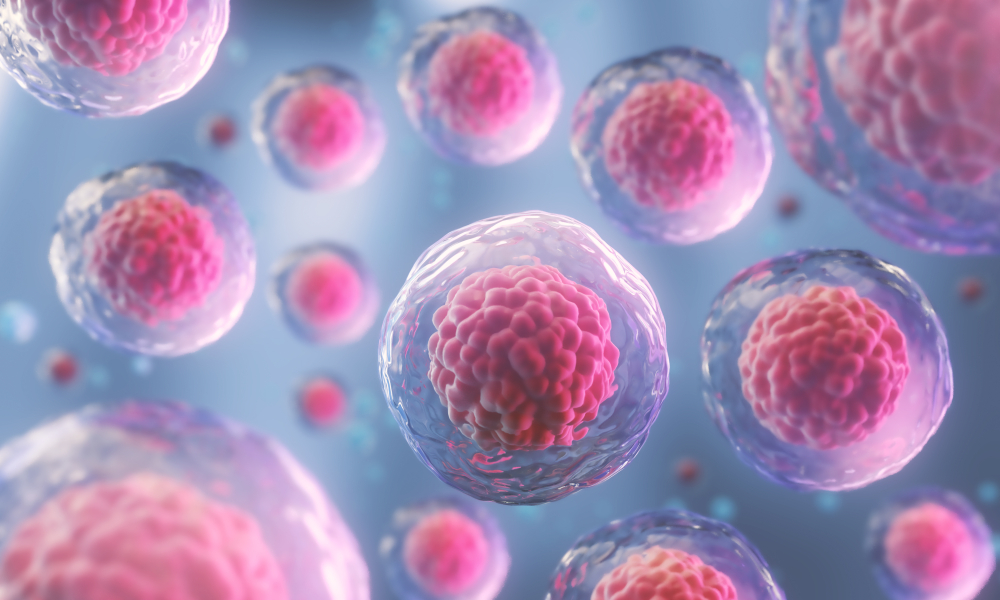
Scientists have tried to understand the bare essentials of life by taking existing cells and stripping them down to their basic parts—much like dismantling a car to see how the engine works. But researchers at the University of Minnesota took the exact opposite approach. They built a cell from the ground up. Nicknamed “SpudCell,” this creation is the world’s first synthetic cell pieced together entirely from non-living chemicals.
To build it, the team started with a microscopic bubble of fat to act as the cell’s outer wall. Inside this protective shell, they placed a custom-made set of genetic instructions. Instead of the long, complex strings of DNA found in nature, they used seven small loops of custom genetic code.
The scale of this genetic blueprint is incredibly small. For context, human DNA contains about 3 million units of genetic information (known to scientists as kilobase pairs). Until now, biologists believed that even the absolute simplest living organism needed at least 113 of these units to survive. SpudCell rewrites that rule. It functions on just 90 units, carrying a mere 36 genes and roughly 150 to 200 chemical molecules to keep it running.
Because every piece of SpudCell was designed in a lab, it works a bit like a set of microscopic building blocks. Scientists can easily swap parts in and out to change how the cell behaves. This breakthrough proves that raw, lifeless chemicals can be deliberately organized to act just like biological life.
As Kate Adamala, a synthetic biologist and co-lead on the project, explained: “We’ve replicated in chemistry what only used to be possible in biology: the complete set of behaviors of a cell. It proves that the most fundamental functions of life, like growth and replication, do not need a mysterious magical spark.”
SpudCell’s Simple Recipe for Life
SpudCell is not a static chemical model. It performs the core actions of a living organism by feeding, growing, replicating its genetic material, and dividing.
Because SpudCell lacks the complex machinery of a natural cell, it cannot produce its own ribosomes to build proteins. It relies entirely on external help. To eat, SpudCell depends on “feeder” bubbles floating in its environment. These microscopic nutrient packets carry essential enzymes and chemical building blocks. SpudCell uses a specially designed surface protein to grab onto these feeder bubbles and merge with them. Through this fusion process, the synthetic cell absorbs its food and begins to grow.
Once nourished, SpudCell copies its genetic code and prepares to split. Natural cells use an intricate internal scaffolding to pinch themselves in half. SpudCell does not have this internal structure. Instead, researchers programmed proteins to gather tightly on the outer membrane. As these proteins crowd together, they create physical stress on the cell surface until the membrane simply pops into two separate daughter cells. This entire life cycle takes about 12 hours at a warm 86 degrees Fahrenheit.
The researchers even watched SpudCell experience a basic form of natural selection. By introducing a mutated version of the cell designed to absorb food faster, they set up a microscopic competition. The mutant cells out-ate the original ones. After just five generations, the faster-growing variants dominated the population.
What Counts as “Life”?

The creation of SpudCell forces us to confront a fundamental question: when does a collection of chemicals become a living organism? Traditionally, the line between chemistry and biology was considered an uncrossable boundary. SpudCell blurs that line, acting as a bridge between the non-living and the living.
By all traditional biological definitions, SpudCell is alive. It consumes resources from its environment, it uses those resources to grow, it replicates its genetic material, it passes that material on to the next generation, and it even demonstrates the capacity to evolve. It checks every box on the basic checklist for life.
However, many scientists argue that it still falls short of being a “true” living organism due to its extreme limitations and absolute reliance on the laboratory environment. SpudCell cannot survive on its own in nature. It cannot produce its own proteins, meaning it will die without a constant supply of the artificial “feeder” bubbles provided by researchers. Furthermore, while it can split into daughter cells, its lifespan is incredibly fragile and entirely dictated by the temperature and chemical balance of its petri dish.
Regardless of where one stands in this debate, SpudCell proves that the mechanics of life are not exclusive to nature. It demonstrates that the biological processes we associate with living things can be replicated entirely through synthetic chemistry, challenging our deeply held definitions of what it means to be alive.
The Future of Medicine and Manufacturing

While answering philosophical questions about the nature of life is fascinating, the practical value of SpudCell lies in what it can do for humanity. Because scientists know exactly how this cell is built—down to the last molecule—they can program it to work as a microscopic biological factory.
In nature, living microbes are already used as tiny factories to produce everyday necessities like insulin and biodegradable plastics. However, natural cells are incredibly complex, carrying thousands of extra genes that can make them unpredictable. A stripped-down, synthetic “chassis” like SpudCell changes the game. By customizing its minimal genetic code, researchers can instruct these cells to manufacture specific materials safely and efficiently.
In medicine, this level of control could lead to highly precise therapeutic drugs. Because SpudCell is entirely synthetic, it could even be designed to build proteins using chemical ingredients that natural evolution never used, opening the door to entirely new categories of medical treatments.
Beyond healthcare, these microscopic workshops could revolutionize industrial manufacturing. Instead of relying on traditional factories that generate high carbon emissions, synthetic cells could be engineered to break down toxic chemicals, capture greenhouse gases, or sustainably produce fuels and plastics. As project lead Kate Adamala pointed out: “We need to be able to manufacture things in a way that doesn’t harm the planet and in a way that’s actually renewable.”
Life, Open-Sourced
The idea of engineering life from scratch often evokes science fiction imagery of rogue, unstoppable creations. The reality of SpudCell, however, is much quieter. Resting in a laboratory petri dish, it is incredibly fragile and entirely dependent on a highly controlled environment to survive even a single day. It poses no danger, yet it gently shifts the horizon of modern science. As these synthetic systems inevitably evolve from delicate experiments into more capable microscopic machines, the world watches a new technological frontier unfold—one that prompts deep reflection on how artificial biology will eventually interact with the natural world.
The next chapter of this breakthrough hinges on a uniquely human decision. Rather than locking the blueprints of SpudCell behind lucrative corporate patents, its creators licensed the technology to Biotic, an open-source, public-benefit organization. It is an approach that treats synthetic life not as a commercial product, but as shared global infrastructure. This open-handed release leaves a profound concept to ponder: the greatest achievement might not just be the creation of synthetic life, but the choice to give it away. It transforms a singular scientific milestone into a worldwide, collaborative canvas, opening the door for international researchers to explore these chemical blueprints and quietly rewrite the future of medicine and environmental preservation.
Source:
- Biotic | SpudCell. (2026). Biotic.org. https://www.biotic.org/research/spudcell/