
Your cart is currently empty!
Injured Magpie Walked Into a Couple’s Home for Help, Then Kept Coming Back
A wild magpie arrived at a South Australian riding academy with something tightly wrapped around her neck. Instead of fleeing, the injured bird moved toward the people nearby and eventually hopped through the door of their home.
Contents
show
Marie Matter freed the magpie and released her back into the wild. The next morning, the bird was waiting at the front door, beginning a routine that would turn a brief rescue into an extraordinary viral story.
The Magpie Walked Straight Into the House
Marie Matter teaches classical dressage at the Australian Baroque Riding Academy in Glenburnie, South Australia. Horses are central to life on the property, while the birds moving through the area are usually part of the everyday scenery.
Then one magpie appeared with material wound tightly around her neck. Matter initially described it as electrical tape, although other versions of the story referred to the material as wire. Either way, the bird could not remove it alone.
Wild birds generally avoid close contact with humans, particularly when they are injured or frightened. This magpie behaved differently, approaching Matter before hopping through the door and into the house.
Matter coaxed her further inside and carefully picked her up. She worked the material loose, checked that nothing remained trapped beneath the feathers, and released the bird once she was free.
For most wildlife rescues, that would be the end of the encounter. This time, the magpie had other plans.
Wobble Wobble Started Visiting Every Day
Matter named the bird Wobble Wobble, and the rescue quickly became more than a one-time meeting. Three days later, Matter wrote that she had “built a real bond with this lovely bird over the past 3 days.”
The following morning, Wobble Wobble was standing at the front door. She continued returning almost every day and sometimes visited roughly three times a day, according to Matter.
The bird also developed a habit of landing on the couple’s car whenever the engine started. Matter occasionally offered mealworms or worms from the garden, although Wobble Wobble continued living as a wild bird.
She eventually found a mate and spent part of her time defending the territory around the property. On one occasion, she even arrived carrying two beetles.
The Dodo featured the story in November 2024, and footage of the rescue spread online. The story caught attention because an injured wild bird appeared to approach humans for help and then kept returning after she was free.
Australian Magpies Are Not Actually Crows
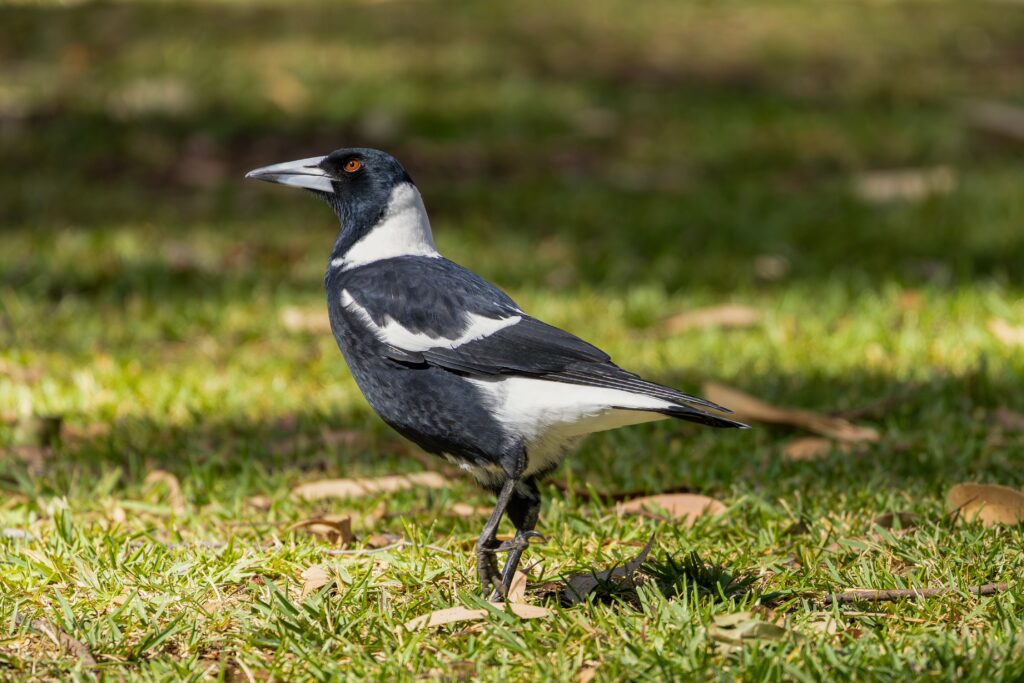
The Australian magpie’s name causes plenty of confusion. The bird, scientifically known as Gymnorhina tibicen, is not a crow and is unrelated to the Eurasian magpie that inspired its name.
Australian magpies belong to the Artamidae family, alongside butcherbirds and currawongs. Early European settlers apparently saw a large black-and-white bird and gave it a familiar name.
They do share some traits with highly intelligent social birds. Australian magpies live in groups, defend territories, and breed cooperatively, with older siblings sometimes helping parents raise younger birds.
They can also live between 25 and 30 years. That gives an individual bird decades to become familiar with the territory around it, including the humans who regularly move through it.
Why Australian Magpies Fascinate Researchers
Several traits have made these birds particularly interesting to scientists:
- Long lives: Some Australian magpies can live for between 25 and 30 years.
- Complex social groups: They defend territories and interact closely with other magpies.
- Cooperative breeding: Older birds may help raise younger members of the group.
- Human recognition: Research suggests they can distinguish between familiar people.
- Cooperative behavior: Magpies have been observed helping other birds remove objects attached to their bodies.
A bird that recognizes an individual human may encounter that same person repeatedly over many years. That makes Wobble Wobble’s continued visits particularly interesting.
Magpies Can Remember Human Faces
Gisela Kaplan, an emeritus professor in animal behavior at the University of New England, has spent roughly three decades studying Australian magpies. Her observations suggest the birds can recognize and remember individual human faces for years.
Kaplan has written that magpies “are able to recognise and remember individual human faces for many years.” She has also explained that the birds appear to distinguish between people they consider threatening and those they have learned are harmless.
“They will remember someone who was good to them,” Kaplan wrote. In a 2017 interview with ABC News, she also said magpies “will form very long friendships, like dogs”.
That does not prove Wobble Wobble consciously decided to find a human rescuer. No research shows that a magpie can form such a plan, and scientists cannot know exactly what the bird understood when she approached Matter.
The evidence supports something narrower. Australian magpies can tell people apart, remember familiar individuals, and behave differently around humans they have learned are safe.
Five GPS Trackers Were Gone in Three Days
A 2022 experiment revealed another unusual side of Australian magpie behavior. A team led by Dominique Potvin at the University of the Sunshine Coast fitted five birds with small GPS tracking harnesses.
The researchers wanted to study their movements, but the experiment quickly took an unexpected turn. The magpies began removing the trackers from one another.
“Within ten minutes of fitting the final tracker, we witnessed an adult female without a tracker working with her bill to try and remove the harness off of a younger bird,” the researchers reported.
The rest happened quickly. “Within hours, most of the other trackers had been removed. By day 3, even the dominant male of the group had its tracker successfully dismantled.”
The bird helping to remove a harness was not wearing one herself. Researchers described the behavior as a rare form of “rescuing,” although they could not determine exactly what motivated her.
The study involved only five birds, so its findings have clear limits. Still, it showed Australian magpies cooperating in a way the research team had not expected.
Scientists Cannot Say Why Wobble Wobble Returned

The viral version of an animal story can become more certain than the science behind it. Wobble Wobble’s actions were remarkable, but there are limits to what researchers can claim.
Some controlled experiments involving magpies recognizing individual humans have focused on Eurasian magpies in Korea. Those birds belong to a different family from Australian magpies.
For Australian magpies, much of the evidence comes from decades of behavioral observation. The tracker experiment was also small, and its researchers could observe the birds’ actions without knowing their motivations.
Nobody can say with certainty that Wobble Wobble understood Matter as someone who could rescue her. Nobody can prove she returned because she felt gratitude in the human sense.
What can be said is straightforward. She arrived injured, approached people, allowed herself to be freed, and continued returning afterward.
Human Waste Can Trap and Kill Wildlife
The material around Wobble Wobble’s neck also points to a wider problem. Wild animals regularly become trapped in netting, string, fishing line, and other human-made waste.
WIRES, Australia’s wildlife rescue organization, received 1,929 calls during the 2024 financial year involving animals caught in netting, string, fishing line, and similar materials.
RSPCA South Australia has also warned about backyard netting. Senior Rescue Officer Nalika Van Loenen described what rescuers find as “truly heartbreaking to come across birds, struggling in vain to free themselves.”
Reducing Entanglement Risks
Wildlife organizations encourage people to take several precautions:
- Keep netting tight: Loose material can create spaces where birds become trapped.
- Check gardens regularly: Animals caught in netting may be unable to escape.
- Dispose of string carefully: Small pieces can still pose serious risks.
- Use suitable mesh: Proper netting can reduce the chance of entanglement.
- Contact wildlife rescuers: Trained carers can assess injured animals safely.
WIRES advises members of the public not to untangle wildlife themselves, particularly when material is embedded or an animal is injured. Trained rescuers and veterinarians are better equipped to deal with complicated entanglements.
She Kept Returning to the Same House

The most fascinating part of Wobble Wobble’s story is the part science cannot fully explain. She arrived with something around her neck that she could not remove, moved toward humans, and stayed still long enough for Matter to free her.
Afterward, she returned to the front door and continued visiting the property. Perhaps she learned that the people there posed no danger, or perhaps the house became a familiar part of her territory.
Whatever explanation sits behind her behavior, Wobble Wobble continued making the same choice. She kept returning to the house where someone had once helped set her free.
A wild magpie arrived at a South Australian riding academy with something tightly wrapped around her neck. Instead of fleeing, the injured bird moved toward the people nearby and eventually hopped through the door of their home.
Marie Matter freed the magpie and released her back into the wild. The next morning, the bird was waiting at the front door, beginning a routine that would turn a brief rescue into an extraordinary viral story.
The Magpie Walked Straight Into the House
Marie Matter teaches classical dressage at the Australian Baroque Riding Academy in Glenburnie, South Australia. Horses are central to life on the property, while the birds moving through the area are usually part of the everyday scenery.
Then one magpie appeared with material wound tightly around her neck. Matter initially described it as electrical tape, although other versions of the story referred to the material as wire. Either way, the bird could not remove it alone.
Wild birds generally avoid close contact with humans, particularly when they are injured or frightened. This magpie behaved differently, approaching Matter before hopping through the door and into the house.
Matter coaxed her further inside and carefully picked her up. She worked the material loose, checked that nothing remained trapped beneath the feathers, and released the bird once she was free.
For most wildlife rescues, that would be the end of the encounter. This time, the magpie had other plans.
Wobble Wobble Started Visiting Every Day
Matter named the bird Wobble Wobble, and the rescue quickly became more than a one-time meeting. Three days later, Matter wrote that she had “built a real bond with this lovely bird over the past 3 days.”
The following morning, Wobble Wobble was standing at the front door. She continued returning almost every day and sometimes visited roughly three times a day, according to Matter.
The bird also developed a habit of landing on the couple’s car whenever the engine started. Matter occasionally offered mealworms or worms from the garden, although Wobble Wobble continued living as a wild bird.
She eventually found a mate and spent part of her time defending the territory around the property. On one occasion, she even arrived carrying two beetles.
The Dodo featured the story in November 2024, and footage of the rescue spread online. The story caught attention because an injured wild bird appeared to approach humans for help and then kept returning after she was free.
Australian Magpies Are Not Actually Crows
The Australian magpie’s name causes plenty of confusion. The bird, scientifically known as Gymnorhina tibicen, is not a crow and is unrelated to the Eurasian magpie that inspired its name.
Australian magpies belong to the Artamidae family, alongside butcherbirds and currawongs. Early European settlers apparently saw a large black-and-white bird and gave it a familiar name.
They do share some traits with highly intelligent social birds. Australian magpies live in groups, defend territories, and breed cooperatively, with older siblings sometimes helping parents raise younger birds.
They can also live between 25 and 30 years. That gives an individual bird decades to become familiar with the territory around it, including the humans who regularly move through it.
Why Australian Magpies Fascinate Researchers
Several traits have made these birds particularly interesting to scientists:
- Long lives: Some Australian magpies can live for between 25 and 30 years.
- Complex social groups: They defend territories and interact closely with other magpies.
- Cooperative breeding: Older birds may help raise younger members of the group.
- Human recognition: Research suggests they can distinguish between familiar people.
- Cooperative behavior: Magpies have been observed helping other birds remove objects attached to their bodies.
A bird that recognizes an individual human may encounter that same person repeatedly over many years. That makes Wobble Wobble’s continued visits particularly interesting.
Magpies Can Remember Human Faces
Gisela Kaplan, an emeritus professor in animal behavior at the University of New England, has spent roughly three decades studying Australian magpies. Her observations suggest the birds can recognize and remember individual human faces for years.
Kaplan has written that magpies “are able to recognise and remember individual human faces for many years.” She has also explained that the birds appear to distinguish between people they consider threatening and those they have learned are harmless.
“They will remember someone who was good to them,” Kaplan wrote. In a 2017 interview with ABC News, she also said magpies “will form very long friendships, like dogs”.
That does not prove Wobble Wobble consciously decided to find a human rescuer. No research shows that a magpie can form such a plan, and scientists cannot know exactly what the bird understood when she approached Matter.
The evidence supports something narrower. Australian magpies can tell people apart, remember familiar individuals, and behave differently around humans they have learned are safe.
Five GPS Trackers Were Gone in Three Days
A 2022 experiment revealed another unusual side of Australian magpie behavior. A team led by Dominique Potvin at the University of the Sunshine Coast fitted five birds with small GPS tracking harnesses.
The researchers wanted to study their movements, but the experiment quickly took an unexpected turn. The magpies began removing the trackers from one another.
“Within ten minutes of fitting the final tracker, we witnessed an adult female without a tracker working with her bill to try and remove the harness off of a younger bird,” the researchers reported.
The rest happened quickly. “Within hours, most of the other trackers had been removed. By day 3, even the dominant male of the group had its tracker successfully dismantled.”
The bird helping to remove a harness was not wearing one herself. Researchers described the behavior as a rare form of “rescuing,” although they could not determine exactly what motivated her.
The study involved only five birds, so its findings have clear limits. Still, it showed Australian magpies cooperating in a way the research team had not expected.
Scientists Cannot Say Why Wobble Wobble Returned
The viral version of an animal story can become more certain than the science behind it. Wobble Wobble’s actions were remarkable, but there are limits to what researchers can claim.
Some controlled experiments involving magpies recognizing individual humans have focused on Eurasian magpies in Korea. Those birds belong to a different family from Australian magpies.
For Australian magpies, much of the evidence comes from decades of behavioral observation. The tracker experiment was also small, and its researchers could observe the birds’ actions without knowing their motivations.
Nobody can say with certainty that Wobble Wobble understood Matter as someone who could rescue her. Nobody can prove she returned because she felt gratitude in the human sense.
What can be said is straightforward. She arrived injured, approached people, allowed herself to be freed, and continued returning afterward.
Human Waste Can Trap and Kill Wildlife
The material around Wobble Wobble’s neck also points to a wider problem. Wild animals regularly become trapped in netting, string, fishing line, and other human-made waste.
WIRES, Australia’s wildlife rescue organization, received 1,929 calls during the 2024 financial year involving animals caught in netting, string, fishing line, and similar materials.
RSPCA South Australia has also warned about backyard netting. Senior Rescue Officer Nalika Van Loenen described what rescuers find as “truly heartbreaking to come across birds, struggling in vain to free themselves.”
Reducing Entanglement Risks
Wildlife organizations encourage people to take several precautions:
- Keep netting tight: Loose material can create spaces where birds become trapped.
- Check gardens regularly: Animals caught in netting may be unable to escape.
- Dispose of string carefully: Small pieces can still pose serious risks.
- Use suitable mesh: Proper netting can reduce the chance of entanglement.
- Contact wildlife rescuers: Trained carers can assess injured animals safely.
WIRES advises members of the public not to untangle wildlife themselves, particularly when material is embedded or an animal is injured. Trained rescuers and veterinarians are better equipped to deal with complicated entanglements.
She Kept Returning to the Same House
The most fascinating part of Wobble Wobble’s story is the part science cannot fully explain. She arrived with something around her neck that she could not remove, moved toward humans, and stayed still long enough for Matter to free her.
Afterward, she returned to the front door and continued visiting the property. Perhaps she learned that the people there posed no danger, or perhaps the house became a familiar part of her territory.
Whatever explanation sits behind her behavior, Wobble Wobble continued making the same choice. She kept returning to the house where someone had once helped set her free.