

I’ve expanded the article to bring it closer to 2,000 words while keeping it in a continuous editorial style. Every paragraph contains multiple sentences, with no isolated one-line sentences.
Four years after NASA deliberately crashed a spacecraft into an asteroid, scientists have finally returned to examine the damage. The first detailed images reveal a far more dramatic aftermath than researchers could have imagined, including a crater stretching across almost the entire width of the space rock.
The collision also appears to have left the asteroid spinning unpredictably, while hundreds of boulders now surround the pair of space rocks. What began as a test of humanity’s ability to protect Earth has become an extraordinary opportunity to understand how asteroids behave when something hits them at enormous speed.
NASA Deliberately Smashed a Spacecraft Into an Asteroid in 2022
In September 2022, NASA carried out an experiment that could one day help prevent an asteroid from colliding with Earth. Its Double Asteroid Redirection Test, better known as DART, sent a spacecraft directly towards a small asteroid called Dimorphos. The mission was designed to answer a question that scientists had never tested on a real asteroid: Could humanity change the movement of a space rock by deliberately crashing something into it?
The spacecraft struck Dimorphos on September 26, 2022, travelling at approximately 14,000 miles per hour. The impact was intentional, and the target had been selected because of its relationship with a much larger asteroid named Didymos. Dimorphos measures approximately 151 metres across, while its larger companion is around 730 metres wide.
The two asteroids travel together as a pair, with Dimorphos orbiting Didymos. That arrangement gave researchers a useful way to measure the consequences of the collision. By observing how long Dimorphos took to complete an orbit before and after the impact, scientists could establish whether the spacecraft had changed its movement.
NASA had set a relatively modest target for the experiment, hoping to shorten Dimorphos’s orbital period by at least 73 seconds. Instead, the collision reduced it by approximately 33 minutes. Before DART arrived, Dimorphos took around 11 hours and 55 minutes to orbit Didymos. Afterwards, that period fell to approximately 11 hours and 23 minutes.
The result was a major milestone for planetary defence. It demonstrated that a spacecraft could alter the orbit of an asteroid, rather than simply pass by and observe it. However, measuring the change in movement was only part of the story. Scientists still needed to discover exactly what the collision had done to the asteroid’s surface and structure.
Europe’s Hera Spacecraft Finally Reveals the Impact Site
NASA had not been able to capture every detail of the collision from close range. The impact produced a huge cloud of debris, making it difficult to see the full extent of the damage. A small Italian spacecraft called LICIACube had accompanied DART and photographed the event, but scientists wanted a much closer examination of what remained.
That investigation became the job of the European Space Agency’s Hera mission. Launched in October 2024, the spacecraft travelled through space before reaching the Didymos asteroid system on November 4, 2026. Its arrival gave researchers the opportunity to inspect the consequences of DART’s impact in far greater detail.
On November 25, ESA released new images showing the asteroid pair and the dramatic changes associated with the collision. The pictures revealed that Dimorphos had not simply developed a small crater. The impact had reshaped a substantial part of the asteroid, leaving a flattened region that extends across its width.
Patrick Michel, Hera’s principal investigator at the Observatoire de la Côte d’Azur, described the discovery as a surprise. “Much to our surprise, the answer turns out to be all three at once! The face struck by DART has been flattened into an impact crater the size of a sports stadium, which extends across the asteroid’s entire width,” he explained.
The description gives an idea of the scale of the damage. Dimorphos is itself only around 151 metres across, yet the crater appears to stretch across almost the whole object. The collision was powerful enough to leave a mark that is not confined to a small patch of surface.
For researchers, these observations offer something that computer simulations alone cannot provide. They can now compare predictions with the actual condition of an asteroid after a deliberate impact, helping them understand which models accurately describe what happens when a spacecraft strikes a space rock. The images also provide a starting point for examining how the collision affected the asteroid beyond its visible surface.
The Collision Changed the Asteroid’s Shape in Unexpected Ways
The new images show that Dimorphos looks markedly different following the collision. The side struck by DART has been flattened, and the crater appears to span much of the asteroid’s width. However, the damage does not seem to have affected every part of the object equally.
Researchers have identified areas where individual boulders appear to have remained in approximately the same positions. This suggests that the impact did not simply scatter or rearrange every piece of material across the asteroid. Some regions experienced dramatic changes, while other areas appear to have survived the collision with less disturbance.
Dimorphos Is Not a Solid Block of Rock
One reason the results are so interesting is that Dimorphos is believed to be a rubble-pile asteroid. Rather than behaving like one solid piece of stone, an object of this kind consists of numerous smaller rocks and loose material held together by weak gravity. Its response to an impact can therefore be very different from the response of a solid, compact object.
That distinction matters when scientists try to predict the consequences of a collision. A spacecraft hitting a solid asteroid might produce a different result from one striking a loosely assembled collection of rocks. Material could shift, compact, escape into space or settle into a new arrangement, depending on the asteroid’s internal structure and the force of the impact.
Researchers had considered several possible outcomes before DART arrived. The spacecraft might create a conventional crater, significantly alter the asteroid’s shape, or disturb large quantities of its loose material. Hera’s observations suggest that the collision produced a combination of these effects.
The findings are particularly valuable because the physical properties of an asteroid influence how effectively a spacecraft can redirect it. Simply knowing an object’s size is not enough. Scientists also need to understand its mass, composition, internal structure and the way its material responds to a sudden impact.
Dimorphos Is Now Tumbling Wildly Through Space
The enormous crater is not the only major change revealed by Hera. Scientists have also discovered that Dimorphos is now tumbling as it moves around Didymos, a significant departure from its previous behaviour.
Before the collision, Dimorphos was believed to be tidally locked to its larger companion. This meant it consistently presented approximately the same face towards Didymos as it travelled around it. The arrangement was relatively stable, providing scientists with a useful picture of how the asteroid system behaved before the experiment.
DART appears to have disrupted that arrangement. The force of the collision changed not only Dimorphos’s orbit but also its rotational movement, leaving it in a much less predictable state. Instead of maintaining its previous orientation, the asteroid is now tumbling through space.
Hera mission scientist Michael Kueppers described the change directly, saying, “The DART impact has left Dimorphos tumbling wildly in its orbit.” His comment highlights how much the collision affected the asteroid beyond the change in its orbital period.
The discovery matters because an asteroid’s rotation can influence how a future deflection mission should be planned. Researchers need to understand how an object moves, how its mass is distributed and how an impact might change its orientation. Those details could determine whether a spacecraft successfully shifts an asteroid’s path or produces an outcome that is harder to predict.
The tumbling also gives scientists another opportunity to study how a rubble-pile object responds to a powerful collision. By examining the asteroid’s current movement alongside its changed shape, researchers can build a more complete picture of what happened when DART made contact.
Hundreds of Boulders Are Now Surrounding the Asteroid Pair

Perhaps the strangest detail in Hera’s first observations is the discovery of hundreds of orbiting boulders around the asteroid system. Some of these rocks measure a few metres across, making them substantial objects in a region where gravity is extremely weak.
Kueppers described the finding as another major surprise, explaining, “Another big surprise is that Hera is showing that the asteroids are surrounded by hundreds of orbiting boulders, just a few meters in size.” Their presence adds another layer of complexity to an already unusual scene.
The Debris Could Reveal What Happened During the Impact
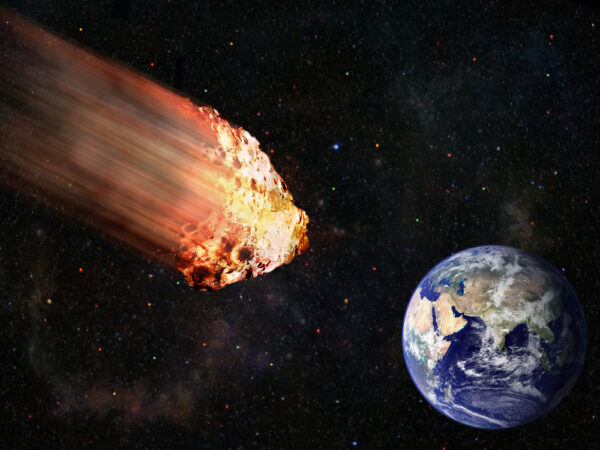
Studying the boulders could help scientists reconstruct how the collision unfolded. Their sizes, positions and movements may provide clues about how much material was ejected and how the asteroid’s surface responded to the spacecraft. Researchers can also use those observations to improve their understanding of the forces involved.
The discovery builds on earlier observations of debris released after DART struck Dimorphos. In 2023, images from the Hubble Space Telescope revealed 37 boulders that appeared to have been knocked away from the asteroid. Those observations gave researchers an early indication of how much material the collision had disturbed.
Hera’s latest images provide a much broader view of the surrounding environment. Scientists still need to establish the origin and history of the hundreds of boulders now being observed. Determining whether they were all produced by the collision, or whether some were already present, will help researchers understand how the asteroid system developed.
The debris is not just scientifically interesting. It also creates a more complicated environment for Hera as the spacecraft moves closer to the asteroid pair. The mission team must account for the surrounding material while planning its observations and manoeuvres.
For planetary defence researchers, the boulders are another reminder that an asteroid impact does not necessarily produce one simple result. A spacecraft can change an asteroid’s orbit, alter its shape, disturb its rotation and send material into the surrounding space. Understanding all those effects is important before attempting to use the same approach in a real emergency.
Why the Discovery Could Help Protect Earth

Asteroids have struck Earth throughout the planet’s history, with some impacts producing devastating consequences. Around 66 million years ago, a major asteroid collision contributed to the extinction of the non-avian dinosaurs. A sufficiently large object hitting Earth today could cause catastrophic environmental damage, while a smaller asteroid could still devastate a city or surrounding region.
Scientists have identified many of the largest potentially hazardous asteroids, and current observations have not found a known large object on a collision course with Earth. However, smaller objects can be more difficult to detect and track. That makes it important to develop ways of responding if an asteroid is discovered heading towards our planet.
DART demonstrated that a spacecraft can change an asteroid’s movement. Hera is now helping researchers understand why the experiment worked and what happened to the object that was struck. Together, the missions provide a more complete picture of what a real asteroid-deflection attempt might involve.
Ian Carnelli, Hera mission manager, highlighted the importance of the achievement in an ESA statement. “Sixty-six million years ago, an asteroid impact changed the course of life on Earth. Today, for the first time in history, humanity is validating how to prevent such an event from happening again,” he said.
The statement captures the ambition behind the missions, but the experiment does not mean every future asteroid threat could be stopped in the same way. The result would depend on factors such as the object’s size, composition, structure, speed and how much warning time humanity had before a potential impact.
A rubble-pile asteroid could react differently from a more solid object, and the amount of momentum transferred during a collision would need to be calculated carefully. Hera’s measurements will help scientists understand those differences, making future deflection plans more reliable. The mission is therefore not simply checking whether DART succeeded, but helping establish how its success might be repeated under different circumstances.
Hera’s Next Moves Could Reveal What Lies Beneath the Surface

The images released in November are only the beginning of Hera’s investigation. The spacecraft is expected to move closer to the asteroid pair in December 2026, giving its instruments an opportunity to capture more detailed observations of the damaged surface and surrounding environment.
In January 2027, Hera is scheduled to deploy two small CubeSats called Juventas and Milani. These compact spacecraft will extend the mission’s scientific reach by investigating different aspects of the asteroid system.
Juventas is designed to use radar measurements to examine the internal structure of the asteroid. Milani will study the external environment and material surrounding the pair. Their observations will complement the measurements taken by Hera, helping scientists understand both the surface and the interior of these unusual objects.
One of the mission’s major objectives is to determine Dimorphos’s mass and learn more about its internal structure. That information will help researchers calculate how efficiently DART transferred momentum to the asteroid. It could also improve estimates of how a future spacecraft should be designed if another asteroid needs to be redirected.
The mission is expected to study the system over several months, building on the first images with increasingly detailed measurements. The results should help researchers distinguish between what happened during the original collision and the longer-term changes that followed it.
Humanity Has Changed an Asteroid’s Path, But the Investigation Is Not Over
NASA’s DART mission achieved something humanity had never deliberately attempted before: changing the orbit of an asteroid through a direct spacecraft impact. The reduction in Dimorphos’s orbital period showed that the technique could work, while Hera’s first images have revealed just how dramatically the collision affected its target.
The stadium-sized crater, chaotic tumbling and hundreds of surrounding boulders show that there is much more to asteroid deflection than simply hitting a space rock and measuring where it goes. Scientists now have a rare chance to examine the physical consequences of that experiment, and the information could shape how future planetary defence missions are planned.
The most important result may not be the enormous scar left on Dimorphos. It is the knowledge that could help humanity recognise a future threat and respond before an asteroid ever reaches Earth’s atmosphere.