
Your cart is currently empty!
For the First Time in Human History, We Can Witness a Sunset on Another World
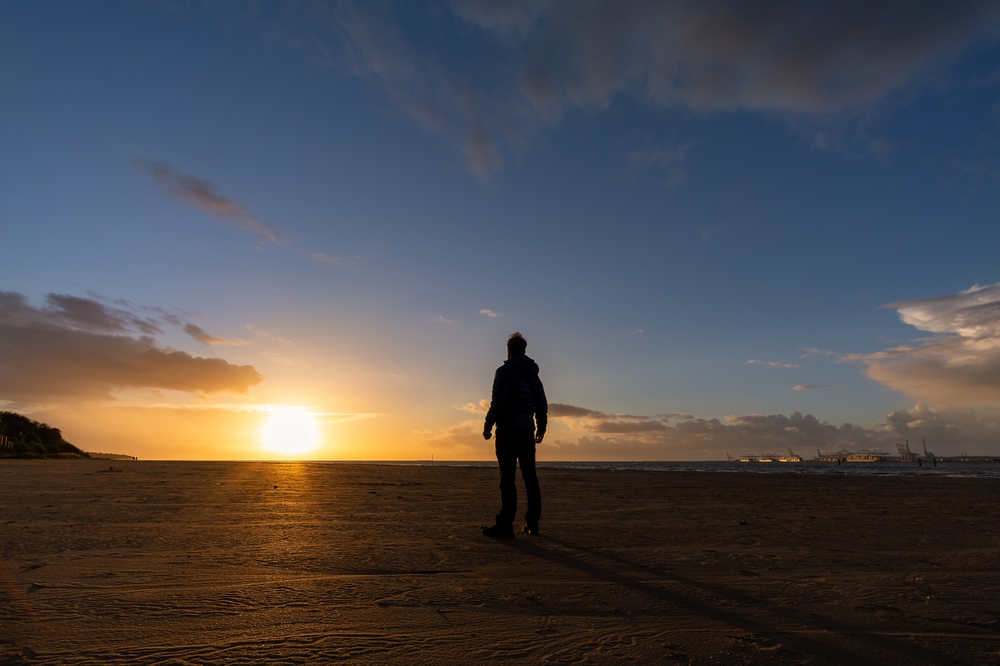
For thousands of generations, humans looked up at Mars as a distant red light in the sky, a mystery shaped by myth, science, and imagination. Today, people can see something no ancient observer ever could: a real sunset on another world.
Contents
show
Captured by NASA’s rover missions from the surface of Mars, the image is not artwork or science fiction. It is a documented glimpse of evening falling across a cold, dusty planet millions of miles away, and it turns one of Earth’s most familiar sights into a reminder of how far human curiosity has reached.
A Real Martian Sunset, Captured by NASA
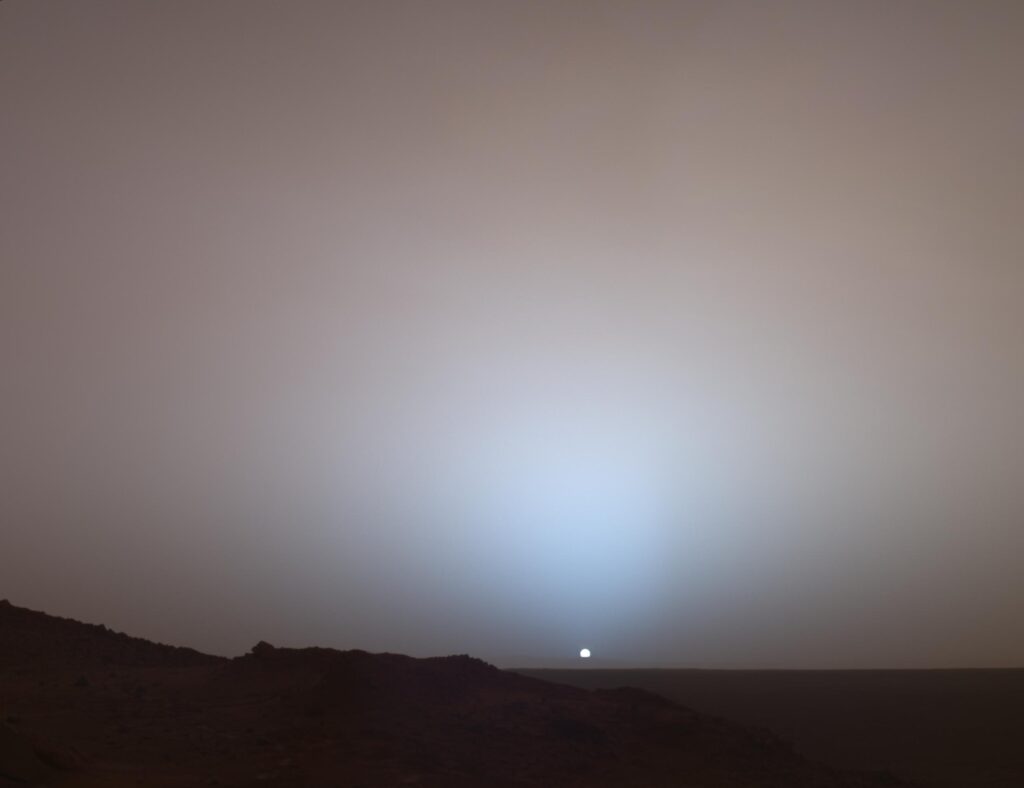
The image is real, and its backstory is just as striking as the photo itself. On May 19, 2005, NASA’s Mars Exploration Rover Spirit photographed the Sun sinking below the rim of Gusev Crater on Mars. The panorama was taken around 6:07 p.m. on the rover’s 489th Martian day, or sol, offering people on Earth a view of an ordinary daily event unfolding on an entirely different world.
There is one important detail worth clarifying. The NASA image often shared online comes from Spirit’s 2005 view of a Martian sunset, while the Smithsonian reference highlights Curiosity’s first color images of a sunset in Gale Crater, captured years later. Curiosity’s sequence showed the Sun dropping below the horizon over nearly seven minutes, giving researchers another look at how light behaves in the Martian atmosphere.
That distinction matters because the power of the image does not depend on exaggeration. It does not need to be presented as science fiction, speculation, or digital art. It is a documented NASA observation from the surface of Mars. A rover built by human hands, operating millions of miles away, paused long enough to record a scene that feels deeply familiar: a bright Sun lowering into the horizon at the end of a day. The difference is that this day did not end on Earth. It ended on Mars.
Why Sunsets on Mars Look Blue
On Earth, sunsets often glow in shades of orange, red, and gold because the atmosphere scatters shorter blue wavelengths away from the direct line of sight, leaving warmer colors to dominate near the horizon. Mars offers a different visual story. Although the planet is famously called the Red Planet, its sunsets can appear bluish near the Sun because fine dust particles in the thin Martian atmosphere interact with sunlight in a way that allows more blue wavelengths to pass through. Smithsonian Magazine notes that Curiosity’s Mastcam is not perfectly identical to human vision, but the blue cast still reflects a real atmospheric effect rather than an artistic filter.
That color shift is more than a beautiful curiosity. NASA has explained that sunset and twilight images are occasionally taken by rover science teams to study how far Martian dust reaches into the atmosphere and to look for dust or ice clouds. On Mars, twilight can also linger far longer than it does on Earth, remaining faintly visible for up to two hours before sunrise or after sunset because high-altitude dust scatters sunlight around the planet’s night side.
In other words, the image is not simply a postcard from another planet. It is a scientific measurement wrapped in a deeply human moment. The same dust that gives Mars its rusty landscape also shapes the strange blue quiet of its evening sky.
Robotic Missions Brought Mars Within Reach
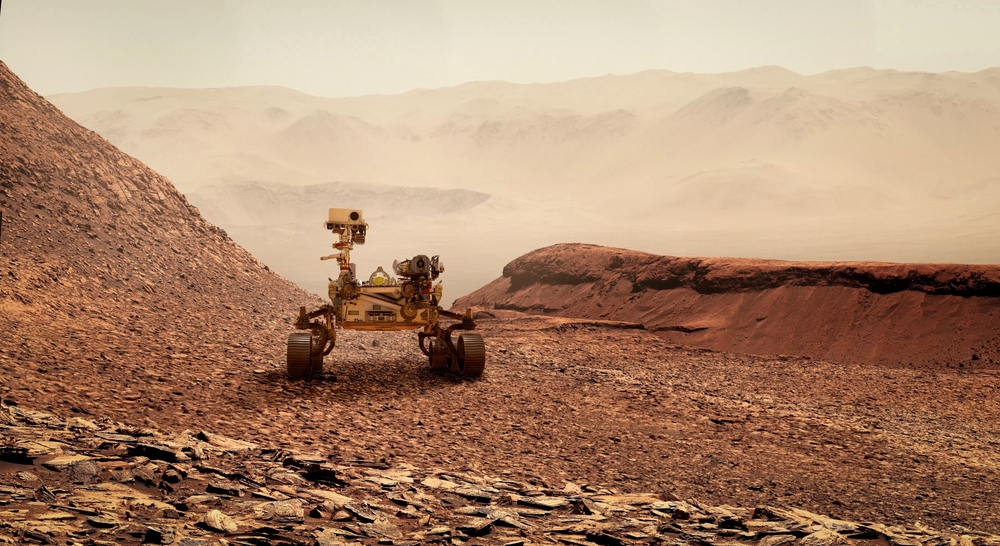
For most of human history, Mars was a distant point of light, visible from Earth but unreachable in any direct, physical sense. The sunset image changed that distance in a quiet but powerful way. It did not show a dramatic landing, a dust storm, or a rocky landscape under harsh sunlight. It showed evening arriving. That simple detail made Mars feel less like an abstract planet in a textbook and more like an actual place with weather, horizons, shadows, and passing days.
NASA’s Spirit rover captured its sunset view from inside Gusev Crater, using its Panoramic Camera to assemble a mosaic as the Sun dipped below the crater rim. Years later, Curiosity added another layer to that story from Gale Crater, where it photographed a Martian sunset in color across a sequence lasting nearly seven minutes. Together, these images show how robotic missions have expanded human experience without requiring a person to stand there in a spacesuit. A machine becomes the witness, but the view belongs to everyone.
That is why the image resonates beyond science circles. It compresses centuries of curiosity into one familiar scene. Anyone who has watched the Sun disappear behind a mountain, ocean, building, or field can recognize the emotional shape of the moment. The horizon is alien, the atmosphere is different, and the colors are unexpected, but the rhythm is familiar. A day ends, even on Mars.
What Generations Could Only Imagine
Part of the image’s power comes from the timing of human history. Countless generations looked up at Mars as a red point in the night sky without any way to see its surface, its horizon, or the way daylight fades there. Ancient astronomers tracked its movement. Writers imagined civilizations on it. Scientists debated whether its markings might hint at water, weather, or life. Yet only in the modern space age did Mars become visible as a place with its own daily rhythms.
That makes the sunset image more than a technical achievement. It represents a rare overlap between ordinary human experience and extraordinary exploration. A sunset is one of the most familiar sights on Earth, yet this one happened under a thin carbon dioxide atmosphere, above a cold desert landscape, on a planet no human being has ever walked on. The scene feels intimate because it resembles something people know, but it is also profoundly distant because it belongs to another world.
In that sense, the photo invites a quieter kind of awe. It reminds readers that scientific progress is not only measured in data, missions, and engineering milestones. Sometimes it is measured in the ability to witness something simple that no previous era could see: evening falling on Mars.
A Reminder of What Human Curiosity Can Reach
The Martian sunset is powerful because it is both ordinary and impossible. It shows the end of a day, something people understand instinctively, but it happened on a world no human has ever touched. That contrast is what makes the image endure. It turns Mars from a distant red dot into a real place with light, atmosphere, dust, weather, and evening.
It also reminds us why exploration matters. Missions like Spirit and Curiosity do more than collect data. They expand the human sense of where wonder can exist. In one quiet image, a rover on another planet gave Earth a new horizon to look at and a reason to keep asking what else is waiting beyond our own sky.