
Your cart is currently empty!
Scientists Created a Strange Device That Makes Sound Seem to Vanish Into Thin Air
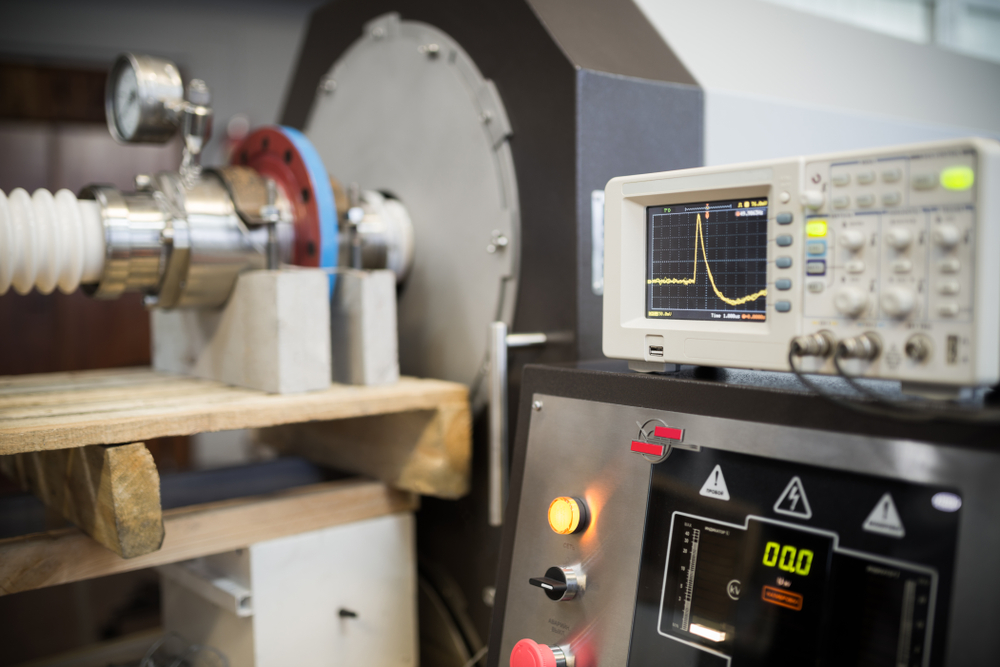
Physicists have developed a device inspired by black holes that can dramatically reduce sound reflections, potentially changing how engineers tackle unwanted noise in pipes and ventilation systems. The technology uses a structure known as a sonic black hole, which slows sound waves and absorbs much of their energy before it can bounce back as an echo. A working prototype has already been tested in a laboratory, and its unusual design could make the technology easier to install in existing systems without rebuilding the entire pipe.
Contents
show
The concept sounds like something pulled straight from science fiction, but the mechanism relies on the behaviour of sound waves rather than the extreme gravity associated with black holes in space. Researchers created a compact structure made from 29 rings mounted along a central rod, using 3D printing to produce a device that can be inserted into a pipe. Their experiments broadly matched computer simulations, while suggesting that the new configuration could reduce reflections across a wider range of sound frequencies than conventional designs.
Scientists Have Developed a New Way to Reduce Echoes
Sound travels through enclosed spaces and reflects whenever it encounters surfaces, obstructions or changes in shape. This behaviour can create problems in ventilation ducts, air conditioning systems, industrial exhaust pipes and plumbing networks, where sound waves may bounce around and produce unwanted noise. Engineers have developed different ways to control these reflections, but conventional sonic black holes have faced practical limitations that make them difficult to install in existing infrastructure.
The new device was developed by acoustics engineer Oriol Guasch and colleagues at La Salle, Universitat Ramon Llull in Spain. Their approach focuses on controlling how sound moves through a pipe, gradually slowing the waves and concentrating their energy towards the end of the structure. Under ideal conditions, the arrangement can prevent much of the sound from returning to its source, making the pipe behave acoustically as though it continues far beyond its actual endpoint.
Guasch explained the effect through the example of someone shouting into a duct that is closed at the far end. Normally, the sound travels down the duct before reflecting off the termination and returning as an echo. With a sonic black hole installed at the end, the reflected sound can be dramatically reduced, creating a very different acoustic experience.
The researchers’ design offers a practical alternative to structures that must be manufactured as part of the pipe itself. Because the new component can be produced separately and inserted when needed, it could eventually make acoustic control easier to introduce into systems that are already operating. The prototype has demonstrated the principle in a laboratory, although further testing is needed before its performance in everyday industrial conditions can be established.
How a Sonic Black Hole Traps Sound Waves
Black holes in space are known for their ability to prevent light from escaping beyond a boundary called the event horizon. A sonic black hole borrows this concept in a different physical setting, using carefully arranged structures to alter the movement of sound waves. It does not reproduce the immense gravitational forces of an astrophysical black hole, but it creates a similar effect in which waves approach a limiting point without readily returning.
Sound Gradually Slows Inside the Structure

Conventional sonic black holes use a sequence of rings and cavities built into a pipe’s inner walls. The dimensions of these features change progressively along the pipe, altering how sound travels as it moves deeper into the structure. The wave slows down and its wavelength becomes shorter, causing its energy to become increasingly concentrated near the far end.
This behaviour resembles an idea associated with the ancient Greek philosopher Zeno and his famous dichotomy paradox. In the paradox, a traveller must cover half the remaining distance to a destination, then half of what remains, continuing through ever-smaller distances without seemingly reaching the endpoint. A sonic black hole produces a physical slowing effect under specific conditions, although the analogy does not mean that sound literally travels forever.
The Energy Is Dissipated Rather Than Simply Destroyed
As sound energy becomes concentrated, friction and heat exchange between the air and the device’s surfaces dissipate much of it. This leaves less energy available to travel back through the pipe as a reflected sound wave. The device therefore reduces echoes through a combination of wave slowing and energy dissipation.
Guasch described the ideal behaviour by explaining that the wave appears to take an infinite amount of time to reach the limiting point from an external observer’s perspective. In practice, however, a real device has physical limitations, and the researchers did not demonstrate complete elimination of reflected sound. Their findings show that the structure can reduce reflections, while further work is needed to determine how well it performs across different environments.

The New Device Resembles a Tiny Sonic Christmas Tree
Traditional sonic black holes usually require rings and cavities to be integrated directly into a pipe’s walls. This makes installation more complicated because the acoustic structure often needs to be included during manufacturing. Retrofitting the technology into existing ventilation or industrial systems can therefore require additional engineering work, limiting its immediate practicality.
The researchers addressed this problem by turning the conventional design inside out. Instead of building the rings into the pipe walls, they mounted them along a central rod, creating a compact structure that resembles a small Christmas tree. The rings have gradually changing diameters, while the spaces between them form cavities that influence how sound waves behave as they pass through the device.

A Removable Component Could Simplify Installation
The central rod allows the entire structure to be manufactured independently before being inserted into a pipe. This modular arrangement could give engineers more flexibility when adding noise-control components to existing infrastructure. It may also make the technology easier to manufacture and adapt for different applications, although the suitability of each installation would still need to be tested.
The design also appears to offer an acoustic advantage. Computer simulations comparing the new configuration with a conventional sonic black hole suggested that the plug-in structure could reflect less sound across a broader range of frequencies. That wider operating range could be useful in systems where noise changes in pitch, although the result currently rests on the researchers’ simulations rather than proof of equivalent performance in every real-world setting.
Researchers Tested a 3D-Printed Prototype
To test the concept physically, the team created a 3D-printed device measuring approximately 15 centimetres in length. It contained 29 rings mounted along a central rod and was inserted into an impedance tube, a laboratory instrument used to measure how sound waves behave when they encounter a material or structure. This arrangement allowed the researchers to investigate how much sound was reflected by the device under controlled conditions.
The team used a speaker to send sound waves through the tube at different frequencies, while microphones measured the amount that bounced back. The setup provided a way to compare the prototype’s actual acoustic behaviour with the predictions produced by computer simulations. Rather than relying on an unusual demonstration, the experiment focused on measurable changes in sound reflection.
The results broadly matched the team’s simulations, supporting the idea that the plug-in structure could work as intended. However, the device did not eliminate every reflected wave, and its laboratory performance should not be confused with a fully developed commercial noise-control product. The findings establish that the concept has practical potential, while leaving questions about long-term performance and installation conditions unanswered.
The researchers also compared the new geometry with a conventional sonic black hole through computer simulations. These suggested that the plug-in design could operate across a wider frequency range because of differences in the resonances created by the cavities between its rings. The results provide a reason to investigate the design further, particularly for applications where conventional structures have limited effectiveness.
Where the Sound-Absorbing Technology Could Be Used
The most immediate potential application is noise control in pipes, ventilation ducts and silencers. These systems often carry sound over considerable distances, and reflections can contribute to unwanted noise in buildings and industrial environments. A removable acoustic device could provide engineers with another way to address the problem without redesigning an entire pipe network.
Potential uses include:
- Ventilation systems: Reducing sound reflections inside ducts could help manage noise travelling through buildings.
- Air conditioning equipment: Engineers could explore whether the device improves acoustic performance in existing ductwork.
- Industrial exhaust pipes: The structure may offer another approach to reducing reflected noise in industrial installations.
- Plumbing networks: Further testing could establish whether the design is useful in pipe systems where sound reflections create problems.
- Acoustic research: The technology provides a way to investigate how engineered structures control waves across different frequencies.
These applications remain possibilities rather than confirmed commercial uses. The research has not established that the prototype is ready for widespread deployment, and different systems could produce very different results. Even so, the ability to manufacture the device separately gives engineers a practical reason to continue investigating it.
Several Obstacles Still Stand in the Way
The small cavities between the rings are central to the device’s operation, but they could also create maintenance challenges. Dust and other particles may accumulate in the spaces, potentially obstructing the structure or changing how sound travels through it. A device intended for long-term use in ventilation or industrial systems would need to retain its acoustic performance despite exposure to ordinary operating conditions.
Temperature, pressure and flowing air could also influence how the design behaves outside the laboratory. Engineers would need to test these factors to understand whether the device remains effective under different loads and environmental conditions. The prototype’s encouraging results do not yet answer those questions, and additional testing would be required before its reliability could be established.
The researchers are also investigating whether sonic black holes could be developed in two and three dimensions, potentially extending the technology into room acoustics. Such work could move the concept beyond pipes and ducts, although the performance of these possible designs remains to be determined. For now, the plug-in prototype represents a first step towards making a specialised acoustic effect easier to manufacture and use.
A Black Hole Idea Could Help Solve an Everyday Noise Problem
The research brings together physics, mathematics and engineering to control a familiar phenomenon in an unusual way. By slowing sound waves and dissipating their energy, the team has shown how a structure inspired by black holes can be adapted to a practical problem without relying on gravity or anything resembling a cosmic event horizon.
Guasch has described the physics and mathematics behind the work as especially interesting because they connect areas of knowledge that might initially appear unrelated. He also noted that the level of control now possible over waves would have seemed almost like science fiction several years ago. The next stage is to establish how the technology performs when exposed to the dust, pressure, temperature changes and airflow found in working systems.
If those challenges can be addressed, engineers could eventually gain a removable tool for reducing unwanted noise in existing pipes and ventilation networks. The prototype has not made sound disappear completely, but it has demonstrated a way to stop much of it from coming back. That could be the most useful result of all: a device inspired by some of the universe’s strangest objects, designed to make everyday spaces quieter.
Sources:
- Deng, J., Li, J., Gao, N., Zhang, Z., Li, Y., & Guasch, O. (2025). A plug-in sonic black hole for duct terminations. Applied Acoustics, 243, 111119. https://doi.org/10.1016/j.apacoust.2025.111119
- Deng, J., Li, J., & Guasch, O. (2026). Sonic black holes without rainbow trapping: Separating two distinct mechanisms. Journal of Sound and Vibration, 640, 119889. https://doi.org/10.1016/j.jsv.2026.119889