
Your cart is currently empty!
Scientists Find a Surprising Smile Hidden Inside a Blade of Grass

Every so often, nature finds a gentle way to capture our attention. A curious observer once placed a single blade of grass beneath a microscope and found something that made the world pause. Inside its thin green surface appeared tiny shapes that resembled smiling faces, sparking conversations across social media and beyond. The discovery, often referred to as “smiling grass,” quickly became a reminder that even familiar landscapes still have secrets waiting to be seen.
Contents
show
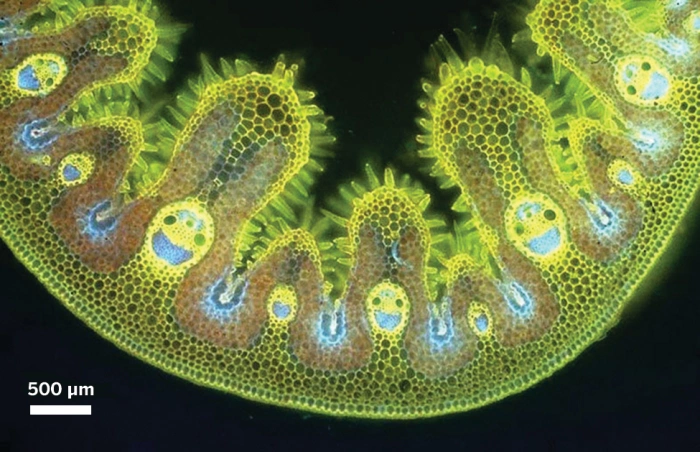
What began as a simple scientific observation soon grew into a celebration of curiosity itself. The image did not prove that grass can smile, but it did show how easily wonder can bloom when we take time to look more closely. Perhaps the real story was never about the grass at all, but about our ability to find joy and meaning in the quiet details of the world around us.
Inside the Architecture of Life
What looks like a smile beneath a microscope is not the work of imagination, but a glimpse into the quiet order that governs every living plant. A closer look at a simple blade of grass reveals a network so precise it could rival the structure of a city. Beneath its smooth surface lies an intricate system of pathways that keep the plant alive, moving water, minerals, and nutrients with quiet efficiency.
According to Foldscope’s official blog, the illusion of faces comes from the plant’s vascular bundles, the biological framework that carries essential resources throughout its tissue. Each bundle contains two main components: the xylem, which transports water and minerals upward from the roots, and the phloem, which distributes sugars created through photosynthesis to nourish the entire blade. When observed through a microscope, these structures appear as circular and elongated shapes that happen to align in a way that resembles facial features. What our minds interpret as eyes and smiles is, in truth, the geometry of life itself.
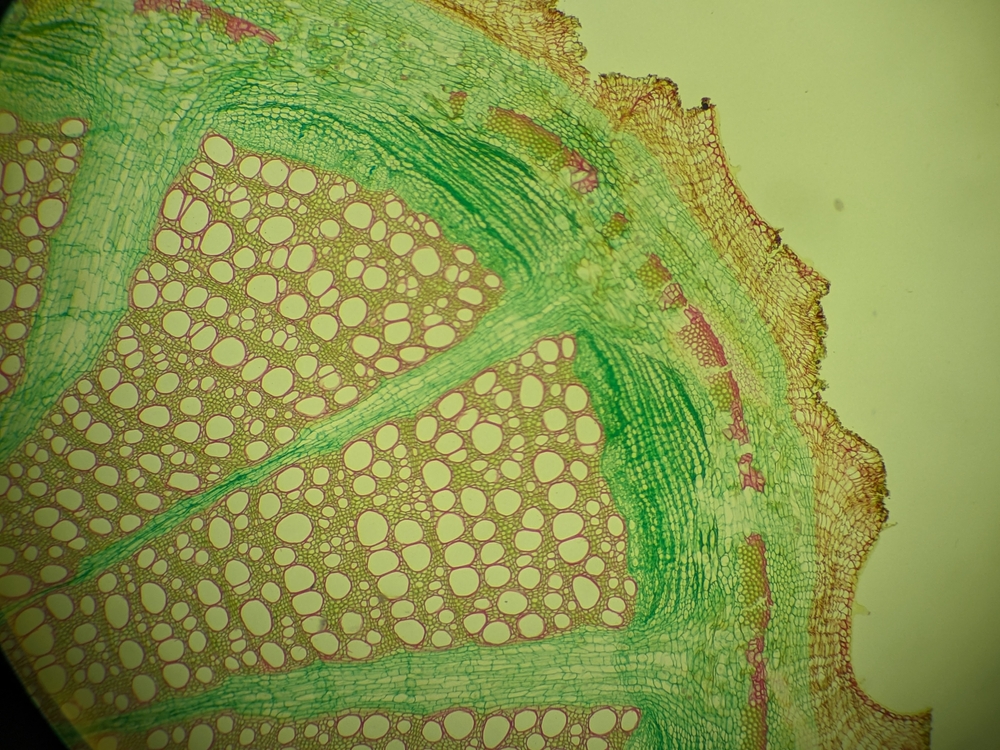
The design within each blade of grass shows how evolution blends strength and flexibility with quiet brilliance. It bends in the wind, stands again after rain, and continues the endless cycle of absorbing sunlight and feeding the world below it. The structure represents not an imitation of emotion but a demonstration of nature’s own mastery. The beauty lies not in what the grass seems to mimic, but in how perfectly it performs the work of being alive.
How Curiosity Brings the Invisible to Light
Studying a blade of grass demands more than tools. It demands attention. The so-called “smiling grass” phenomenon is a reminder that discovery often depends on the patience to see what others overlook. Beneath every clear image captured through a microscope is a process that combines scientific method with a sense of care. Each observation begins long before the lens focuses. It starts with curiosity and a willingness to slow down enough to notice.
According to Foldscope’s official blog, creating a viewable grass sample is a precise task. The blade must be sliced so finely that light can pass through its tissue. The section is then placed on a slide with a drop of clear adhesive to keep it upright, covered gently with glass, and left to dry. Even the slightest shift in light or angle can change the image completely. This delicate balance of technique and patience is what turns a simple experiment into an act of discovery.
The device used for this process, the Foldscope, is a paper microscope developed by Manu Prakash and his research team at Stanford University. Compact, durable, and affordable, it can fit in the palm of a hand yet produce magnified images that reveal the intricate systems within plants. Studies, including the Cleveland State University optical performance review, have confirmed that despite its low cost, its clarity and functionality compare impressively to standard laboratory microscopes.

When light moves through the prepared sample, it reveals the xylem and phloem, the vessels that carry water, minerals, and nutrients throughout the plant. Their circular arrangement creates patterns that resemble familiar human features, which is how the illusion of smiling grass begins. Yet, the real beauty lies not in the illusion itself, but in the precision of life that it exposes. The microscope does not change what exists; it simply brings the invisible into focus.
Through platforms like Microcosmos, Foldscope users share their discoveries from across the world, adding to a collective appreciation of science as an everyday experience. Whether it happens in a classroom or a backyard, each image shared is proof that exploration does not require a laboratory. It begins with curiosity, continues with focus, and ends with the realization that there is always more to see than meets the eye.
When Curiosity Shapes Environmental Awareness
Small discoveries often spark larger conversations about how we see and care for the natural world. What began as a curious look into the structure of grass has quietly encouraged people to observe their surroundings with renewed attention. Teachers, researchers, and hobbyists using Foldscope have turned simple experiments into lessons on how interconnected life truly is. By studying a blade of grass, students learn not only about vascular tissue but also about the ecological systems that depend on it.

According to educational initiatives highlighted by Foldscope Instruments, portable microscopes have been introduced to classrooms in more than 150 countries, helping bridge the gap between technology and nature education. These tools give learners a tangible way to understand how soil health, plant structure, and water quality are connected. When young observers realize that a single leaf can contain an entire ecosystem of movement and design, environmental care becomes personal. Science becomes less of an abstract subject and more of a daily practice in awareness.
The smiling grass phenomenon represents more than a viral curiosity. It reflects a growing movement to make science accessible, empathetic, and environmentally grounded. Every magnified image shared online serves as both data and art, reminding us that sustainability starts with the act of observing. The more people learn to see, the more they begin to protect.
Technology and the Return to Seeing
In an age when most discoveries are made through powerful digital instruments, the Foldscope represents a quiet return to hands-on exploration. While advanced laboratories rely on complex imaging systems and artificial intelligence to decode the natural world, this simple paper microscope places discovery back into human hands. It encourages observation not as data collection, but as an act of direct connection.

The accessibility of the Foldscope has created a bridge between technology and sensory learning. It reminds us that while innovation can reveal distant galaxies or map genetic codes, it can also bring attention to what exists beneath our feet. The simplicity of its design invites people to rediscover the lost skill of seeing to observe without distraction, to analyze without detachment, and to approach the natural world not as a resource, but as a teacher.
This shift in perspective aligns with a broader movement in science communication that values participation over perfection. Projects supported by Foldscope Instruments and other citizen science platforms encourage individuals to document, share, and discuss their findings. In doing so, technology ceases to be only a tool for measurement and emerges as a medium for empathy. The smiling grass, once a fleeting curiosity, now stands as a symbol of what can happen when technology helps us look inward as much as outward.
Seeing the Extraordinary in the Ordinary
The story of the smiling grass is a quiet reminder that discovery does not always happen in distant places or advanced laboratories. Sometimes it begins in a backyard, with a lens, a question, and a moment of curiosity. What started as a small viral image has grown into a lesson about how much of life unfolds beyond what we can see. Each blade of grass, each droplet of water, and each cell under a microscope holds evidence of nature’s quiet precision and creativity.

Science often teaches us to measure and analyze, but it also teaches us to observe. The smiling grass shows that knowledge and wonder can exist side by side. When people take the time to look closely, they find that the natural world is not separate from them but deeply intertwined with their own existence. It reminds us that awe is not unscientific, as it is the spark that keeps inquiry alive.
In a time when attention is divided and pace overshadows patience, this small discovery asks for something simple yet profound: to notice. To look closer, not only at the world around us but also at the connections that hold it together. The smiling grass may not truly smile, yet it continues to inspire one, and perhaps that is enough proof that curiosity remains one of our most powerful forms of hope.