
Your cart is currently empty!
A Bath Toy Sent This Toddler To The Hospital And Nearly Cost Him His Vision

A routine bath turned into a medical emergency for a two-year-old boy after water from a squirting bath toy accidentally got into his eye. Within hours, the irritation had progressed into a severe infection that doctors warned could threaten his vision.
Contents
show
His mother, Eden Strong, had no idea that a toy designed to make bath time more fun could become part of such a frightening chain of events. Her warning has since resonated with hundreds of other parents who say they have seen similar problems with toys that trap water inside.
What Started As A Normal Bath Became A Medical Emergency
Strong’s son, Baylor, was two years old when the incident happened. Like many young children, he enjoyed bath time and played with toys designed to squirt water.
According to Strong, Baylor accidentally squirted water from one of the toys into his eye while he was taking a bath.
At first, there appeared to be little reason for alarm.
His eye looked irritated, something that can easily happen when a child gets bath water or a toy’s contents in their face. But over the following hours, the situation changed dramatically.
Strong said Baylor’s eye went from looking pink to becoming severely swollen and infected within roughly 12 hours.
The family initially sought medical care when the symptoms appeared to be getting worse. Instead of settling down, the swelling continued to progress.
Strong later described the moment she saw her son after he woke up as one of the most terrifying experiences of her life.

“When he woke up at 6am and I laid eyes on him in his crib, I screamed to my husband to get in the car,” Strong wrote in a Facebook post about the incident.
She said the white part of Baylor’s eye was bulging between his eyelid, while his iris had become partly obscured. He also had a high fever and was hot to the touch.
The family rushed him to a larger hospital.
Doctors were concerned enough about the severity of the infection to order a CT scan. Strong said the medical team warned that the infection could threaten Baylor’s vision if it spread toward his retina.
They also warned that an infection around the eye can become much more serious if it spreads beyond the eye area.
Baylor was treated with intravenous antibiotics while doctors monitored the infection.
For his mother, the fear was immediate and overwhelming.
“I just remember praying, ‘Please don’t take his eyes. He has such pretty eyes,” Strong said.
Fortunately, Baylor eventually recovered fully.
The experience, however, left Strong questioning a product she had considered a normal part of childhood.
The Problem With Squirting Bath Toys Is What Happens Inside
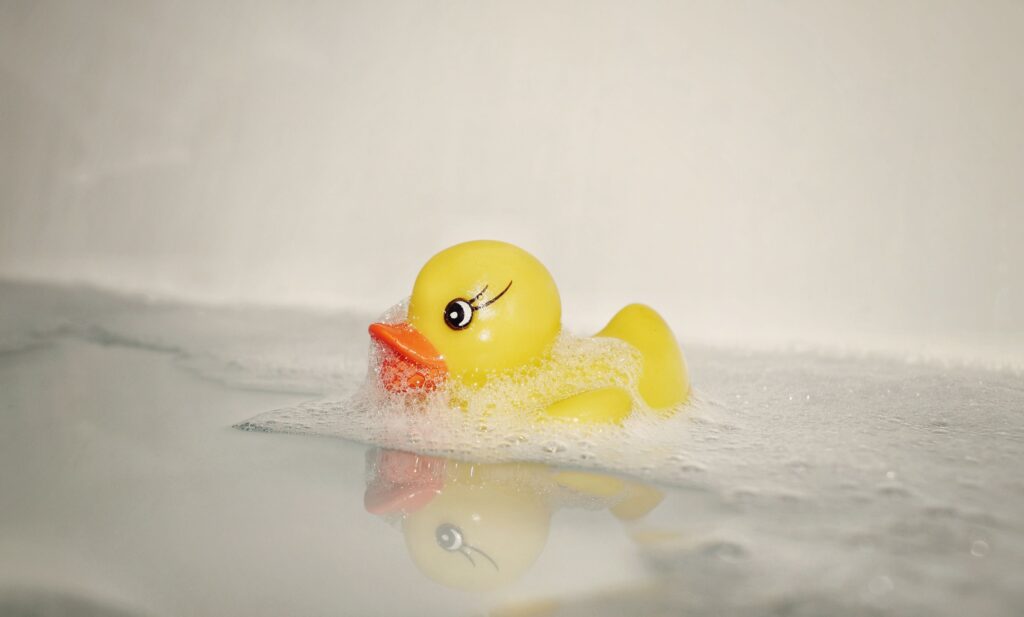
Squirting bath toys are popular because they are cheap, simple and entertaining. Children can fill them with water, squeeze them and watch the water shoot back out.
The problem is that the same design that makes them entertaining can also make them difficult to clean completely.
Water can enter through a small opening and remain inside the toy. Parents may rinse the outside, wash the surface or try to flush water through the opening, yet still have no way of knowing what is happening inside.
Strong said she regularly cleaned Baylor’s bath toys because she knew they could trap water and develop mold.
She still believed she was keeping them clean.
Then she discovered how difficult it can be to clean the inside of these toys properly.
“You cannot clean them, you just can’t,” Strong wrote.
Strong said there was no visible mold inside the toy involved in Baylor’s incident. That distinction is important because the available accounts do not establish that mold caused his infection.
Her concern was that microorganisms could be present inside a toy even when a parent cannot see them.
The original reports said Strong believed the squirting toy was responsible for the infection after the water entered Baylor’s eye. She later sent the toy to the manufacturer for inspection.
She said she did not want to identify the company because she believed it was a reputable manufacturer that had produced a problematic product.
There was also no reported recall of squirting bath toys connected to the incident. The Consumer Product Safety Commission had received consumer reports involving mold, according to the reporting provided, but the sources did not identify a recall covering these toys.
That means parents should be careful about turning one family’s experience into a claim that every squirting bath toy is dangerous.
What the story does show is a potential hygiene problem that can be difficult for parents to see.
Eye Cellulitis Can Become Serious Very Quickly

Baylor’s condition was described as cellulitis affecting the area around his eye.
Cellulitis is a bacterial infection and inflammation that can occur in different parts of the body. Around the eye, doctors distinguish between preseptal cellulitis and orbital cellulitis.
Preseptal cellulitis affects tissues in front of the structure separating the eyelid from the eye socket. Orbital cellulitis affects tissues behind and around the eye.
Both require prompt medical attention.
Why Doctors Take Eye Infections Seriously
The symptoms can include swelling, redness, warmth and pain around the eye. Fever can also occur.
Orbital cellulitis can produce more severe symptoms, including an eye that appears to bulge, difficulty moving the eye and changes in vision or color vision.
Those symptoms can look alarming because they indicate that the infection is affecting deeper tissues around the eye.
The medical reference supplied for this story states that bacteria are the most common cause of cellulitis around the eyelid or eye socket. It also notes that infections can enter the area through injuries or spread from nearby infections such as sinus infections.
Common bacteria associated with eye cellulitis include Staphylococcus aureus, Streptococcus pyogenes and Haemophilus influenzae.
The exact bacteria involved can be difficult to identify.

That is one reason Baylor’s case should not be reduced to the simple claim that “moldy bath water” caused him to nearly lose his sight. The supplied sources do not establish that mold was responsible, and they do not identify the specific bacteria involved.
What they do establish is that Baylor developed a serious infection after contaminated water from a bath toy entered his eye, according to his mother’s account.
Doctors were concerned enough to investigate the infection with imaging and treat him in the hospital.
The potential complications of severe cellulitis around the eye can include vision loss, meningitis, a brain abscess and brain damage caused by an abscess.
Those complications are uncommon enough that parents should not assume every swollen eye represents an emergency of the same severity. But they are serious enough that significant swelling, fever, pain or changes in the appearance or function of the eye should not be ignored.
The Warning Signs Parents Should Not Brush Off

One of the most striking parts of Baylor’s story was how quickly his symptoms changed.
What initially appeared to be ordinary eye irritation became something much more serious.
That is why parents need to pay attention to changes after an injury, exposure or suspected infection around a child’s eye.
According to the medical reference provided for this story, symptoms that can occur with cellulitis around the eye include:
- Swelling of the upper or lower eyelid
- Redness or warmth around the eye
- Pain in the eye area
- Fever
- A bulging or unusually swollen appearance of the eye
- Trouble moving the eye
- Changes in vision or color vision
The reference also stresses that these symptoms can resemble other medical conditions, which means parents should not attempt to diagnose cellulitis themselves.
A child with symptoms suggesting cellulitis around the eye should receive medical attention promptly.
Baylor’s case demonstrates why the appearance of the eye can be especially important. Strong described his eye as becoming so swollen that its normal appearance was dramatically altered.
That was far beyond the minor irritation she initially thought she was seeing.
Parents should also pay attention when an eye problem is accompanied by fever or when symptoms are getting worse instead of better.
Why The Toy Could Look Clean And Still Raise Concerns

The most unsettling part of Strong’s experience was that she believed she had been doing what a careful parent should do.
She knew the toys could trap water.
She cleaned them.
She had thought about the possibility of mold.
Yet none of those precautions allowed her to see what was happening inside.
That is the problem with products that contain enclosed spaces that are difficult to inspect. A toy can appear clean on the outside while water remains trapped inside.
Strong said she had no moldy toy photographs to share because she never saw visible mold in Baylor’s toy.
“You can’t see bacteria,” she wrote.
That observation became central to her warning.
The incident also generated a surprising number of responses from other parents. Strong said she received hundreds of messages and photographs from parents who believed their children had experienced similar problems involving bath toys.
She described the response as “mind-blowing” and said she was shocked by how many families contacted her.
Those reports are not proof that squirting bath toys routinely cause serious infections.
They do, however, explain why Strong began questioning whether the basic design of these toys deserves more scrutiny.
She argued that the problem could involve the broader category of water-squirting bath toys rather than one specific manufacturer.
“I’ve been shocked,” Strong said. “I have a completely full inbox with parents sending me pictures of their children who have gone through the same thing.”
Her concern was that manufacturers should consider what happens when water remains trapped inside a toy that cannot easily be opened and cleaned.
What Parents Can Do With Squirting Bath Toys

Strong eventually changed the way Baylor played in the bath.
Her recommendation was straightforward.
“I would just throw all the squeezable ones away for sure,” she said.
Parents do not have to make the same decision based solely on one family’s experience. The sources provided for this story do not establish a blanket safety warning or recall for all squirting bath toys.
But families who already have these toys can think about how they are cleaned, whether water can remain trapped inside and whether there is any practical way to inspect the interior.
For parents who would rather avoid the issue altogether, there are plenty of bath toys that do not require water to be stored inside an enclosed chamber.
The simplest precautions include:
- Choose bath toys that do not trap water inside sealed or difficult-to-clean spaces.
- Throw away toys that develop visible mold or cannot be cleaned properly.
- Pay attention to toys that retain water after bath time.
- Avoid allowing a child to deliberately squirt bath water into another child’s eyes.
- Take worsening eye swelling, fever or vision changes seriously and seek medical care promptly.
The point is not to make parents afraid of bath time.
It is to recognize that some everyday children’s products have design features that deserve more attention than they usually receive.
Baylor’s Story Changed What His Family Uses In The Bath

Baylor eventually made a full recovery and returned to playing normally.
That outcome is the part of the story every parent will want to hear.
His mother was not left dealing with permanent blindness, and the feared complications did not happen.
But she has continued to speak about the experience because she believes another family could face the same frightening situation without realizing that a bath toy might be involved.
The incident also illustrates how quickly a seemingly minor eye problem can become medically significant.
A child getting water in the eye during a bath is ordinary.
A child developing rapidly increasing swelling, fever and an infection around the eye is not.
Those two situations can initially look deceptively similar.
For Strong, the difference became painfully clear over a single night.
She went from seeing what looked like ordinary irritation to rushing her son to a hospital while fearing that he could lose his vision.
She later told “Good Morning America” that these toys were not a necessity.
“It’s not like these [rubber water squirting bath toys] are a necessity,” Strong said.
That is perhaps the most practical part of her warning.
Parents have plenty of choices when it comes to bath toys. If a particular toy cannot be emptied or properly cleaned, choosing another option is a simple way to remove one potential source of concern.
A Viral Warning With A More Complicated Medical Reality
Strong’s story spread because the image of a toddler facing possible vision loss after an ordinary bath toy is difficult to forget.
It also taps into a fear familiar to parents: something in the home that looks harmless can become dangerous under the wrong circumstances.
But the medical details matter.
The available sources do not prove that mold caused Baylor’s cellulitis. They do not identify a specific bacterium, and they do not establish that every squirting bath toy poses the same risk.
They do show that Baylor experienced a serious eye infection after water from a bath toy entered his eye, according to his mother.
They also show why the medical response was so urgent.
Cellulitis around the eye can require antibiotics, hospital treatment and, in severe cases, surgery. Doctors may use CT scans or MRI scans to determine how far an infection has spread.
For a parent, the lesson is therefore broader than simply deciding what to do with a rubber duck.
If a child develops significant swelling, redness, pain or fever around the eye, particularly when the symptoms are worsening rapidly, it deserves medical attention.
Baylor’s mother thought she was dealing with an irritated eye.
Hours later, doctors were discussing the possibility of permanent vision loss.
That gap is exactly why she decided to tell the story.
The bath toy was small. The consequences were anything but.