
Your cart is currently empty!
Wetherspoons Draws The Line On Loud Phone Calls In Pubs
If you have ever sat in a pub trying to enjoy a quiet drink while someone nearby blasts a video from their phone, Wetherspoons has some news for you.
Contents
show
The pub chain has introduced a new rule across all 792 of its pubs, asking customers to stop playing music, videos and phone calls through their device speakers. Customers are being told to put their phones on silent or use headphones instead.
The move follows complaints from customers who said amplified conversations and videos were driving them “nuts.” It also taps into a much wider argument about how much noise people should have to put up with in public spaces.
Wetherspoons Has Introduced The Rule Across Its Pubs
The new policy applies across Wetherspoons’ 792 pubs in the UK.
Customers are being asked not to take calls using speakerphone or play music and videos out loud from smartphones and tablets. Instead, the chain wants people to switch their devices to silent mode or use earphones.
Signs have been put up in pubs to make customers aware of the change.
A Wetherspoon spokesman said: “Following complaints from customers, who are being driven nuts by other people’s videos and amplified phone conversations, Wetherspoon has asked customers to switch their phones to silent or to use earphones.”
The company told the BBC that staff would use “common sense” when enforcing the policy.
That means someone who accidentally plays a video out loud is not necessarily going to be thrown out immediately. However, managers can ask customers to stop, and the company confirmed that asking someone to leave remains an option if they refuse.
The policy also applies to the chain’s Lloyds bars, including the venues where music is played in the evening.
That detail makes the decision particularly notable. Wetherspoons has long cultivated a pub atmosphere where customers are not surrounded by background music, so the company clearly sees unwanted phone audio as something that cuts against that experience.
Sir Tim Martin Has A Very Wetherspoons Way Of Explaining It
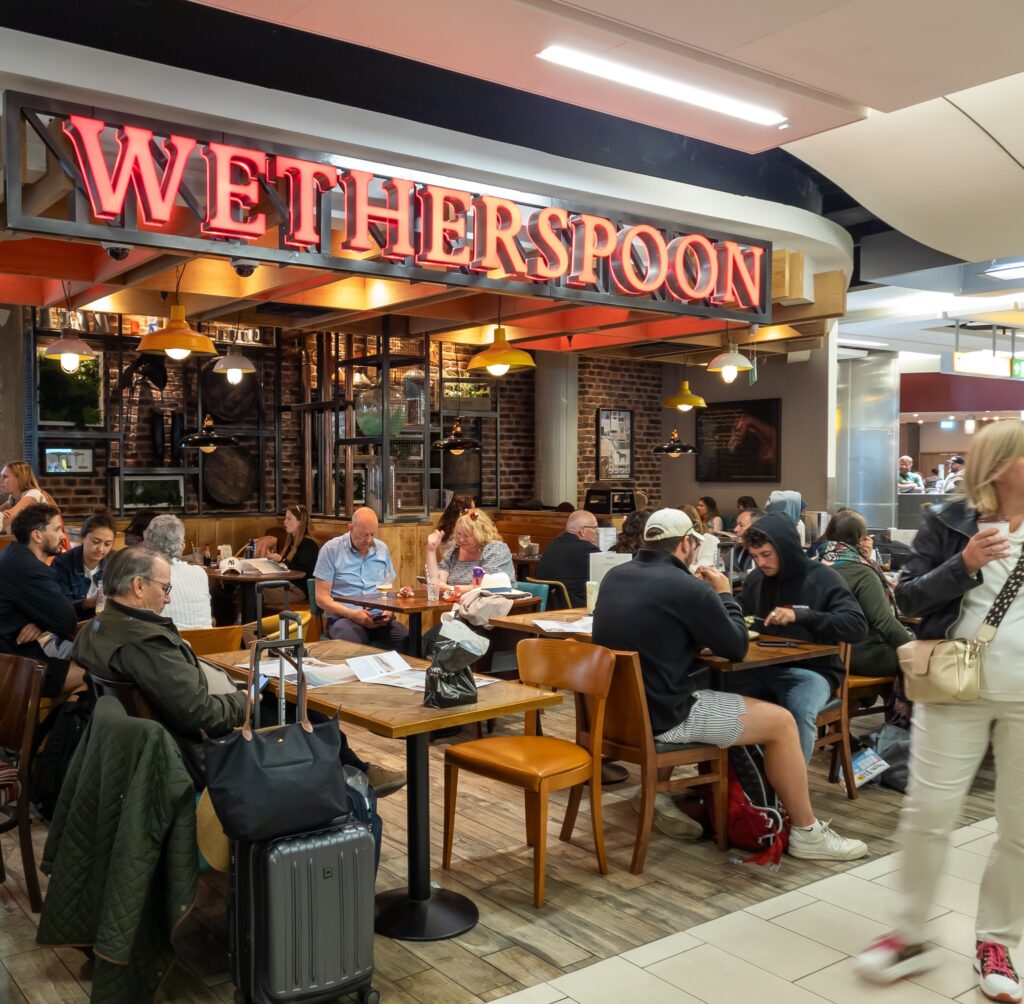
Wetherspoons founder and chairman Sir Tim Martin did not exactly describe the policy in corporate language.
Instead, he leaned into the chain’s famously dry sense of humor.
“In a world dominated by other people’s music and amplified sound, Wetherspoon pubs are an oasis of tranquillity and contemplation,” Martin said.
He then added a line that is likely to be remembered far longer than the policy itself.
“In order to avoid customers being driven chicken jalfrezi by a cacophony of sound, we are kindly asking phone users to pipe down.”
The unusual phrase refers to the Wetherspoons menu, where chicken jalfrezi is one of the food options customers may order alongside their drinks.
The underlying message, however, is straightforward.
The company believes customers should be able to have a drink without being forced to listen to somebody else’s phone conversation, TikTok video, YouTube clip or music.
That may sound like basic pub etiquette to some people. For others, it is another example of businesses placing increasingly strict limits on how customers use their phones.
The Phone Noise Problem Has Become A Bigger Public Argument

Wetherspoons is hardly operating in isolation.
The use of phones without headphones has become a recurring source of annoyance on public transport, in restaurants and in other shared spaces.
Transport for London has already tried to discourage passengers from playing music and videos aloud on its network.
A survey of 1,000 people conducted for TfL found that 70% considered loud music and phone calls without headphones to be a nuisance.
The issue has also entered political debate.
The Liberal Democrats have previously called for fines of up to £1,000 for people who play music or videos out loud on buses and trains. A YouGov poll published in 2025 found that 62% of people surveyed supported the idea, while 28% opposed it.
Support was particularly strong among older respondents. Almost three-quarters of pensioners backed the proposed fines.
Younger people were less united.
Among those aged between 18 and 24, the poll found that 47% supported the proposal while 43% opposed it.
That gap hints at something bigger than simple phone etiquette. Different generations appear to have developed very different ideas about what counts as acceptable phone behavior in public.
Younger People See Phone Speakers Differently
Research cited by the BBC suggests that attitudes toward speakerphone use can vary sharply by age.
An Ofcom survey of 1,010 people conducted in August 2022 found that 69% of 13 to 17-year-olds considered video calls without headphones acceptable.
The same survey found that 73% considered listening to music without headphones acceptable, while 83% said watching videos without headphones was acceptable.
Those numbers help explain why the argument over phone noise can feel so heated.
One person may see a phone speaker as a completely normal way to watch something. Another may regard the same behavior as basic bad manners.
Neither group necessarily sees the situation in quite the same way.
For older generations, shared public spaces have traditionally come with an expectation that personal entertainment should remain personal. Headphones make that possible.
For younger people who have grown up surrounded by smartphones, social media videos and constant digital communication, playing something through a phone speaker may feel far less unusual.
Wetherspoons has now clearly chosen which side of that argument it wants its pubs to be on.
Another Pub Chain Went Much Further
Wetherspoons’ new rule may sound strict, but another British pub chain has taken the idea much further.
Samuel Smith pubs have a longstanding policy banning customers from using phones, laptops and tablets across its estate.
The policy has been described as creating a “digital detox” environment.
Mark Evans, who manages the Black Horse Inn in Bradford, told the BBC that the absence of phones can change how people interact.
“Even strangers in for the first time, within 10 or 15 minutes, they’re joining in a conversation with other people,” Evans said.
The approach can also produce a very different kind of pub experience.
Instead of groups sitting together while looking at separate screens, customers are encouraged to talk to the people around them. The phone becomes less central to the evening.
But even that policy comes with an obvious complication.
Evans pointed out that customers are still allowed to pay using their phones.
That means modern technology cannot be completely removed from the pub experience, even in places that deliberately try to limit it.
Wetherspoons has opted for a narrower restriction. Customers can still use their phones. They just cannot make everyone else listen.
What Wetherspoons Customers Can And Cannot Do
The new approach is relatively simple, although the precise enforcement will be left partly to individual managers.
Customers can still use their devices in pubs, but they are being asked to keep audio private.
The basic expectations are:
- Take phone calls without using the speaker function.
- Use headphones or earphones when watching videos.
- Use headphones when listening to music.
- Keep devices on silent when appropriate.
- Follow staff instructions if asked to turn down or stop unwanted audio.
The chain has not suggested that ordinary phone use is being banned.
That distinction matters.
Someone checking messages, browsing social media or making a normal call with the phone held to their ear is not the target of the new policy. The focus is specifically on amplified sound that can be heard by other customers.
That makes the rule closer to a traditional noise policy than a general attack on phones.
Wetherspoons Has Been Moving Away From The Noisy Pub Image

There is another reason the new rule fits the Wetherspoons model.
The chain has traditionally avoided playing music in most of its pubs.
Sir Tim Martin has previously described the pubs as places offering an alternative to venues filled with background music and amplified sound.
The company operates 792 pubs today, although that number is significantly lower than its peak of 955 in late 2015.
Wetherspoons has also faced financial pressure in recent years, including higher costs for food, labour, repairs, energy and business rates.
The company’s latest financial update said annual profit was expected to be lower than previously anticipated because of those rising costs.
The phone policy is not presented as a financial measure, though.
According to the company, it came directly from customer complaints.
That suggests Wetherspoons believes quiet is part of what some customers are paying for when they choose one of its pubs.
There is a simple logic behind that.
A person can choose to watch a video with headphones. Everyone sitting around them cannot choose whether to hear it when the speaker is turned up.
The Real Test Will Be How Staff Enforce It

The wording of the policy leaves some room for judgment.
Wetherspoons has said staff will use common sense rather than automatically removing people who break the rule.
That could make enforcement easier.
A customer who accidentally answers a call on speaker may simply be asked to switch it off. Someone who repeatedly refuses could face stronger action.
The approach also avoids turning every phone-related incident into a confrontation.
That may be important in busy pubs, where staff already have to deal with a range of customer disputes and complaints.
The British Beer and Pub Association, which represents Wetherspoons and other pub companies, backed the idea of having a clear policy.
The organisation said: “having a clear policy helps staff enforce rules and customers know what they can and can’t do”.
There is also a practical benefit for customers.
Nobody has to guess what Wetherspoons considers acceptable anymore. The signs make the expectation clear before an argument begins.
Britain’s Phone Etiquette Debate Is Only Getting Louder
The Wetherspoons decision arrives at a time when public arguments about phone behavior are becoming increasingly common.
People are surrounded by devices capable of broadcasting almost anything instantly.
A phone can now be a television, music player, video call device, speaker, camera and entertainment system. The technology makes those activities easy, but it also means personal choices can quickly become public experiences for everyone nearby.
That is particularly obvious in places where people expect to socialize.
A pub is a shared environment. One customer’s entertainment can become another customer’s background noise.
The same tension has appeared on trains and buses, where passengers have little choice about who sits nearby.
TfL’s campaign and the proposed fines backed by the Liberal Democrats show that the argument is no longer confined to complaints between individual passengers.
It has become a question of public etiquette.
Wetherspoons has now drawn its own line.
If customers want to listen to something, they can still do it. They just need to keep the sound to themselves.
For anyone who has spent an evening listening to a stranger’s entire phone conversation from three tables away, that probably sounds like a reasonable trade.
For everyone else, the next time a phone suddenly starts blasting music across a pub, there may be a very simple answer.
Grab the headphones.
And keep the chicken jalfrezi peaceful.