
Your cart is currently empty!
When Tears Become Bullets: How a Taiwanese Artist Turned Grief into a Gun of Expression
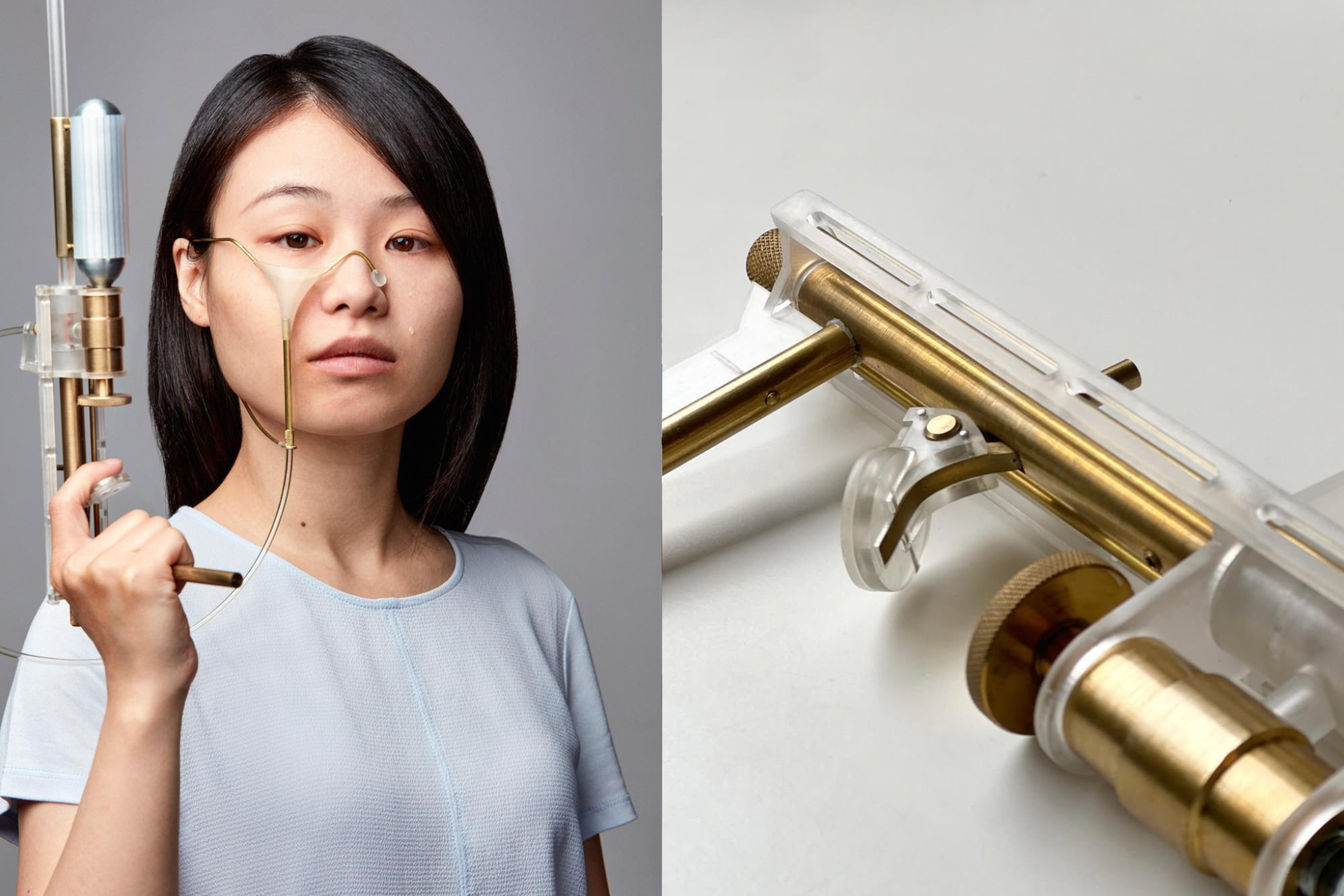
Have you ever felt the strong urge to retaliate after someone had hurt you to the point of tears? Taiwanese artist Yi-Fei Chen once did, and that very impulse inspired her to design a surreal and deeply symbolic device: the Tear Gun.
Contents
show
Originally created in 2016 as a graduation project, the device is capable of collecting, freezing, and then shooting her tears. What began as an emotional outburst became a meditation on vulnerability, control, and creative expression.
From Breakdown to Breakthrough: The Birth of the Tear Gun
In an interview with AsiaOne, Fei Chen described the incident that first set this creative process in motion. While studying at the Design Academy Eindhoven in the Netherlands, she found herself in a heated discussion with her mentor about a project. The conversation became emotionally charged, and she unexpectedly began to cry in frustration. “I felt very frustrated and angry, and I just burst into tears in front of my mentor,” she said.
Coming from Taiwan, where deference to teachers and elders is ingrained, Chen had been taught that expressing disagreement was inappropriate. This cultural context left her unable to voice her feelings openly. Instead, she experienced a conflicting mix of shame and anger that she could not articulate. As she explained, “Even though I was crying, I still felt I couldn’t just leave during the conversation.”
That moment of wanting to respond but feeling constrained became the foundation for her later work. The idea for the Tear Gun emerged not as an act of retaliation, but as a way to materialize emotion and reclaim agency. She began to imagine what it would mean to transform something as delicate as tears into a physical substance she could control. The process of conceptualizing and later engineering the device became a form of emotional processing, turning vulnerability into creativity. In reflecting on the experience, Chen has acknowledged that the project allowed her to translate inner turmoil into purposeful design. What started as an instinctive reaction evolved into a thoughtful inquiry into communication, power, and emotional authenticity.
Turning Emotion Into Mechanism
At first glance, the Tear Gun appears like something out of science fiction. But its mechanics are deceptively simple. According to Fei Chen, the device collects real tears, then freezes them within about 20 seconds using carbon dioxide from a high-pressure bottle. Once solidified into tiny ice pellets, the tears can be fired using a spring mechanism.
Fei Chen took three months to develop the first functioning prototype. What started as a conceptual piece for her graduation quickly became a statement about the nature of emotional suppression and release. “He was quite happy with the result even though it was something [created] against him,” Fei Chen told AsiaOne, referring to her teacher’s reaction.
The mentor who inspired the project even participated in a live demonstration, wearing protective gear as Fei Chen symbolically “shot” her frozen tears at him in front of a classroom audience. It was a moment equal parts catharsis and performance art, revealing the paradox of emotional confrontation and connection.
From Classroom Project to International Exhibit
The Tear Gun quickly captured the imagination of the global design community. It was showcased at several international exhibitions, including Dutch Design Week 2016, 100 Years of Dutch Design at the Taiwan Design Museum, and later at the Temporary Art Centre Eindhoven in 2017.
Fei Chen, who studied at the Design Academy Eindhoven, continued to refine the piece over the years. During the pandemic, she developed a third version of the Tear Gun, larger, more intricate, and equipped with two carbon dioxide bottles for greater functionality.
Though the piece could be mistaken for an eccentric weapon, Fei Chen has been clear that it was never about revenge. In an Instagram Reel posted on October 9, she clarified: “The tears are kind of a metaphor of yourself. You find a different angle, a different method to make yourself stronger or powerful. But in a way that keeps you who you are.”
Her statement reframed the project from confrontation to contemplation, a symbol of inner transformation rather than retaliation.
Viral Revival: Social Media Discovers the Tear Gun
Although it was created nearly a decade ago, the Tear Gun recently resurfaced online, gaining viral traction after being shared by the Facebook page Enigma Elysium in early November. The post garnered over 31,000 likes and 2,700 comments, reflecting the internet’s fascination with both its poetic and bizarre nature.
Reactions have been mixed. Some praised the ingenuity and symbolism, calling it a “beautiful metaphor for emotional resilience,” while others questioned its practicality or ethical implications. Yet even among skeptics, the artwork sparked genuine dialogue about emotional repression, especially in cultures that discourage open expression.
The renewed attention demonstrates how art that stems from authentic emotion often finds timeless relevance, especially in a digital era where personal expression is constantly scrutinized, filtered, or commodified.
Beyond the Tear Gun: Art as Self-Defense and Expression
While the Tear Gun remains her most recognized creation, Fei Chen’s artistic journey continued to evolve through works that explore emotion as both a shield and a form of communication. One of her subsequent projects, Excuse Me, extends this exploration into social dynamics and personal boundaries. As described by Dutch Design Week, the chair-like installation functions as what she calls a “social escape tool.” The user interacts with an inflated balloon attached to the seat that must be periodically replenished with water. If neglected, the balloon bursts, scattering thousands of Styrofoam balls across the surrounding space. The work examines the quiet tension between the desire for connection and the instinct to withdraw, illustrating how avoidance and care can manifest physically.
Fei Chen’s intention with Excuse Me was not simply to design a spectacle, but to reflect how people navigate social expectations and discomfort. In her own words, “I make things that help me understand myself,” she told Dutch Design Week, emphasizing that her art often begins as personal introspection but evolves into shared emotional experiences. “But I think everyone can see a part of themselves in these emotions.”
This capacity to translate deeply private emotions into collective meaning defines Fei Chen’s artistic philosophy. Her work moves beyond conventional design and enters the realm of emotional engineering, where psychological states are converted into interactive experiences. Unlike the Tear Gun, which dealt with confrontation and empowerment, Excuse Me investigates self-preservation and the need for space in overstimulating environments. The two projects together form a continuum of emotional exploration: one transforming pain into strength, the other transforming anxiety into self-awareness.
Fei Chen’s broader body of work highlights a growing recognition within contemporary design circles that emotional expression can be a legitimate creative material. By integrating personal vulnerability with tactile innovation, she challenges the idea that emotional responses must remain hidden or managed. Instead, she demonstrates that they can be studied, sculpted, and even displayed as an integral part of human-centered design. Through these works, Chen positions art not merely as decoration or commentary, but as an evolving method of self-defense, healing, and honest communication between artist and audience.
Turning Vulnerability Into Power
Fei Chen’s story demonstrates how a deeply personal moment can become a force for innovation when shaped through creativity. The Tear Gun, conceived from frustration and restraint, speaks to emotional resilience and the courage to express oneself within the limits of tradition. What began as an inner struggle evolved into an act of reclaiming control through art. For Chen, design became a language that allowed her to communicate what could not be said directly.
Her experience shows that vulnerability can be a source of strength rather than something to conceal. The transformation of tears into art symbolizes the ability to reimagine pain as empowerment. As she said in her AsiaOne interview, her project was never about revenge but about “finding a different method to make yourself stronger or powerful.” The Tear Gun thus becomes a reflection of the creative process itself, turning raw emotion into insight and expression.
Chen’s approach also highlights the balance between emotion and intellect in design. In societies where composure is prized, her work reminds us that sincerity and openness can coexist with precision and thoughtfulness. The Tear Gun is more than an art piece; it is a statement about the value of feeling deeply and thinking critically at the same time.
Her journey aligns with the growing appreciation for emotional authenticity within contemporary art and design. The concept of affective design, which merges empathy and creativity, reinforces this shift toward valuing emotion as an essential tool for innovation. Artists like Chen demonstrate that emotional intelligence is integral to understanding human experience and translating it into meaningful work.

Ultimately, Fei Chen’s work captures the unity of intellect, feeling, and imagination. The Tear Gun may not exist as a mass-produced object, yet its message endures: even in moments of pain, there is the possibility of creation. By transforming her tears into a symbol of strength, Chen invites others to see vulnerability not as defeat but as the beginning of self-knowledge and artistic power.
Featured Image from @fei_studio_ on Instagram