
Your cart is currently empty!
Physicist Claims to Pinpoint the ‘Exact Location of Heaven’ in Astonishing New Theory About the Cosmos

We have long been told that we must choose between the hard facts of science and the mysteries of faith. While one demands proof, the other relies on belief. However, a former Harvard physicist is now challenging that divide with a startling theory.
Contents
show
He claims to have calculated the exact location of Heaven, suggesting that the afterlife is not just a comforting metaphor, but a real place hidden at the very edge of our physical universe.
The Intersection of Physics and Faith

Science and religion often sit on opposite sides of the table. For centuries, theologians have argued for the existence of Heaven based on faith, while scientists have demanded hard evidence. Popular culture paints a picture of fluffy clouds and winged angels, but these images rarely satisfy those looking for concrete proof. However, a former Harvard instructor is bridging this gap with a theory that suggests these two worlds might finally agree.
Dr. Michael Guillen, who holds PhDs in physics, mathematics, and astronomy, believes he has found the physical location of Heaven. In a recent essay, he argues that the spiritual realm is not just a metaphor but a real place that fits within our understanding of the universe. By moving away from artistic interpretations and focusing on modern cosmology, Dr. Guillen proposes that the Bible and physics are actually describing the same reality.
His theory challenges the idea that science and faith must always conflict. Instead of dismissing ancient scriptures, he uses established laws of physics to investigate them. This approach offers a fresh perspective on the age-old question of what lies beyond our world, suggesting that the answer might be hidden in the vastness of space rather than just in the pages of religious texts.
Defining the Boundaries of Space
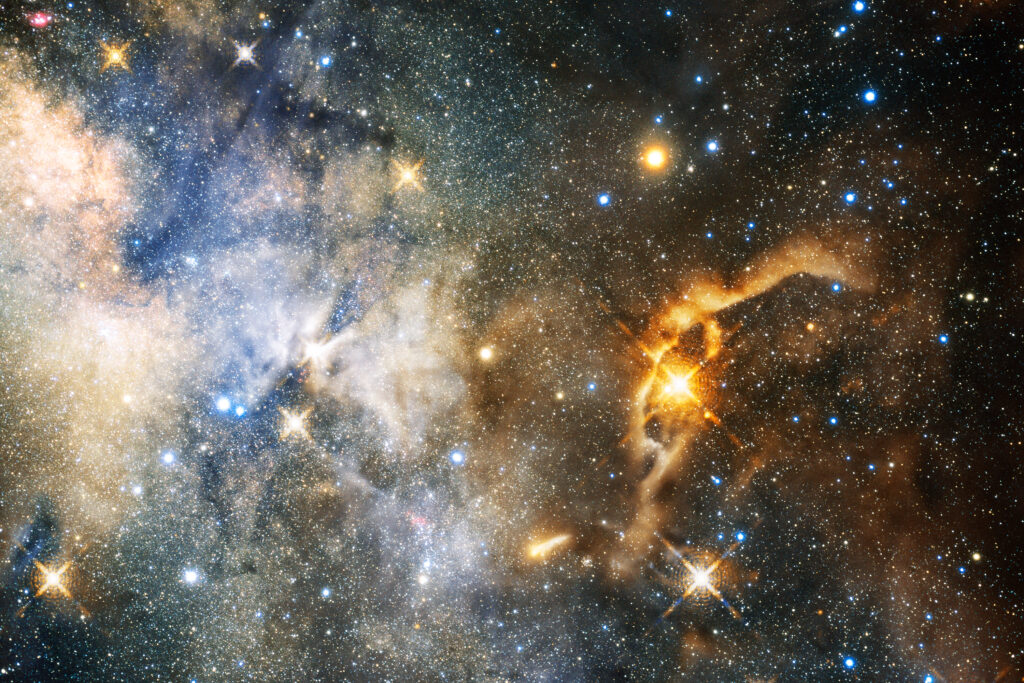
To understand Dr. Guillen’s theory, one must first look at the astronomical principles established nearly a century ago. In 1929, American astronomer Edwin Hubble made a groundbreaking discovery that changed our view of the cosmos. He found that the universe is not sitting still. Instead, galaxies are rushing away from one another, behavior that Dr. Guillen likens to shrapnel flying outward from a massive explosion.
Hubble identified a specific pattern in this movement. The farther away a galaxy is located from Earth, the faster it is moving away from us. Dr. Guillen uses this established scientific fact to calculate a specific boundary in deep space. He points to a theoretical distance of roughly 273 billion trillion miles from our planet.
At this immense distance, the recession speed of galaxies reaches a critical limit. Objects located there would effectively be moving away from Earth at 186,000 miles per second, which is the speed of light. This threshold is significant because, according to Albert Einstein’s theory of special relativity, physical matter cannot travel faster than light. This creates a natural, impassable border within the physical universe, setting the stage for what Dr. Guillen identifies as the gateway to the divine.
An Unreachable Cosmic Horizon

Astronomers call this distant boundary the Cosmic Horizon. It represents the absolute edge of what we can see in the universe. Because space at this distance is moving away from us faster than the speed of light, it acts like a permanent curtain. Any light or signals from beyond this point can never reach Earth, effectively cutting us off from whatever lies on the other side.
Dr. Guillen emphasizes that this barrier is impossible for humans to cross. Even if we built the most advanced, high-speed rocket imaginable, we could never catch up to this receding horizon. The laws of physics are strict on this matter. As Einstein established, material objects cannot travel at the speed of light. Consequently, we are physically confined to this side of the boundary.
For the majority of the scientific community, this horizon is simply a limit on observation. It is just the point where our view ends. However, Dr. Guillen interprets this absolute inaccessibility differently. He views it as a vital clue, defining a location that exists comfortably within scientific theory but remains forever out of reach for mere mortals.
A Realm Beyond Time

Dr. Guillen’s theory takes a fascinating turn when examining how time itself behaves at this distant edge. According to Einstein’s theories of relativity, time slows down as you approach the speed of light and theoretically stops altogether once you reach it. Therefore, at the Cosmic Horizon, the familiar concepts of yesterday, today, and tomorrow simply vanish. In these deep reaches of space, there is no past or future—only a state of pure “timelessness.”
While time may cease to exist at this boundary, Dr. Guillen argues that space does not. This distinction implies that there is a physical place beyond the horizon—a hidden universe that is real but operates entirely outside the clock. Because the flow of time is absent, this realm remains in a permanent, unchanging state, echoing the concept of eternity often discussed in religious texts.
However, this environment operates under different rules than our own. Since human life relies on the passage of time and physical matter, biological bodies cannot survive there. Dr. Guillen suggests that this space is habitable only by “light-like entities” or non-material beings. This scientific description aligns closely with traditional views of the afterlife, where the spirit is described as leaving the physical body behind to exist in an eternal realm free from the ravages of time.
Mapping the Divine
Dr. Guillen believes that this scientific framework maps perfectly onto ancient scripture. He points out that the Bible describes three distinct levels of heaven. The first is the immediate atmosphere surrounding our planet, and the second is the vast expanse of outer space. The third and highest level is described as the specific dwelling place of the Creator. By identifying the Cosmic Horizon as the ultimate vertical limit of the universe, Dr. Guillen suggests this matches the biblical description of a divine realm located far “up” above the Earth.
Beyond location, the theory also addresses the concept of age. Modern cosmology indicates that the Cosmic Horizon is lined with the oldest observable objects in existence. Logic follows that anything residing beyond that boundary must predate the universe itself. This scientific observation aligns with the theological definition of a Creator who existed before the Big Bang and the beginning of time.
Finally, the nature of this distant realm fits religious descriptions of the afterlife. Since physical matter cannot cross the speed-of-light barrier to reach this horizon, only non-physical entities can exist there. Dr. Guillen proposes that this limitation matches the biblical account of spirits or non-material beings inhabiting the divine realm. For him, the physics does not disprove the scripture. Instead, it provides a plausible coordinate for a place previously thought to be purely mythical.
A Unifying Perspective

Standard science paints a lonely picture of our future. Because the universe is expanding faster and faster, distant galaxies will eventually disappear from our view. We will be left in a dark, isolated patch of space. While this sounds frightening to many astronomers, Dr. Guillen offers a more hopeful interpretation.
He suggests that this expansion is not just empty space stretching out. Instead, he views it as Heaven getting larger. In his theory, the boundaries of the divine realm are pushing outward to make room for more souls. It turns a cold scientific fact into a comforting thought about the afterlife.
Dr. Guillen’s work encourages us to stop seeing science and religion as enemies. For years, people felt they had to pick between facts and faith. This theory implies we can have both. It reminds us that the cosmos is vast and mysterious. Whether looking through a telescope or reading scripture, there is still so much left to discover about our place in the universe.