
Your cart is currently empty!
A Mysterious Black Substance Found on a Ship Reveals a Groundbreaking New Form of Life

During a shipyard visit in Cleveland, the crew of the 87-foot research vessel Blue Heron encountered a mystery that had nothing to do with faulty engines or broken propellers. A viscous, jet-black substance was found leaking from the ship’s rudder shaft, prompting an immediate investigation into what appeared to be a major pollution leak. However, the material behaved in ways that left seasoned mariners confused, resisting fire and lacking the tell-tale signs of petroleum. This bizarre anomaly was just the beginning of a story that would eventually lead scientists to redefine their understanding of life in the Great Lakes.
Contents
show
A Sticky Situation in Cleveland

What started as a routine maintenance stop in Cleveland quickly turned into a scientific mystery. While the 87-foot research vessel Blue Heron was out of the water for propeller repairs, the crew noticed a thick, black substance leaking from the rudder shaft. At first glance, it looked like typical engine grease or a messy oil leak, but the crew soon realized something was different about this “goo.”
Captain Rual Lee and Marine Superintendent Doug Ricketts noticed the substance didn’t behave like oil. When they put it in water, it didn’t create the shimmering rainbow film that petroleum usually does. They even tried a quick field test with a blowtorch, but the material wouldn’t catch fire, proving it wasn’t a flammable fuel. Instead of the sharp, chemical smell of grease, it had a strange metallic odor. The sheer amount of the stuff was also baffling, as the rudder housing isn’t meant to hold that much lubricant.
Curious and a bit concerned, Ricketts scooped a sample into a plastic cup and brought it to the University of Minnesota Duluth’s Large Lakes Observatory. Scientists there initially thought they were dealing with a simple pollution case. However, as they began to look closer, they realized the crew had stumbled onto a biological enigma hiding in the very machinery used to study the lakes. This unexpected find shifted the focus from a mechanical fix to a groundbreaking genetic investigation.
The Great Lakes’ Secret Inhabitant

Researchers at the University of Minnesota Duluth’s Large Lakes Observatory initially expected the sample to contain industrial residue or other chemical contaminants. Instead, laboratory and genetic analyses indicated that the material was a dense microbial biofilm made up of numerous microscopic organisms. Early sequencing suggested that some members of this community showed low similarity to known reference sequences, pointing to a potentially uncharacterized microbial population rather than a simple pollution source.
The team found that the substance was composed of trillions of tiny organisms living together in a sticky, protective structure known as a biofilm. While biofilms are common in nature, like the plaque on teeth or the slippery coating on river rocks, this specific version was unlike anything documented before. Genetic tests showed that the primary organism shared less than 90% of its DNA with its closest known relatives. In biological terms, that is a massive gap, suggesting the discovery of an entirely new genus or family of life.
The discovery was so unusual that the scientists gave it a nickname: “ShipGoo001.” It wasn’t just a random cluster of bacteria; it was a highly organized system that had adapted to survive in an incredibly harsh, dark, and isolated environment inside the ship’s metal housing. Finding such a distinct life form in a well-studied area like the Great Lakes was a reminder of how little is still known about the microscopic world. This realization transformed the project from a local curiosity into a major scientific breakthrough.
Life Thriving on Metal
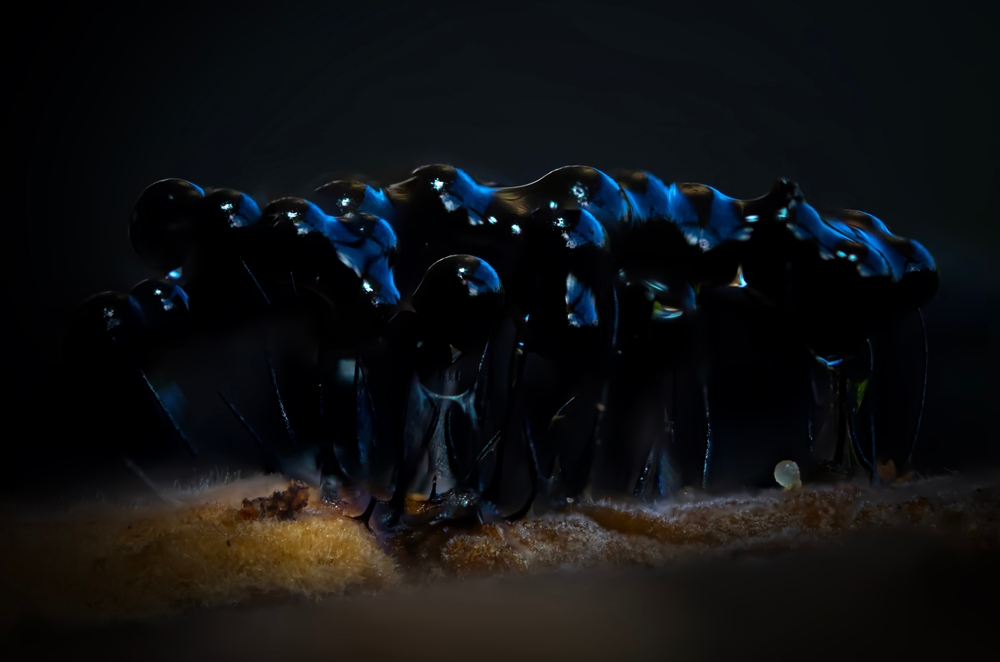
What makes this discovery truly remarkable is how these organisms survive in a place where most life would perish. Inside the dark, cramped rudder housing of the Blue Heron, there is no sunlight for photosynthesis and very little organic food. Instead of relying on traditional nutrients, the microbes in the black goo appear to sustain themselves by interacting with the ship’s metal. They are part of a rare group of “lithotrophs”—life forms that effectively eat rock or minerals to gain energy.
The substance was found clinging to the stainless steel rudder shaft and the surrounding bronze housing. Scientists believe the microbes may be drawing electrons directly from the metal surfaces or consuming the iron and minerals within the water trapped inside the ship’s mechanics. This process allows them to create energy in a total vacuum of light. Interestingly, while most metal-eating bacteria cause significant damage and rust, early observations suggest this “goo” might actually be protecting the ship’s parts by forming a dense, rubbery shield that prevents traditional corrosion.
It was noted that the biological makeup of the biofilm is incredibly tough. It acts like a living glue, holding the colony together against the friction and movement of the ship’s rudder. This ability to thrive on inorganic materials in an industrial environment challenges the common understanding of where life can exist.
Redefining What Lives Below
One of the most pressing questions for the research team is where this organism actually came from. While it was found inside the Blue Heron, it is unlikely the ship is its only home. Scientists suspect the “goo” may exist naturally within the deep, cold sediments of the Great Lakes, perhaps in areas where iron and other minerals are highly concentrated. The ship might have simply provided a perfect, concentrated environment for these microbes to thrive and become visible to the human eye.
The discovery suggests that the Great Lakes harbor a far more diverse range of life than previously imagined. For decades, scientific focus has been on the fish, plants, and well-known bacteria that inhabit these waters. Finding a potentially new genus of life living off inorganic metal underscores how much of the underwater world remains a frontier. This find is a humbling reminder that even in heavily trafficked and studied bodies of water, nature still holds secrets that can redefine biological classifications.
This evolutionary mystery also raises questions about how the life form travels. If it exists in the deep lake bed, how did it find its way into a ship’s rudder housing? Researchers are now looking at other vessels and submerged infrastructure to see if similar biofilms have established themselves elsewhere. Understanding the spread of “ShipGoo001” could provide insights into how specialized life forms adapt to human industrial activity, turning our steel and bronze structures into accidental laboratories for evolution.
Protecting What We Are Only Beginning to Understand

The existence of this new species suggests that the boundary between nature and technology is thinner than once thought. While human activity often harms the environment, this life form shows that nature can also adapt to the things we build, turning industrial tools into accidental habitats. This discovery shifts the perspective on our surroundings; a mechanical issue or a strange substance isn’t always just a mess to be scrubbed away. Sometimes, it is a window into a part of the world that has been thriving right next to us.
For most people, this story serves as an invitation to stay observant. Major scientific breakthroughs often begin because someone was curious enough to look twice at something that seemed out of place. Whether it is noticing an unusual growth in a local park or a strange detail in a backyard, these small observations are the starting points for understanding the planet.
Protecting the Great Lakes starts with recognizing that they are still full of life we haven’t even named yet. By supporting local research and remaining curious about the “odd” things in the environment, we help ensure these hidden neighbors are understood and preserved. The discovery of this black goo proves that a journey of exploration doesn’t require a laboratory or a remote expedition. It only requires a willingness to pay attention to the mysteries hiding in our own backyards and shipyards.