
Your cart is currently empty!
Scientists Can’t Explain Why This Mushroom Makes People See Tiny Humans

Most people associate hallucinogenic mushrooms with swirling colors, distorted shapes, and dreamlike experiences that blur the line between imagination and reality. But one little-known mushroom found in southwestern China appears to trigger something far stranger. Instead of the unpredictable visual effects commonly linked to psychedelic fungi, this species has gained an unusual reputation for causing people to report seeing tiny human-like figures marching across tables, climbing walls, and wandering around rooms. The bizarre consistency of these reports has fascinated researchers for decades, leaving scientists with a mystery that still has no clear explanation despite years of investigation.
Contents
show
The mushroom, known as Lanmaoa asiatica, has become the focus of growing scientific curiosity because the hallucinations it produces are remarkably similar from one person to another. Researchers say this level of consistency is extremely rare among naturally occurring hallucinogens, which usually produce highly personal experiences influenced by an individual’s mindset and surroundings. Even more surprising, scientists have discovered that the mushroom does not contain psilocy
in, the psychedelic compound responsible for the effects of so-called magic mushrooms. That means an entirely different substance is likely responsible for one of the strangest hallucinations ever documented, and researchers are still trying to identify exactly what it is.
A Popular Edible Mushroom With An Unexpected Side Effect
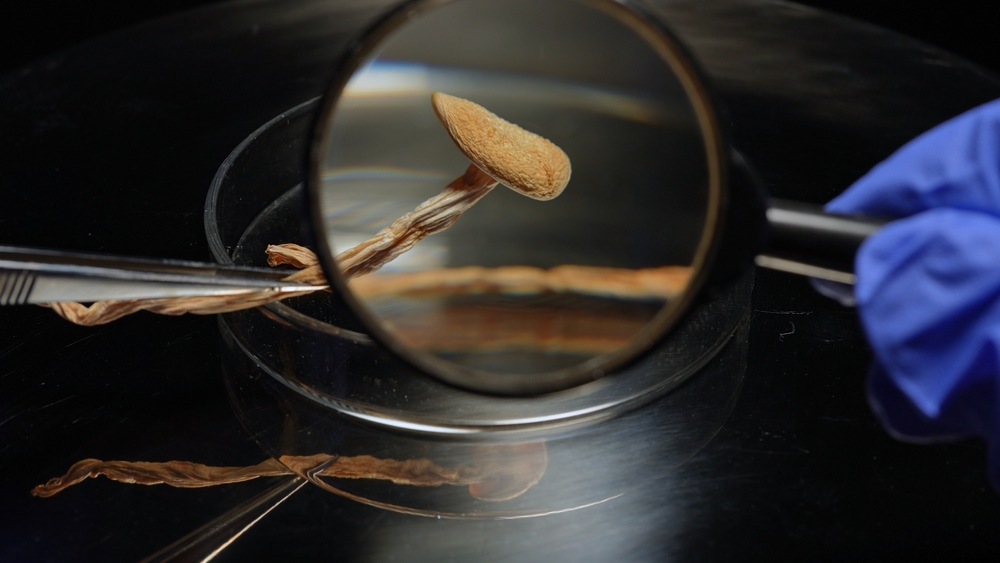
In Yunnan Province, China, Lanmaoa asiatica is not an obscure fungus hidden deep inside remote forests. It is a mushroom that regularly appears in local markets and restaurants, where it is appreciated for its rich, savory flavor. Like many wild mushrooms, however, it requires careful preparation before it is safe to eat.
Local chefs are well aware of its unusual reputation. According to reports, diners are often warned to cook the mushroom thoroughly before eating it because consuming it undercooked has been linked to severe hallucinations. The warning is so common that it has become part of local food culture, reflecting knowledge that has been passed down for generations.
University of Utah doctoral researcher Colin Domnauer recalled visiting a mushroom hot pot restaurant where staff treated the warning seriously. Before anyone could start eating, customers were instructed to wait until a timer finished counting down to ensure the mushrooms had been cooked properly. Ignoring that advice, locals believe, could result in an experience unlike anything produced by ordinary psychedelic mushrooms.
Unlike many food poisoning cases that mainly cause stomach problems, this mushroom has earned attention because of its strange psychological effects. Doctors in Yunnan reportedly treat hundreds of cases every year involving people who develop vivid hallucinations after eating improperly prepared Lanmaoa asiatica, making it one of the most unusual naturally occurring mushroom poisonings documented.
Reports Of Tiny Human Figures Stretch Back Decades
What makes Lanmaoa asiatica so unusual is not simply that it causes hallucinations. It is the striking similarity between the experiences reported by completely different people. Across different countries, cultures, and generations, many who have consumed the mushroom describe seeing tiny human figures, often no taller than an inch or two, walking across furniture, peeking from behind objects, or climbing walls. Scientists refer to these visions as “Lilliputian hallucinations,” a rare neurological phenomenon in which people perceive miniature people or animals that appear astonishingly lifelike.
One account collected by researcher Colin Domnauer came from Papua New Guinea, where an elder described seeing tiny people with mushrooms growing around their faces. According to the account, the figures teased him while he unsuccessfully tried to chase them away. Similar stories have surfaced in China for decades, suggesting the experience is far more than isolated coincidence. Unlike most psychedelic experiences, which vary dramatically depending on the person, the hallucinations associated with Lanmaoa asiatica often follow remarkably similar patterns.
Another memorable account came from a professor in China’s Yunnan Province, who described lifting a tablecloth only to watch miniature people continue marching beneath it. Each time he lifted the cloth, he claimed the tiny figures remained in place, smiling as they continued their strange procession. Curious about what he was seeing, he even attempted to measure them, estimating that the figures stood roughly an inch tall. Reports like these have become some of the most unusual case studies in mushroom toxicology because they repeatedly describe nearly identical scenes despite involving different individuals.
The hallucinations can also last much longer than those caused by traditional psychedelic mushrooms. Symptoms typically begin between 12 and 24 hours after consumption and may continue for as long as three days. Because the visions are often accompanied by confusion and disorientation, many affected people require hospitalization until the effects wear off completely. That extended duration has made the mushroom a significant concern for doctors in regions where it is commonly eaten.
Scientists Still Don’t Know What Causes The Strange Visions

For researchers, the biggest mystery is not that Lanmaoa asiatica causes hallucinations, but why those hallucinations are so specific. Most hallucinogenic substances produce experiences shaped by a person’s emotions, expectations, and surroundings. Two people taking the same substance can report completely different visions. With this mushroom, however, reports of tiny human figures appear with surprising regularity, making scientists suspect that a unique chemical compound may be acting on the brain in a way never fully documented before.
Domnauer has spent years trying to trace the mushroom’s history while investigating the biology behind its effects. The consistency of the reports immediately caught his attention because they appeared across different cultures and historical records. Instead of dismissing the stories as folklore, he began examining whether a common biological mechanism could explain why so many people describe nearly identical visions after eating the mushroom.
His research has already ruled out one obvious possibility. Laboratory analysis found that Lanmaoa asiatica does not contain psilocybin, the well-known psychedelic compound found in magic mushrooms. That discovery means another, still unidentified chemical is almost certainly responsible for the hallucinations. Experiments involving mice also showed that extracts from the mushroom caused the animals to become lethargic, suggesting the fungus affects the nervous system in ways scientists are only beginning to understand.
Domnauer has said that he is unaware of any other natural substance that produces such reliable hallucinations across different individuals. Despite dedicating years to studying the mushroom, he has never eaten it himself. Considering that its effects can last several days and frequently lead to hospitalization, he has admitted there is little incentive to experience its strange visions firsthand.
Even LSD’s Creator Couldn’t Explain This Mushroom

The mystery surrounding Lanmaoa asiatica has puzzled experts for decades, including some of the biggest names in psychedelic research. Albert Hofmann, the Swiss chemist who first synthesized LSD and later became one of the world’s leading authorities on hallucinogenic compounds, also examined reports linked to the mushroom. Despite his extensive work on psychedelics, Hofmann was unable to identify the chemical responsible for the unusual visions, leaving one of the fungus’s biggest questions unanswered.
Although the mushroom received its official scientific name in 2015, researchers believe there is still much to learn about its chemistry and how it interacts with the human brain. Unlike many poisonous mushrooms whose toxic compounds have been thoroughly identified, Lanmaoa asiatica continues to resist easy explanation. Scientists know it behaves differently from both edible mushrooms and traditional psychedelic species, but the exact compound responsible remains unknown.
That uncertainty has only increased interest among researchers studying naturally occurring toxins and psychoactive substances. Understanding what makes the mushroom unique could help scientists learn more about how the brain processes visual information and why certain chemicals produce highly specific hallucinations instead of random distortions. The research may even offer broader insights into neurological conditions that involve visual hallucinations, although much more evidence is needed before drawing those conclusions.
Why Researchers Believe This Mystery Is Worth Solving
For Colin Domnauer, the mushroom represents far more than an unusual food poisoning case. He has described being fascinated by how the same strange visions have appeared across cultures and generations, suggesting that the reports may reflect a genuine biological phenomenon rather than folklore or coincidence. The consistency of these experiences continues to separate Lanmaoa asiatica from almost every other known hallucinogenic mushroom.
Researchers are particularly interested because the mushroom challenges what scientists thought they understood about hallucinations. Instead of producing highly individualized experiences, it seems capable of triggering one of the same visual illusions in many different people. That makes it a valuable subject for neuroscience, toxicology, and fungal biology, even if the mechanism behind its effects remains hidden.
Scientists are continuing to analyze mushroom samples collected from different regions while searching for previously unknown compounds that may explain the phenomenon. Each new study brings researchers closer to identifying the chemical responsible, but so far the fungus has refused to give up its secrets. Until that changes, Lanmaoa asiatica remains one of the most unusual mushrooms ever documented.
Sources:
- Domnauer, C., & Dentinger, B. T. M. (2026b). Phylogenomic systematics of Lanmaoa (Boletaceae) reveals cryptic diversity, resolves global evolutionary relationships, and suggests a novel psychoactive lineage. Mycologia, 118(4), 732–742. https://doi.org/10.1080/00275514.2026.2670968