
Your cart is currently empty!
Finnish Man Builds Solar Yacht That Travels Thousands Of Miles Without Fuel
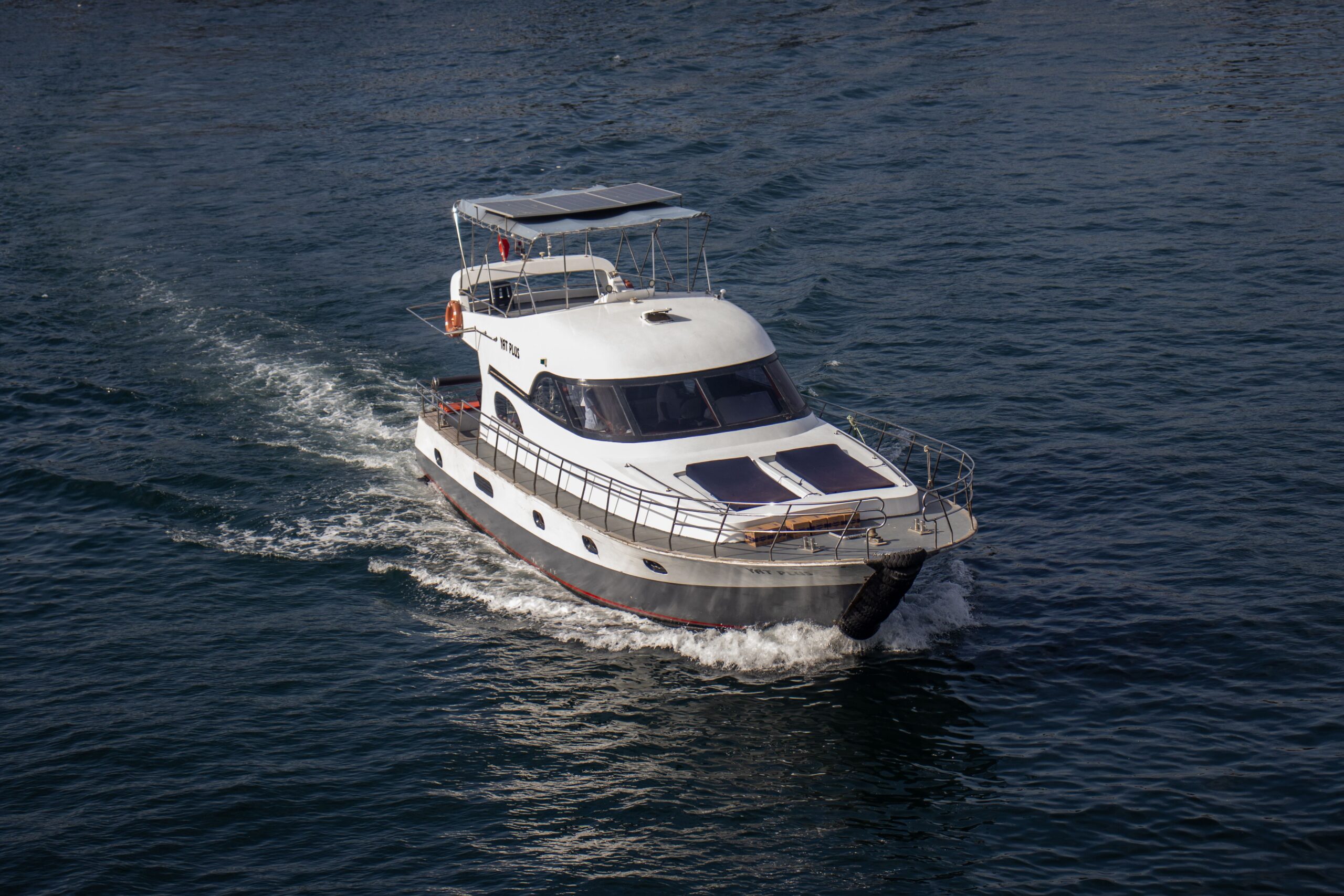
A homemade yacht built in a Finnish forest has now travelled more than 3,000 nautical miles without buying a single litre of fuel.
Contents
show
Lukas Sjoman spent around $20,000 building the 11-meter Helios 11, using marine plywood, glass fibre and ordinary residential solar panels. Then he pointed the boat south and put the idea to a brutal test.
The Yacht Started Life in a Finnish Shed
The Helios 11 was built over roughly 200 days, with Sjoman working alone in a forest shed in Finland.
At around 11 meters long and weighing approximately 1.5 tons, the yacht was designed around one central goal: reduce the energy needed to move it while collecting enough sunlight to keep its batteries charged.
That meant keeping the hull relatively light and efficient.
The boat draws only around half a meter of water, allowing it to reach shallow anchorages that would be inaccessible to many larger yachts.
Sjoman has also described the vessel as a prototype rather than a finished commercial product. Its purpose was to prove that a relatively simple electric boat could cover serious distances without depending on fuel.
Then came the difficult part.
He had to actually take it to sea.
Ten Ordinary Solar Panels Power the Boat
The technology underneath the Helios 11 is surprisingly familiar.
The yacht carries 10 standard residential solar panels capable of producing up to 4,000 watts in peak sunlight. That electricity feeds the batteries and powers the electric motor.
At anchor, the panels can recharge the battery. While cruising, the available solar energy helps reduce how quickly the batteries are depleted.
The boat’s most efficient cruising speed is around 5 to 5.5 knots.
That figure is crucial because the yacht was never designed to behave like a conventional speedboat. Its entire design revolves around using as little energy as possible.
The Boat Still Has Some Surprisingly Normal Comforts
The Helios 11 is more than a bare electric platform covered in solar panels.
Inside, it has an electric stove, a compact refrigerator and a marine toilet.
Sjoman later added two 48V battery packs costing around $1,900. Those additions brought usable storage to approximately 22kWh, with total capacity reaching close to 37kWh under favorable conditions.
The result is a small explorer-style yacht that can travel, sleep aboard and operate without carrying conventional fuel.
The $20,724 Price Tag Got Attention

The number attached to the project is one of the reasons the yacht has attracted so much attention.
Sjoman put the material cost at approximately $20,724.
That included roughly $2,881 for the battery pack, between $4,033 and $4,609 for the motor, and less than $900 each for the solar panels and controllers.
But the headline figure does not represent the complete cost of building the boat.
Once tools, electricity and other expenses are considered, the realistic total was estimated at between $23,000 and $34,500.
A professionally built version of a similar boat could cost somewhere between $69,000 and $92,000.
That difference makes the project particularly interesting. The boat was not created with exotic technology that only a major manufacturer could afford.
Much of the hardware is commercially available.
The hard part was putting everything together into a hull efficient enough to make the numbers work.
Then He Took It South Through Europe
The real test began when Sjoman started moving south from Finland.
The route took the Helios 11 through Sweden, Denmark and Germany before continuing through French canals and eventually reaching the Mediterranean.
It was hardly ideal timing for a solar-powered boat.
The journey began during the colder months, when northern Europe offered significantly less sunlight than the summer conditions the yacht was designed to exploit.
At one point, the canal journey became particularly difficult as the boat was caught between ice and locks during winter.
For a vessel that depends on sunlight, that was about as unfriendly an environment as possible.
The daily distances also varied dramatically.
In strong summer conditions, the yacht reportedly covered around 170 miles in a day. Poor weather could reduce that figure to around 45 miles, while a more typical day at sea was closer to 100 nautical miles.
The crucial detail remained the same.
The boat did not need to stop at a fuel dock.
Weather Was a Bigger Problem Than the Motor
The voyage demonstrates an important limitation behind the “runs forever” claim.
The yacht can continue operating without conventional fuel, but it cannot manufacture sunlight.
Cloud cover, winter conditions and other weather changes directly affect how much energy the solar array can collect.
That means its range and speed can change dramatically depending on conditions.
In strong sunlight, the panels can provide substantial power. In poor conditions, the boat has to rely much more heavily on stored battery energy.
The Helios 11 therefore represents something more specific than a magic yacht that can travel indefinitely under any circumstances.
It is a fuel-free electric vessel whose energy source is continuously replenished by sunlight when conditions allow.
That distinction matters.
The Voyage Was Not Exactly Smooth Sailing

The journey south produced plenty of problems that had nothing to do with solar power.
While the yacht was anchored at La Rapita on the Spanish coast, its utility dinghy was stolen.
Instead of simply buying another one, the crew improvised a replacement catamaran tender using foam and scrap wood.
Then came an even stranger incident.
People standing on a bridge reportedly threw rocks at the yacht as it passed underneath.
One of the rocks struck the solar array.
For a boat that depends on its panels for propulsion, damage to the array could have been a serious problem.
But when Sjoman checked the system afterward, he reported that the solar output appeared unchanged compared with the previous day’s reading at the same time.
The array had apparently survived the impact without measurable loss of performance.
More Than 3,000 Miles Later, He Reached Ibiza
The Helios 11 eventually reached Ibiza with a recorded distance of 3,106 miles.
Other coverage describes the journey as more than 3,000 nautical miles or roughly 5,000 kilometers, depending on the measurement being used.
Either way, the basic achievement remains striking.
A homemade electric yacht built for around $20,000 in materials had travelled from Finland toward the Spanish coast without buying conventional fuel along the way.
The journey also put a real-world number on the fuel savings.
On one 30-nautical-mile trip, the fuel that would otherwise have been required was estimated at around $46.
Across thousands of miles, those avoided fuel purchases become a much more significant figure.

There Is One Important Catch
The performance figures have not been independently audited.
Most of the information about the yacht’s range, energy use and voyage comes from Sjoman’s own logs, videos and project documentation.
That does not erase the journey, but it does mean some of the more ambitious claims should be treated as the builder’s reported results rather than independently verified laboratory measurements.
The phrase “runs forever” also needs to be understood in context.
The boat does not have an infinite supply of energy. It depends on sunlight and battery storage, and poor weather can dramatically reduce its performance.
What it has demonstrated is that a carefully designed electric vessel can cover remarkable distances while relying on solar energy instead of carrying conventional fuel.
The Next Yacht Is Already Bigger
Sjoman does not appear to be treating the Helios 11 as the final version of the idea.
The next project is a 16-meter power catamaran with roughly twice the deck area.
That additional space creates an obvious advantage: more room for solar panels.
The larger vessel is effectively an attempt to scale the same principle. Build an efficient hull, cover as much usable surface as possible with solar panels, store the electricity in batteries and use an electric motor to turn that energy into movement.
The Finnish forest project began as an experiment that sounded almost impractical.
Then the boat left the shed.
It crossed thousands of miles of European waterways and coastline without stopping for conventional fuel. Whatever happens with the next yacht, Sjoman has already answered the most important question his prototype was built to test: a small homemade solar boat can go a very long way when the hull is designed around the energy available from the sky.