
Your cart is currently empty!
Scientists Investigate the Hidden Forces That Could Be Changing Earth’s Days
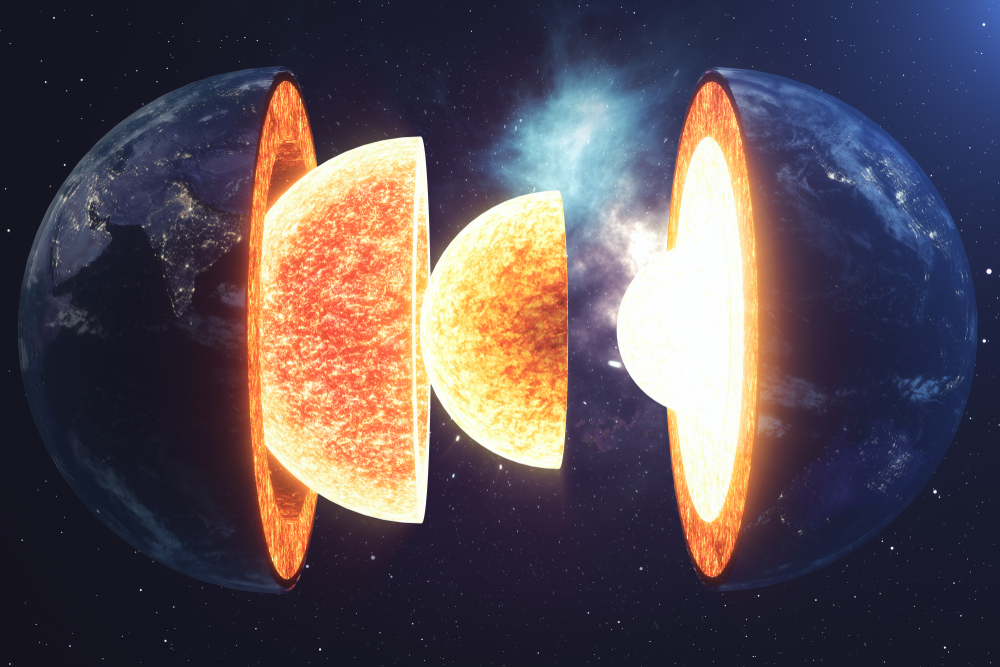
Earth has followed a familiar 24-hour cycle for as long as humans have measured time, but the planet’s rotation is far less consistent than most people realize. Some days are fractionally longer or shorter than others, with differences measured in milliseconds. These changes are too small for people to notice during everyday life, yet they have kept scientists searching for answers about what is happening beneath the planet’s surface.
Contents
show
Now, researchers investigating these subtle shifts have turned their attention to one of Earth‘s most inaccessible regions: its core. Their findings suggest that the movement of the inner core, combined with forces acting between the planet’s deepest layers, could help explain why Earth’s rotation changes over decades. The research offers a closer look at the hidden mechanisms influencing the length of a day, although several questions about the process remain unanswered.

Earth’s Rotation Is Not As Consistent As It Seems
The 24-hour day is one of the most familiar measurements in human life, governing everything from sleep schedules to work routines. However, Earth’s rotation does not operate with the precision of a mechanical clock. The planet’s speed can change slightly as mass moves around its surface and within its interior, affecting the time needed to complete a full rotation. These variations can last for years or decades, creating small differences in the length of individual days.
Scientists have long known that several natural processes can influence Earth’s rotational speed. Major earthquakes can redistribute mass as sections of the planet shift, while melting glaciers and continental ice alter how mass is distributed across Earth’s surface. Atmospheric movements, including powerful hurricane winds, can also influence rotation, as can the movement of ocean tides. Each process affects the planet in a different way, making it difficult to isolate the precise causes of longer-term changes.
The deeper problem is that surface processes alone do not explain every observed fluctuation. Forces can also act through the planet’s interior, reaching the liquid metal of the outer core and affecting how momentum moves between Earth’s layers. Researchers have been particularly interested in understanding how these internal interactions influence changes that develop over decades. The latest investigation focuses on whether the movement of the inner core could help explain some of the variations that remain difficult to predict.

Scientists Turn Their Attention to Earth’s Inner Core
Earth consists of several major layers, including the crust, mantle, outer core and inner core. The mantle extends beneath the crust, while the outer core contains flowing liquid metal surrounding the solid inner core. Although these layers form a single planet, they do not necessarily move in perfect synchronization. Their interactions can influence the distribution of angular momentum, the physical quantity associated with rotational motion.
Geophysicists Huifeng Zhang and Mathieu Dumberry of the University of Alberta examined how these interactions might affect Earth’s day length. They combined seismic estimates of the inner core’s rotation with models of outer-core flow to reconstruct rotational changes between 1964 and 2019. This approach allowed them to investigate how the movement of Earth’s deepest layers might relate to the fluctuations measured at the planet’s surface.
The research examined a longstanding problem in geophysics: how much do forces between the core and mantle contribute to changes in Earth’s rotation? Scientists have understood for decades that interactions between these layers influence long-term fluctuations, but developing reliable predictions has proved difficult. The researchers described the challenge directly in their study, writing, “We have known for more than 30 years … that the decadal changes in day length] are caused by core-mantle interactions.” Their work attempted to explain how those interactions operate and how they might be modeled more accurately.

How Competing Forces Could Change the Length of a Day
The researchers examined how the inner core’s rotation could influence the mantle through competing forces. Their model suggests that the inner core rotates slightly faster than the rest of the planet, allowing it to drift eastward relative to the alignment that gravity would otherwise maintain. Gravity acts to restore that alignment, creating an eastward torque on the mantle. At the same time, flows near the boundary between the core and mantle can produce a westward torque that competes with the gravitational effect.
These opposing forces help explain why Earth’s rotational speed can fluctuate over longer periods. When the torques acting on the mantle do not balance, the resulting difference can influence how quickly the planet rotates. That change appears in measurements of day length, producing variations of milliseconds rather than dramatic changes that would be visible to people living on the surface. The process involves several interacting layers, making it more complicated than simply measuring how quickly the planet turns.
The inner core’s physical shape may also play a role. According to the research, the inner core can deform over periods of just a few years, potentially affecting the layers surrounding it as its shape changes. The researchers considered these changes alongside the inner core’s rotation and the movement of material through the outer core. Together, these mechanisms offer a possible explanation for some of the longer-term variations in Earth’s rotation, although the model does not establish that every fluctuation has the same cause.

What the Research Revealed About Earth’s Hidden Movements
The researchers’ reconstruction pointed to a small but persistent eastward misalignment of the inner core, sustained by its steady eastward drift relative to the mantle. Their model connected this movement with the gravitational forces attempting to restore the core’s alignment and the competing torques generated near the core-mantle boundary. This provides a framework for understanding how the exchange of angular momentum between Earth’s internal layers could influence the length of a day.
The study also examined electromagnetic and topographic forces at the core-mantle boundary. Electromagnetic interactions could help connect flowing material in the outer core with the electrically conducting region of the lowermost mantle. Topographic forces associated with the shape of the boundary may also contribute to the interactions. The researchers found no significant decadal fluctuations in these modeled torques, although that result does not necessarily mean the forces remain unchanged in the actual planet.
The limits of the models are an important part of interpreting the findings. The researchers could predict rotational changes only over periods of two or three decades or longer because seismic estimates of the inner core’s rotation are not precise enough to resolve shorter intervals. The resolution of the core-flow model is also limited, and some forces that influence day length may not have been included in the calculations. The results therefore offer a possible explanation for long-term changes rather than a complete account of every variation in Earth’s rotation.

Why Scientists Still Cannot Predict Every Change
Understanding Earth’s rotation requires researchers to connect several types of evidence, including seismic observations and models of the forces acting deep inside the planet. Seismic measurements provide clues about how the inner core moves, while mathematical models help scientists estimate how that movement interacts with the outer core and mantle. However, neither approach gives researchers a complete picture of what is happening thousands of kilometres beneath the surface.
The difficulty is especially clear when scientists attempt to predict changes over shorter periods. If measurements cannot reliably resolve small differences in the inner core’s rotation, it becomes harder to determine how quickly those differences affect the surrounding layers. Limitations in the models can create further uncertainty, particularly when important forces are missing or their behavior cannot be represented with enough precision. Better observations and more detailed calculations will be needed to determine how closely the proposed mechanisms match Earth’s actual behavior.
Zhang and Dumberry argue that improving the explanation of the forces acting between the core and mantle could deepen scientific understanding of Earth’s interior. Their research connects variations in day length with questions about the planet’s structure, material properties and internal dynamics. It also demonstrates why tiny changes in Earth’s rotation can provide useful evidence about processes that scientists cannot observe directly. The study advances that investigation while leaving room for further research into the forces shaping the planet’s movement.
Earth’s 24-Hour Cycle Hides a More Complicated Story
The familiar 24-hour day remains a practical way to measure time, but Earth’s rotation is influenced by a changing balance of forces. Movements in the atmosphere and oceans can contribute to rotational fluctuations, while interactions between the inner core, outer core and mantle may help explain longer-term changes. Researchers are still working to determine how these mechanisms combine and which forces have the greatest influence over different periods.
The investigation by Zhang and Dumberry suggests that the inner core’s rotation and its interactions with the mantle are important pieces of that puzzle. Their findings do not mean that people need to change their clocks or that Earth’s days are suddenly becoming dramatically longer. Instead, they reveal how even millisecond differences can help scientists investigate the planet’s hidden machinery. Beneath a day that seems perfectly ordinary, Earth’s deepest layers continue to move in ways researchers are only beginning to explain.
Sources:
- Pubmed.ncbi.nlm.nih.gov. (n.d.-h). https://pubmed.ncbi.nlm.nih.gov/42778592/
- Zhang, H., & Dumberry, M. (2026). Gravitational torque drives multidecadal variations in length of day. Nature, 658(8134), 119–124. https://doi.org/10.1038/s41586-026-10999-2