
Your cart is currently empty!
The Last Day Of Life On Earth Has Been Calculated By Scientists, This Is How Long We Have Left
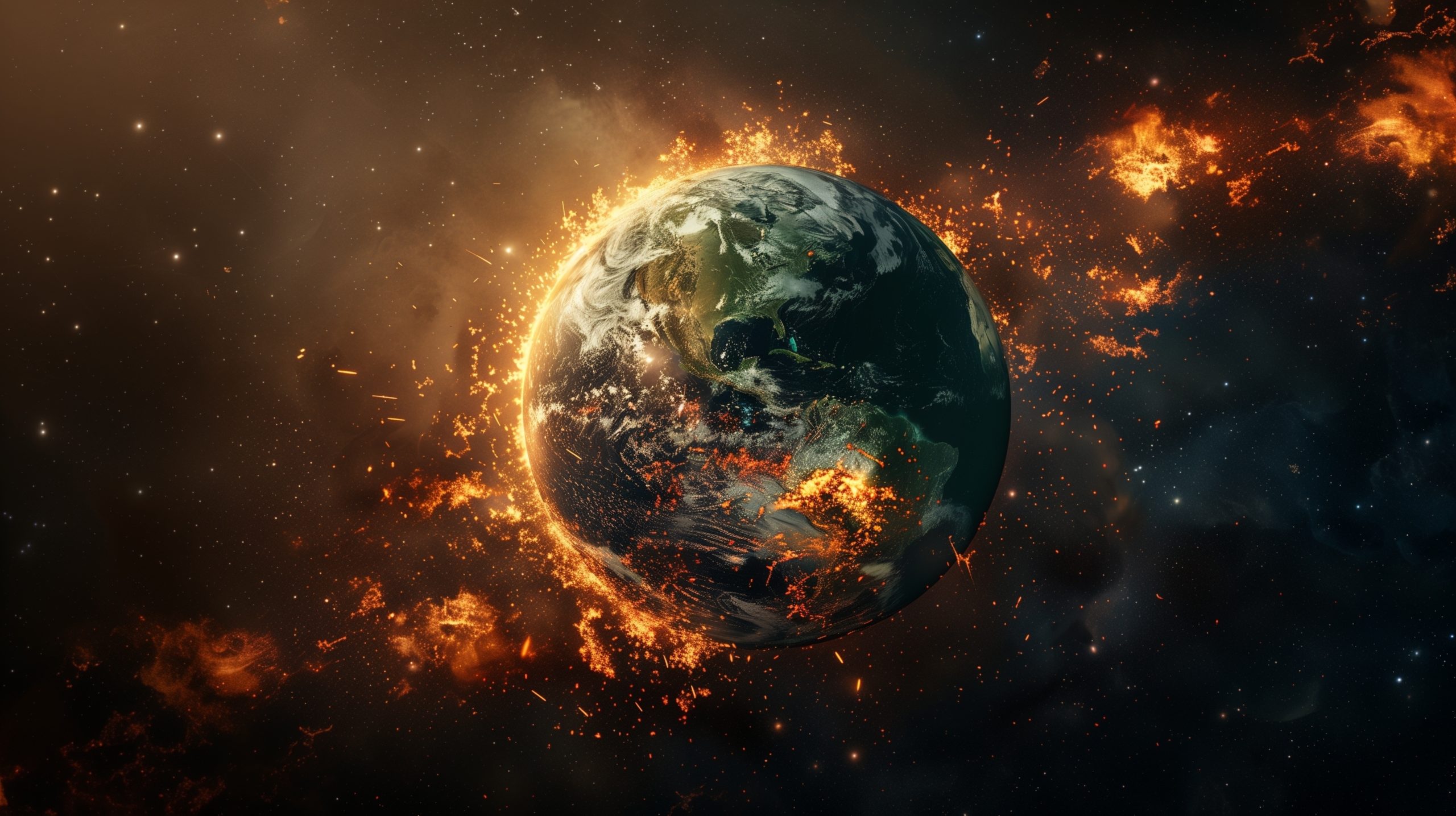
As we admire the beauty of our planet, it’s hard to picture a time when Earth may no longer support life. But scientific research has now given us a clearer sense of its eventual fate. While the end of life on Earth is still far in the future, NASA has provided a startling projection, shedding light on the timeline that could shape our planet’s future.
Contents
show
The question remains: How long do we truly have left? Though this prediction is set far beyond our lifetimes, it serves as a reminder that the choices we make today are impacting the world we leave behind. It’s a wake-up call to recognize that the actions we take now will influence the future generations who inherit our planet.
While the clock may be ticking on Earth’s distant demise, the environmental challenges we face today—ranging from global warming to biodiversity loss—are already pushing us to reconsider how we treat the Earth and the legacy we want to leave.
What NASA’s Calculations Reveal About Earth’s Fate

Scientists have long pondered the future of Earth, and recent research has brought us closer to answering the question: How much time does our planet have left before it becomes inhospitable? According to NASA, we may have about 1 billion years before conditions on Earth become too extreme for life to thrive.
This projection is based on complex simulations that account for the gradual changes Earth will undergo as the Sun continues to evolve. As the Sun ages, it will grow increasingly hotter, and over time, this will lead to higher temperatures on Earth, ultimately making it impossible for life to continue in its current form.

One of the key factors in this prediction is a process known as deoxygenation—the slow decline in oxygen levels in Earth’s atmosphere. Scientists predict that this will occur as the Earth’s oceans lose their ability to produce the oxygen needed to sustain life. As deoxygenation progresses, the planet’s ability to support complex life will diminish, potentially rendering Earth uninhabitable. This gradual shift is part of a natural cycle, but human activity is accelerating the environmental changes that could bring these events closer than previously thought.
Despite the billions of years remaining, NASA’s prediction serves as a reminder of Earth’s fragility. We are not just passive observers of the planet’s fate—we play an active role in determining how long it can continue to support life.
How Earth’s Air Will Disappear

The process leading to deoxygenation isn’t a single event, but a slow domino effect triggered by the Sun. The scientific model outlines a clear, step-by-step chain reaction that will unfold over the next billion years.
- The sun gets hotter: As a main-sequence star, our Sun is naturally becoming more luminous and hotter as it ages. Over the next billion years, the amount of solar energy hitting Earth will steadily increase, acting as the unavoidable trigger for everything that follows.
- Carbon dioxide is stripped from the air. The increased solar energy will speed up the weathering of silicate rocks on Earth’s surface. This geological process pulls carbon dioxide (CO2) out of the atmosphere, trapping it in rock formations. In effect, the planet’s long-term thermostat will be put into overdrive, causing atmospheric CO2 levels to plummet.
- The great starvation begins: While less CO2 might sound helpful, it will prove fatal to most life. Plants, algae, and phytoplankton all rely on carbon dioxide for photosynthesis—it’s the air they “breathe.” As CO2 levels drop, these photosynthetic organisms will begin to starve on a global scale, triggering a collapse of the very foundation of Earth’s ecosystems.
- Rapid deoxygenation: Photosynthesis is the primary source of the free oxygen (O2) in our atmosphere. When this process shuts down, the planet’s great oxygen-producing engine will fall silent. Geological processes will continue to consume the remaining oxygen, causing it to drain from the atmosphere. Models show this final stage could be remarkably fast, with oxygen levels crashing to near-zero in as little as 10,000 years, leaving behind a world hostile to complex life.
In a final twist, the Sun that has nurtured life for eons will be responsible for its undoing—not by burning the world, but by quietly starving it of carbon dioxide until it can no longer breathe.
From Boiling Oceans to a Dying Sun

Even after the air becomes unbreathable, Earth’s long journey toward total destruction is far from over. The deoxygenation event is just the first of two even greater, unavoidable fates baked into the planet’s future, driven by our aging Sun.
First comes the complete sterilization of the planet. In approximately 2 billion years, the Sun’s increasing heat will trigger a runaway greenhouse effect. As surface temperatures rise, Earth’s oceans will begin to evaporate at a massive scale. This water vapor, a powerful greenhouse gas, will trap more heat, causing even more evaporation in a spiraling feedback loop.

The process will only stop when the oceans have completely boiled away, leaving Earth as a dry, sterilized, Venus-like world with temperatures hot enough to melt lead. Any simple microbial life that survived the deoxygenation will be extinguished.
The final chapter for Earth itself comes in about 6 billion years. At this point, the Sun will exhaust the hydrogen fuel in its core and swell into a colossal red giant. Its expansion will be so immense that it will engulf the orbits of Mercury and Venus. While some models suggest Earth might just escape being swallowed, it won’t survive. The planet will be scorched, its atmosphere stripped away and its surface vaporized, leaving nothing but a lifeless, molten rock. This is the absolute end for our world.
The Wild Cards: Random Catastrophes from Space

Distinct from the planet’s predictable fate are the wild cards—random, catastrophic events that operate on a timeline of pure chance. These threats aren’t guaranteed to happen, but they could occur at any time, posing a risk of mass extinction long before the Sun’s slow decline concludes.
The most familiar of these is a major asteroid or comet impact. Earth’s history is marked by such collisions, the most famous being the Chicxulub impactor that wiped out the dinosaurs 65 million years ago.
While a truly sterilizing event—one large enough to boil the oceans and kill all life, including microbes—is considered extremely unlikely, a civilization-altering impact is statistically estimated to occur roughly once every 100 million years.
Another threat comes from the most violent events in the cosmos: a nearby supernova or gamma-ray burst. If a massive star were to explode within about 100 light-years of Earth, it would flood our planet with high-energy radiation. This would have two main effects: first, it would shred the ozone layer, exposing the surface to lethal levels of solar UV radiation. Second, it would create a thick, planet-wide smog of nitrogen dioxide that would block sunlight, potentially triggering a sudden and deep ice age.
The Crisis on Our Doorstep

While these cosmic timelines are fascinating, they risk obscuring a far more urgent threat. The most immediate danger to humanity isn’t unfolding over billions of years, but over decades. The current, human-driven climate and biodiversity crises are destabilizing our world at a rate that dwarfs these slow, natural cycles.
According to major scientific bodies like the IPCC and IPBES, the changes are happening at an unprecedented speed. Global warming is occurring roughly 10 times faster than the average warming rate after past ice ages, and an estimated one million animal and plant species are now threatened with extinction, many within decades.
This creates a critical distinction. The billion-year deoxygenation marks the end of a habitable planet for complex life. The current environmental crisis, however, threatens the stability of modern global civilization. The Earth will, in a broad sense, remain habitable long after it has become inhospitable to our interconnected societies, which are built on the stable climate we’ve known for thousands of years.
Ultimately, the planet’s final day is a distant, astronomical certainty. The more pressing deadline is the one facing our civilization now, and its outcome is not yet written.
Source:
- Ozaki, K., & Reinhard, C. T. (2021). The future lifespan of Earth’s oxygenated atmosphere. Nature Geoscience, 14(3), 138–142. https://doi.org/10.1038/s41561-021-00693-5