

Millions of Americans have faced unexpected disruption after a series of major technology failures affected everything from airline travel and banking to everyday business operations. The problems arrived within days of each other, leaving travelers stranded, customers unable to access their money, and workers struggling to use essential digital services. With several critical systems experiencing problems almost simultaneously, concerns have grown about how vulnerable modern infrastructure has become.
Now, senior officials in the Trump administration are pushing back against fears that the country could be heading toward a larger crisis. Vice President JD Vance has urged Americans against building bunkers or stockpiling emergency supplies, while Homeland Security Secretary Markwayne Mullin says there is no evidence suggesting the incidents were connected to a coordinated cyberattack. Their reassurances come as experts raise questions about aging infrastructure and America’s growing dependence on technology.

A Series Of Technology Failures Disrupts Essential Services
The disruption began last Thursday when a major Microsoft outage affected users around the world. People experienced problems accessing Outlook email, Microsoft Teams, and other widely used workplace services. Businesses that depend on these platforms faced interruptions to their daily operations, with employees struggling to communicate and complete routine tasks. Microsoft attributed the incident to a “technical issue,” and the problem took roughly two days to resolve.
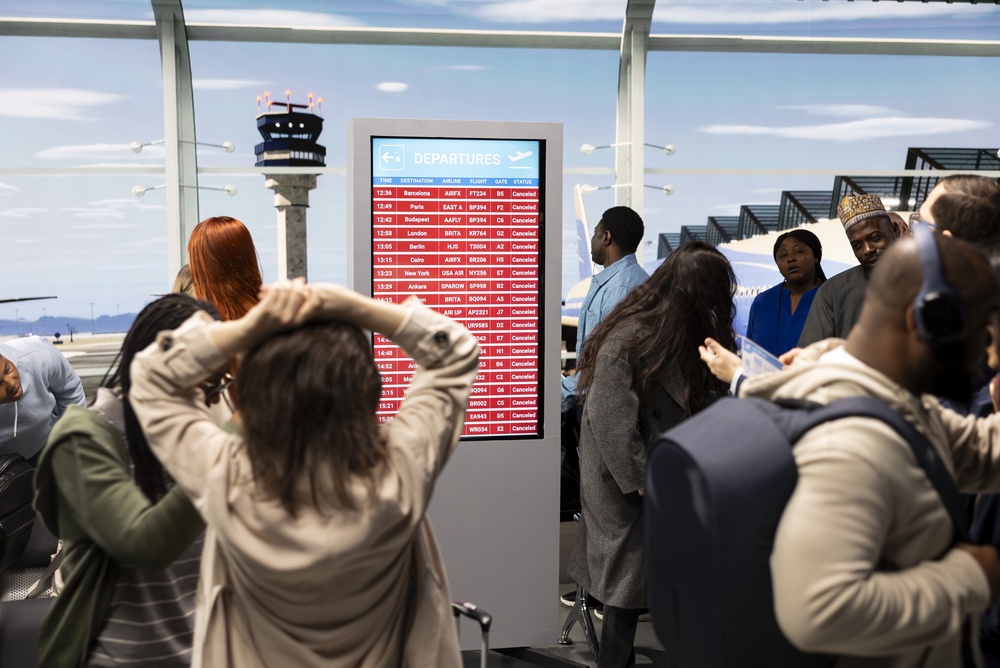
The situation became more complicated the following day when the Federal Aviation Administration experienced a systems failure. Thousands of flights were canceled, disrupting airport operations and leaving millions of travelers dealing with delays and uncertainty just before the weekend. The FAA suspected that a single newly installed router at a remote radio outpost in Arkansas had triggered the problem, raising questions about the reliability of equipment supporting the country’s aviation network.
Then, on Monday, banking customers began reporting another wave of problems. Thousands of Chase Bank customers experienced difficulties accessing their online accounts and completing transactions at physical branches. Chase attributed the incident to a “software bug.” Customers at Bank of America, Wells Fargo, and U.S. Bank also reported smaller-scale problems that appeared connected to Zelle transfers involving Chase accounts.
Another interruption followed later that afternoon when United Airlines experienced a widespread but short-lived systems outage. The disruption lasted approximately 30 minutes and affected fewer than 150 flights, according to an airline spokesperson. Although the individual incidents had different reported causes, their close timing prompted questions about whether something larger was happening behind the scenes.
JD Vance Rejects Fears Of An Approaching National Crisis
As concerns spread, Vice President JD Vance addressed speculation about whether Americans should begin preparing for a major emergency. During an interview released Monday, he revealed that friends had asked him whether they should start building bunkers or stockpiling food and water. His response was direct: “My answer to that is no.”
Vance acknowledged that government agencies must prepare for serious emergencies, even when officials have no indication that one is approaching. He also addressed reports that Pentagon bases were preparing to operate independently of external infrastructure for up to 90 days. Similar preparedness recommendations have emerged in European countries, prompting further discussion about emergency planning.
“We do not see some crisis coming down. But you have to be prepared for everything,” Vance said. He described military preparations as “basic good government,” explaining that responsible planning requires the armed forces to be ready for circumstances that may never happen. He also stressed that these preparations should not be interpreted as evidence of an imminent threat.
“Making sure that our military would be prepared, God forbid if there was a crisis,” Vance said, “but we don’t see a crisis coming down the pike.” His remarks were intended to calm public concerns while making a distinction between routine government preparedness and an actual warning of danger.

Homeland Security Addresses Cyberattack Concerns
Homeland Security Secretary Markwayne Mullin also addressed the situation as questions emerged about the possibility of a coordinated cyberattack. With major services experiencing problems within a short period, some Americans began wondering whether the incidents could have been connected through a common digital threat. Mullin said the available evidence did not support that explanation.
“I can tell you with 98% certainty, we’re not seeing the cyber attack, no one is out there taking claim for it, we’re not seeing the traffic, we’re not seeing the footprints going in, we’re not seeing the footprints going out,” Mullin said. He added that investigators had found nothing pointing toward a connection between the different incidents.
According to Mullin, the government’s cybersecurity agency had informed him that the outages were “all individually unrelated.” This assessment suggests that the disruptions were separate technical failures rather than evidence of one coordinated operation targeting multiple American institutions.
Mullin also sought to reassure people who were worried about the security of the country. “Breathe. The homeland is secure,” he said. He emphasized that officials had been able to respond to the individual problems and restore affected services, although the incidents continued to raise questions about the reliability of the infrastructure supporting everyday life.

Experts Identify A Bigger Problem Behind The Outages
Although officials have rejected claims of an approaching crisis, cybersecurity expert Alex Hamerstone believes the incidents highlight a broader weakness. He pointed to aging infrastructure across the United States and other parts of the world. Many essential systems were developed decades ago, yet they are now expected to support increasingly complex technology and growing demands.
“I think it’s connected in the sense that a lot of our infrastructure in this country, in the world, is aging,” Hamerstone said. He explained that technological systems continue evolving while dependence on them increases every day. The result is an infrastructure network that becomes more complicated to maintain as organizations add newer services and equipment.
Hamerstone also highlighted how interconnected modern systems have become. “Everything is becoming more technically connected and more complex,” he said. This creates additional challenges when a single component experiences problems, particularly when organizations depend on several layers of technology to keep essential services operating.
Mullin acknowledged a similar concern when discussing the country’s backup arrangements. “We used to have backup systems, and the backup systems are overwhelmed by the new systems now,” he said. His comments suggest that some older contingency arrangements may struggle to support the demands of modern technology, leaving organizations with difficult questions about how they should prepare for future disruptions.
America’s Aging Aviation Infrastructure Faces Fresh Scrutiny
The FAA disruption has also intensified the debate over America’s aging air traffic control systems. Vance acknowledged that parts of the country’s infrastructure rely on technology that is decades old. Maintaining these systems can require temporary fixes and complicated arrangements to keep operations running while larger modernization projects remain unfinished.
“The problem is we are dealing with 50-year-old technology. It works most of the time,” Vance said. He also questioned why essential infrastructure had been allowed to depend on such outdated equipment. The recent aviation disruption has brought renewed attention to the consequences of maintaining older systems that support millions of travelers.
Transportation Secretary Sean Duffy has called for as much as $50 billion in emergency funding following the FAA ground stop. The request comes as the administration seeks to accelerate improvements to the country’s aviation infrastructure. However, the proposal has already faced questions from influential Republican lawmakers who want more information about how the requested money would be used.
Congress approved $12.5 billion last year to modernize air traffic control systems. Senate Majority Leader John Thune and other lawmakers have argued that the previously approved funding has not yet been fully spent. That disagreement creates an additional challenge for the administration as it seeks substantial new funding while facing scrutiny over existing resources.
Five Essential Services That Depend On Reliable Technology
The recent disruptions demonstrate how deeply digital infrastructure has become embedded in everyday American life. Problems involving a single organization can affect thousands of people, while failures involving essential services can create difficulties far beyond the original technical issue.
Several areas are particularly dependent on reliable technology:
- Air travel: Airlines and airports rely on interconnected systems to coordinate flights, schedules, and passenger information.
- Banking: Millions of customers depend on digital platforms to access accounts, transfer money, and complete everyday transactions.
- Business operations: Email, video meetings, and cloud services allow employees to communicate and work across different locations.
- Government infrastructure: Transportation and other public services rely on technology to coordinate essential operations.
- Emergency preparedness: Organizations need dependable backup arrangements to continue functioning when their primary systems experience problems.
The difficulty is that these services increasingly depend on technology that must work together. When one system experiences a failure, the consequences can reach people who have no direct connection to the original organization. That makes maintenance, modernization, and reliable backup arrangements central concerns for institutions responsible for essential services.
The Real Challenge Is Keeping Essential Systems Running
The Trump administration has sought to make one point clear: officials do not believe the recent outages indicate an approaching national emergency. Vance has discouraged Americans from preparing for a crisis based on speculation, while Mullin has said investigators have found no evidence connecting the incidents to a coordinated cyberattack.
However, the infrastructure problems raised by the events remain difficult to ignore. Aging equipment, increasingly complicated digital networks, and growing dependence on technology create challenges that cannot always be addressed through temporary repairs. The debate surrounding the FAA’s modernization funding also demonstrates how difficult it can be to move from identifying infrastructure problems to actually fixing them.
America does not need to be facing an imminent crisis for these weaknesses to deserve attention. Millions of people depend on transportation, banking, communications, and government services working when they need them. When several of those systems experience problems within the same week, the consequences become impossible to overlook.
The next major test for the administration will be demonstrating that America’s essential infrastructure can keep working when the technology supporting it inevitably fails.