
Your cart is currently empty!
Brain Injury From Attack Gave This Man Supernatural Math Powers

Jason Padgett once thought mathematics was useless. He sold futons, chased women, and spent most nights drinking at bars in Tacoma, Washington. Numbers meant nothing to him. Geometry was gibberish. Then two strangers attacked him outside a karaoke bar on Friday the 13th, and his brain rewired itself overnight. What happened next defies medical explanation and challenges everything scientists thought they knew about the human mind.
Contents
show
Now Padgett sees the world in a way that only a handful of people on Earth can comprehend. Every curve breaks down into pixels. Water becomes geometry. His daughter’s face contains mathematical equations. And he can draw complex fractal patterns by hand that would stump most PhD mathematicians.
One violent night transformed a party-loving salesman into an acquired savant. But the price he paid was steep.
Before: A Self-Described Shallow Life

Padgett lived simply before September 2002. He worked as a futon salesman, splitting his time between Alaska and Washington state. His priorities were clear: meet girls, hit bars, nurse hangovers, repeat.
“I was very shallow,” he says now, laughing at the memory. “Life rotated around girls, partying, drinking, waking up with a hangover and then going out and chasing girls and going out to bars again.”
Mathematics never entered his world. He actively dismissed it. “I used to say math is stupid, how can you use that in the real world? And I thought that was like a smart statement. I really believed it.”
Books held no interest. Intellectual conversations bored him. Padgett existed in a bubble where fun was the only currency that mattered.
Friday the 13th, 2002
September 13 started like any other Friday night. Padgett went out with friends to a karaoke bar in Tacoma. He had no idea that two men were watching him. Around closing time, they made their move.
One man ran up behind Padgett and smashed him in the back of the head. Padgett recalls the moment with disturbing clarity. “I heard as much as felt this deep, low-pitched thud as the first guy ran up behind me and smashed me in the back of the head. And I saw this puff of white light just like someone took a picture. The next thing I knew I was on my knees and everything was spinning and I didn’t know where I was or how I got there.”
A second blow struck his abdomen. Padgett crumpled. His attackers grabbed his leather jacket, already torn and worn, and vanished into the night.
Somehow, Padgett staggered across the street to a hospital. Doctors diagnosed him with a concussion and a bleeding kidney from the gut punch. Medical staff gave him pain medication and sent him home. Nobody suspected that his brain had suffered trauma that would permanently alter his cognition.
When Home Became a Prison
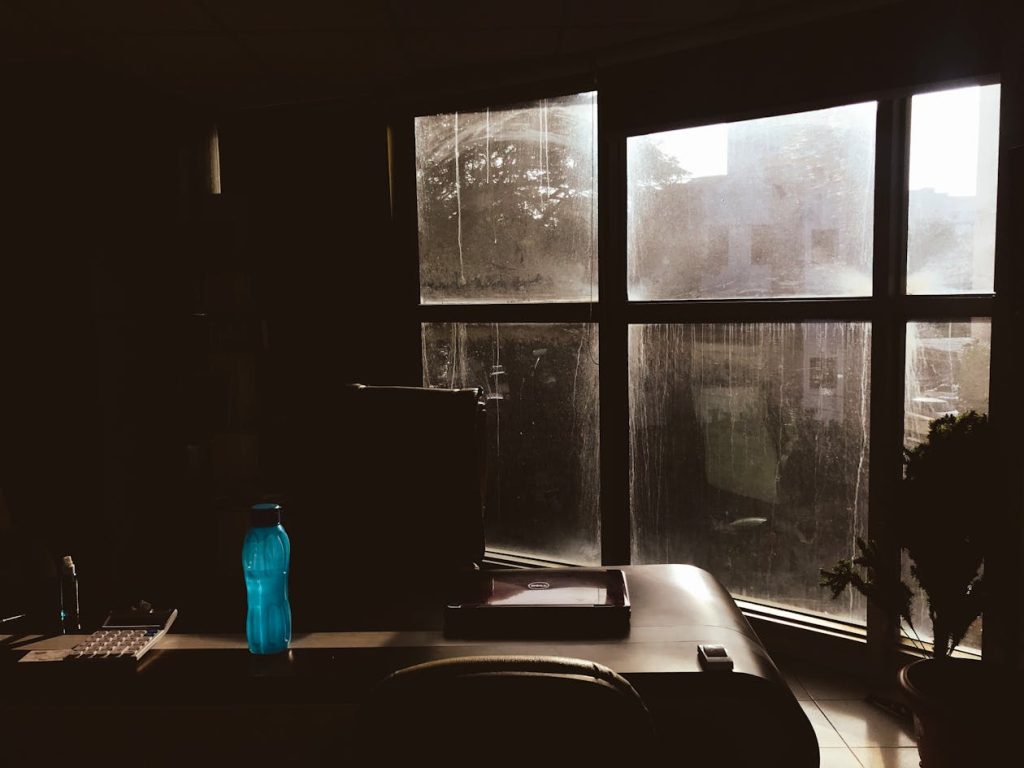
Back in his house, something dark took hold. Padgett developed traumatic brain injury-induced obsessive-compulsive disorder. Fear consumed him. He stopped going outside except for essential food runs.
His paranoia manifested in extreme ways. Padgett nailed blankets and towels over every window in his house. He sealed his front door shut with spray foam. Natural light became an enemy. Open doors meant danger. For three and a half years, he lived as a hermit.
OCD turned him into a germaphobe. His daughter visited during custody negotiations with his ex-partner, and Padgett’s compulsions created tension in their relationship.
“When she would come over I would obsessively wash my hands and clean,” he remembers. “The very first thing I would want to do is get her shoes off, get her into clean clothes, wash her hands.”
Every surface needed scrubbing. Every object his daughter touched required sanitization. Fatherhood became a ritual of fear and control.
Reality Starts to Pixelate
While OCD destroyed his social life, something remarkable was happening to Padgett’s visual perception. Curves no longer appeared smooth. Everything broke down into tiny segments, like looking at the world through an old computer screen.
Water flowing from a tap looked pixelated. “Water coming down the drain didn’t look like it was a smooth, flowing thing anymore, it looked like these little tangent lines,” Padgett explains.
Clouds formed geometric patterns. Sunlight streaming between trees created mathematical structures. Puddles rippled in precise, calculated ways. His entire visual field resembled a retro video game built from shapes and angles.
Beauty mixed with terror. Padgett felt both wonder and fear at his transformed perception. He had no framework to understand what was happening inside his skull.
Math Becomes an Obsession

Padgett began performing automatic calculations with everything he touched. He turned the tap on exactly 16 times while brushing his teeth. Not 15. Not 17. Sixteen. A perfect square. Four squared. Two to the power of four.
“I don’t know why I like perfect squares,” he admits. “It’s not just a perfect square, it’s two to the power of four or four squared but I just like perfect squares… I automatically do that stuff with everything.”
Questions about mathematics and physics consumed his thoughts. Confined to his house, Padgett turned to the internet for answers. He read voraciously about mathematical concepts he’d never cared about before the attack.
One day, he stumbled across information about fractals. Something clicked. Fractals are geometric patterns that repeat at every scale. Zoom into a snowflake and you find smaller snowflakes. Zoom into those and find even tinier ones, infinitely.
Padgett couldn’t stop thinking about fractals. But he lacked the vocabulary to describe what he was seeing.
Drawing the Universe
His daughter asked how televisions work. Padgett tried to explain. Circles on TV screens aren’t real circles. They’re made from rectangles and squares called pixels. Zoom in and the edges become zigzags. Cut those pixels in half. Cut them again. Keep cutting forever, and you get closer to a perfect circle, but you never reach one because you can divide infinitely.
Something unleashed in Padgett’s mind. He grabbed paper and started drawing. And he couldn’t stop.
Soon, he had created over a thousand drawings. Circles, fractals, every geometric shape he could manage. He believed these drawings held the key to understanding reality itself. He carried them everywhere, convinced they contained secrets about the universe.
A Physicist Notices
During one rare outing, a man approached Padgett. He’d noticed the drawings and commented that they looked mathematical.
Padgett launched into an explanation. He was trying to describe the discrete structure of space-time based on the Planck length and quantum black holes. Most people would have backed away slowly. But this stranger revealed he was a physicist. He recognized the high-level mathematics in Padgett’s hand-drawn fractals.
His advice changed Padgett’s trajectory: take a math class.
Padgett enrolled in community college. Learning mathematical language gave him the tools to describe what he’d been seeing for years. Education opened doors that OCD had slammed shut.
He started getting psychological help for his compulsions. Slowly, he reintegrated into society. And he met a woman who would become his wife. After three and a half years of isolation, Padgett was rejoining the world.
But he still didn’t understand why his brain worked so differently now.
A Savant on Television

Padgett saw a TV program featuring someone called a savant who possessed remarkable numerical abilities. For the first time, he heard another person describe what numbers looked like to them.
“I would always describe that math was shapes not numbers and that was the first time I’d heard anybody but me talk about what numbers looked like,” Padgett recalls.
He searched online for more information and found Berit Brogaard, a cognitive neuroscientist at the University of Miami. Hours of phone conversations followed. Brogaard developed a theory: Padgett had synaesthesia.
Synaesthesia is a cross-wiring of the brain where senses mix. Some people with synaesthesia see colors when they hear music. Others smell things when feeling certain emotions. Only about 4% of people have it.
You can be born with synaesthesia or acquire it through trauma, injury, stroke, or allergic reactions. Brogaard believed Padgett’s brain injury caused a form of synaesthesia that triggered visions of mathematical formulas and geometric shapes. She also suspected it made him an acquired savant.
Brain Scans in Helsinki

Brogaard brought Padgett to the Brain Research Unit at Aalto University in Helsinki, Finland. Scientists needed to see inside his brain.
Inside an MRI scanner, Padgett watched hundreds of mathematical equations flash on a screen. Some were real. Others were fake. Researchers monitored which parts of his brain activated.
Results confirmed Brogaard’s theories. Padgett had access to brain areas that most people can’t consciously reach. His visual cortex was working together with the brain regions that process mathematics.
Padgett received formal diagnoses: acquired savant syndrome and synaesthesia. Finally, he understood what had happened to him.
Scientists explain that when neurons die from physical trauma, they release chemicals that increase brain activity in surrounding areas. In rare cases, this creates structural changes in the brain. Padgett’s attackers had accidentally rewired his neural pathways.
Justice Never Came
Police never convicted the two men who attacked Padgett, even though he identified them and pressed charges. For years, they walked free while Padgett rebuilt his life.
Then one of them, Brady Simmons, wrote to Padgett. Simmons was in treatment for prescription drug addiction after attempting suicide. He wanted to apologize.
“I’m a completely different person,” Simmons wrote. “When I look back the abysmal person that I was in the past, I just don’t see how I existed on that level.”
Two lives were permanently altered that September night. Both men became different people.
Life After Diagnosis
Padgett published a book about his experience called Struck by Genius. He tours the world giving talks about mathematics and his unusual brain. He’s delivered multiple TED Talks. He now works as a visual artist, selling his fractal drawings.
His mission expanded beyond his own story. Padgett helps others with unusual or rare life experiences get their stories published or made into films.
Magic Everywhere
Padgett sees beauty in places most people ignore. Raindrops hitting a puddle mesmerize him. Through his eyes, those simple ripples transform into complex overlapping patterns forming stars and snowflakes.
He wants everyone to see what he sees. “You should be walking around in absolute amazement at all times that reality even exists,” he says. “I’m having this mathematical awakening and all around us is absolute magic or about as close as you can get to magic.”
A brutal attack stole years of his life to OCD and fear. But it gave him something rare: a window into mathematical structures underlying reality. Padgett now lives between two worlds, seeing geometric truth behind everyday objects while most people see only surfaces.
His story raises uncomfortable questions about the brain’s hidden potential. What abilities lie dormant in all of us? Could trauma unlock genius in others? Scientists don’t have answers yet. But Padgett’s transformed life proves that human consciousness remains deeply mysterious, capable of radical rewiring when neurons die and release their chemical secrets into surrounding tissue.
From futon salesman to mathematical savant, Padgett traveled a path nobody would choose. Yet he found wonder in the wreckage.