
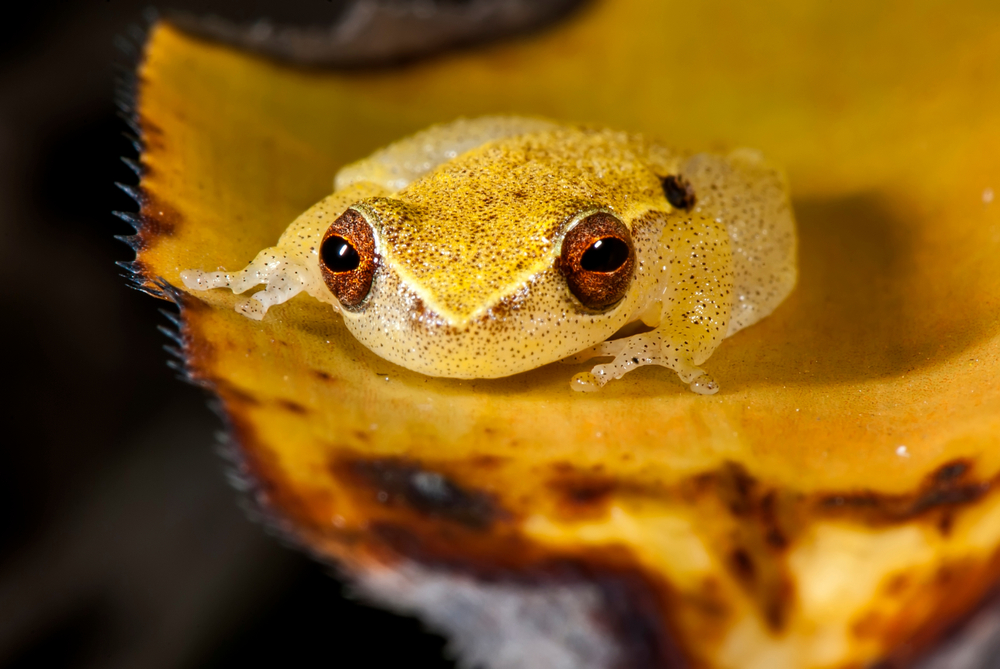
A tiny frog hiding in the forests of India’s eastern Himalayas has surprised scientists with an unusual eating habit. The miniature amphibian has been found swallowing land snails whole, including their shells, making it the first recorded frog in India known to feed on snails.
The discovery is part of an even bigger scientific finding. After five years of searching through remote Himalayan forests, researchers have identified five previously unknown species of miniature horned frogs, nearly doubling the number of known species in their group.
Five Years Of Searching Led To An Unexpected Discovery
Scientists from Harvard University and the University of Delhi have discovered five new species of tiny horned frogs in Arunachal Pradesh, a mountainous state in India’s eastern Himalayas. The discovery followed approximately five years of fieldwork in some of the region’s difficult-to-access forest habitats.
The researchers identified the frogs as members of the genus Jingophrys, a group of diminutive horned frogs found across the Himalayan region and parts of the Indochinese Peninsula. Before this research, scientists had recognised only six species within the group worldwide. The five newly identified species bring that number to 11.
The research was led by Dr Sonali Garg of Harvard University’s Museum of Comparative Zoology. Her collaborators included James Hanken, along with University of Delhi researchers SD Biju, Tage Tajo and Radhakrishna Upadhyaya K.
Their findings were published in the scientific journal Royal Society Open Science on November 11, 2026. The study was titled “Two-Fold Hidden Diversity of Diminutive Horned Frogs (Megophryinae: Jingophrys).”
The discoveries have attracted attention because they reveal how much biodiversity may remain undocumented in India’s eastern Himalayas. Despite being recognised as an exceptionally rich natural region, large parts of these mountains have received limited scientific exploration.
The findings also provide new information about the evolutionary history of the frogs. DNA evidence suggests that the formation of the Himalayan mountain range and the development of the Asian monsoon helped drive the diversification of these amphibians over millions of years.
Meet The Five Newly Discovered Horned Frogs
All five newly identified species belong to the Jingophrys group. These frogs are generally small and have distinctive horn-like skin projections above their eyes, giving them an unusual appearance.
Their miniature size and secretive behaviour make them difficult to locate in their natural habitats. Identifying them also requires careful examination because closely related species can share several physical characteristics.
The five species identified by the international research team are Jingophrys taniitatii, Jingophrys tanogogo, Jingophrys siangensis, Jingophrys hrdy and Jingophrys wularsoni.
Each has a different name connected to the region, its communities or individuals recognised through the research. The discoveries have expanded the recognised diversity of a group that previously contained only six known species.
Jingophrys taniitatii is also known as the Tanii horned frog. Its name recognises the Tanii tribal community living in the region, whose knowledge and assistance contributed to the fieldwork.
Jingophrys tanogogo is the species that has attracted particular interest because of its unusual feeding behaviour. Researchers identified it as the snail-eating horned frog after finding evidence of land snails inside its digestive tract.
Jingophrys siangensis, or the Siang horned frog, takes its name from the Siang region. The remaining two discoveries are Jingophrys hrdy, known as Hrdy’s horned frog, and Jingophrys wularsoni, called Wu-Larson’s horned frog.
Together, these discoveries increase the known number of Jingophrys species from six to 11. They also show that several distinct frog species can remain overlooked in habitats that have not received extensive scientific attention.
The Snail-Eating Frog Has A Rather Unusual Diet
Among the five newly identified species, Jingophrys tanogogo stands out because of what researchers discovered inside its digestive system. Unlike the feeding behaviour commonly associated with frogs, this species has been recorded eating land snails.
The finding makes it the first frog documented feeding on snails in India. Researchers also identified it as the first known member of its family to display this particular feeding behaviour.
Even more surprising is the evidence that the frog swallows the snails with their shells intact. Researchers found entire snail shells inside its digestive tract, providing evidence of its unusual dietary preference.
The discovery was supported by advanced micro-CT imaging. This technology allows scientists to examine internal structures and investigate what an animal has eaten without depending entirely on conventional dissection.
The images revealed the presence of snail shells inside the frog. This provided an important clue about its feeding habits and helped establish why Jingophrys tanogogo deserved particular attention.
Its unusual diet also raises questions about how the species handles food that includes a hard shell. Researchers will need additional observations to understand its feeding process and determine how frequently it consumes snails.
The discovery is particularly interesting because the species is so small. Its feeding behaviour adds another dimension to scientific understanding of the dietary differences that can exist among closely related amphibians.
The researchers have identified the species through their wider investigation of Jingophrys diversity. However, much remains to be understood about its everyday behaviour and ecological requirements.
For now, the snail-eating horned frog has become one of the most unusual discoveries from the five-year Himalayan research project.
Why Finding These Tiny Frogs Was So Difficult
Discovering new species in a remote mountain forest requires considerable preparation and patience. The researchers faced several challenges while searching for the frogs across Arunachal Pradesh.
Some of the newly identified species are extremely secretive. They are also found in remote forests and may become easier to locate only during a short breeding season.
University of Delhi professor SD Biju described this challenge while discussing the findings. “Some of the new species are extremely secretive and found in remote forests only during a short breeding season,” he said.
This limited window creates difficulties for researchers because they must locate the animals during the right period. Missing that opportunity can mean waiting for another breeding season before conducting further observations.
The region’s mountainous terrain adds another obstacle. Forests in the eastern Himalayas can be difficult to access, making it challenging to conduct repeated surveys across different locations.
Researchers therefore needed more than photographs or occasional sightings to establish the discoveries. They combined field observations with laboratory investigations to determine whether the frogs represented previously unknown species.
The team’s work involved several complementary research methods.
- Field surveys: Researchers spent approximately five years searching for frogs in the forests of Arunachal Pradesh, documenting animals found in different locations.
- DNA analysis: Genetic information helped establish evolutionary relationships and distinguish the newly identified species from previously known relatives.
- Physical examination: Scientists compared characteristics such as body size and shape to identify differences between the frogs.
- Vocalisation analysis: Frog calls provided additional information that helped researchers distinguish individual species.
- Micro-CT imaging: Advanced imaging revealed snail shells inside the digestive tract of Jingophrys tanogogo, supporting evidence of its unusual diet.
Using multiple identification methods allowed researchers to build a stronger scientific case for recognising the five species. Their findings also demonstrate why field observations and laboratory analysis are both valuable when investigating poorly studied wildlife.
Local Tribal Communities Played An Essential Role

One of the most important aspects of the discovery was the involvement of local tribal communities. Their knowledge of the forests and assistance during field surveys helped researchers locate frogs in difficult terrain.
Scientists working in unfamiliar environments can face considerable challenges when searching for small, elusive animals. Local people often possess detailed knowledge of the surrounding landscape, including places and habitats that visiting researchers may struggle to identify.
The research team acknowledged that the assistance and knowledge of local communities played an essential role in making the discoveries possible.
This contribution also influenced the naming of some newly identified frogs. Researchers chose names that recognised communities and geographical connections associated with the region.
Jingophrys taniitatii provides a particularly interesting example. The name combines the Tanii tribal name with “tatti,” the Apatani word for frog.
The naming recognises the relationship between the research and the communities whose knowledge supported the fieldwork. It also gives the newly identified species a direct connection to the cultural landscape where researchers found them.
Jingophrys siangensis provides another geographical connection through its name, which recognises the Siang region.
Such acknowledgements are significant in biodiversity research because discovering and documenting wildlife often requires cooperation between scientists and people familiar with the local environment.
The five-year investigation would have faced additional difficulties without assistance from people who knew the forests and their surroundings. Their involvement helped turn local knowledge into an important part of the scientific process.
How The Himalayas Helped These Frogs Evolve
The five discoveries have also provided scientists with an opportunity to examine the evolutionary history of the Jingophrys group.
According to the researchers’ DNA analysis, these frogs diversified into multiple species over millions of years. The process coincided with the uplift of the Himalayan mountain range and the development of the Asian monsoon climate.
The Himalayas have undergone enormous geological changes over their long history. As the mountains rose, they created a wide range of environmental conditions across the region.
The development of the monsoon also influenced the climate and ecosystems. Together, these changes helped shape the habitats where plants and animals evolved.
For frogs living in mountainous environments, geographical changes can influence where populations survive and reproduce. Different groups may become separated as landscapes and environmental conditions change.
Over extended periods, these populations can develop distinct evolutionary characteristics. This process can eventually produce multiple species from ancestral populations.
The researchers’ genetic findings suggest that these historical changes played an important role in the diversification of Jingophrys frogs.
The implications extend beyond amphibians. The uplift of the Himalayas and the evolution of the Asian monsoon have also influenced the development of plants and wildlife throughout the region.
The eastern Himalayas may therefore have played a greater role in shaping regional biodiversity than scientists previously understood.
The newly identified frogs provide another example of how millions of years of geological and climatic changes can contribute to the extraordinary variety of life found in mountain ecosystems.
Arunachal Pradesh Could Still Be Hiding More Unknown Species
Arunachal Pradesh is part of the eastern Himalayas, a region known for its extensive biodiversity and varied natural environments. Its landscapes include tropical forests and other habitats that support a wide range of wildlife.
However, many parts of the region remain poorly explored. Difficult terrain and remote forest locations have limited the amount of scientific research conducted in certain areas.
The discovery of five new frog species demonstrates how important continued fieldwork can be. Animals that have remained unrecognised for years may be living in habitats that scientists have only recently begun studying more closely.
The Jingophrys discoveries are particularly significant because they nearly double the known number of species within the group. Finding five additional species through one research project suggests that existing knowledge of Himalayan amphibians may still be incomplete.
Researchers have also pointed out that further investigations are necessary. Identifying a species is only the beginning of understanding its biology and ecological requirements.
Scientists still need to establish where the newly discovered frogs live, how they behave and what conditions they need to survive.
Their geographical distribution is another important question. Understanding whether individual species occupy restricted areas or occur across wider habitats can help researchers assess their conservation needs.
Some frogs may be particularly vulnerable if they depend on specific forest environments or limited breeding locations. However, the available findings do not establish the conservation status of these five newly identified species.
Further surveys and ecological studies will be needed before scientists can make informed assessments.
The researchers have therefore emphasised the importance of additional work to understand the frogs and determine what protection they may require.
Scientists Still Have More To Learn About These Frogs
The discovery has answered several questions about Himalayan frog diversity, but it has also opened up new areas of investigation.
Scientists now have five additional species to study, including one with a feeding behaviour previously undocumented in its family. Each discovery offers an opportunity to understand more about the biology and evolutionary relationships of these miniature amphibians.
Researchers will need to examine their habitats, breeding patterns and feeding behaviour in greater detail. The snail-eating horned frog, in particular, raises questions about how its unusual diet fits into its wider ecology.
The genetic findings also provide a foundation for investigating how the Himalayan landscape influenced the evolution of these animals. Understanding the relationship between mountain formation, monsoon development and species diversification could reveal more about the region’s biological history.
There is also a practical reason to continue studying these frogs. Scientists cannot properly assess conservation requirements without knowing where species live and what environmental conditions support them.
The remote forests of Arunachal Pradesh make this work challenging, but the latest findings show the value of sustained research.
Five years of searching have already revealed five species that were previously unknown to science. The tiny snail-eating frog may have captured the most attention, but the other four discoveries are equally important additions to the scientific record.
India’s eastern Himalayas have plenty of unexplored habitats, and researchers still have much to learn about the wildlife living within them. Somewhere in those forests, another small amphibian could be waiting for scientists to find it.