
Your cart is currently empty!
Former NASA Engineer Claims He Built an Engine That Can Counter Earth’s Gravity
For more than a century, humanity has accepted one simple truth about space travel: if you want to move forward, you have to throw something backward. Every rocket ever launched, from the earliest experimental vehicles to NASA’s most powerful spacecraft, has relied on that basic principle. It is one of the foundations of modern physics, and without it, satellites wouldn’t reach orbit, astronauts wouldn’t travel beyond Earth, and ambitious missions to the Moon and Mars would remain impossible. That is exactly why a remarkable new claim from a former NASA engineer has captured attention across the scientific community. According to Charles Buhler, his private research team has developed an experimental propulsion system that can generate thrust without expelling any propellant, a concept that, if proven, could transform everything we know about spaceflight.
Contents
show
The announcement has generated both excitement and skepticism in equal measure. Buhler says years of research led his team to discover what he describes as a completely new force produced by electric fields, one that allegedly generated enough thrust to counter Earth’s gravity during laboratory testing. Such a claim naturally raises eyebrows because it appears to challenge one of physics’ most fundamental principles: the conservation of momentum. While supporters believe the technology deserves serious attention, many scientists are urging caution until independent laboratories can reproduce the results. Similar propulsion concepts have promised revolutionary breakthroughs before, only to collapse under more rigorous testing. For now, the experimental engine sits somewhere between one of the most exciting engineering claims in recent memory and another scientific mystery waiting to be solved.
Charles Buhler Believes His Team Has Discovered a “New Force”
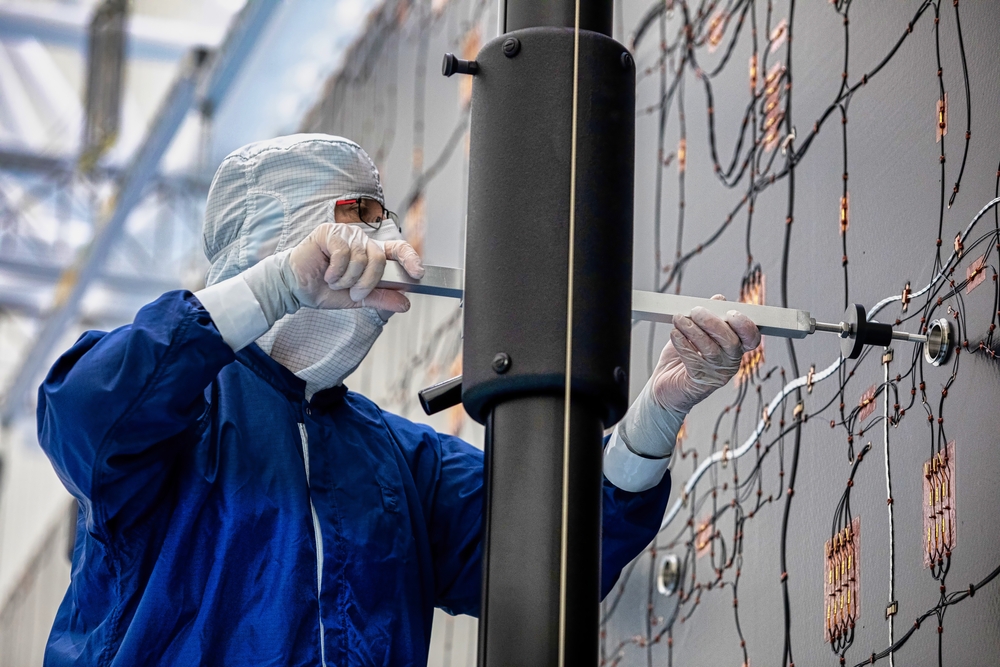
Charles Buhler is not a newcomer to the world of advanced engineering. Before founding Exodus Propulsion Technologies, he spent years working at NASA’s Kennedy Space Center, where he helped establish the Electrostatics and Surface Physics Laboratory. The laboratory focuses on understanding electrostatic effects that can interfere with spacecraft systems or even create dangerous conditions during rocket launches. His career has largely revolved around the behavior of electric fields, making his latest research a continuation of decades of specialized work rather than a sudden leap into fringe science.
Through his private company, Buhler now claims his team has discovered an entirely new propulsion effect. Instead of relying on chemical reactions or high-speed exhaust gases, the system reportedly produces force using carefully engineered electric fields. Speaking to The Debrief, Buhler described the finding as a major scientific milestone, saying, “The most important message to convey to the public is that a major discovery occurred.” He argues that the technology demonstrates electric fields alone can create a sustainable force capable of moving an object without ejecting any mass, something conventional physics says should not happen under normal circumstances.
Buhler has repeatedly emphasized that this work is completely separate from NASA and should not be viewed as an official agency project. Although his background at Kennedy Space Center naturally attracts attention, the propulsion research has been conducted entirely through Exodus Propulsion Technologies. According to Buhler, the engineering team includes individuals with experience at NASA, Blue Origin, and the U.S. Air Force, bringing together decades of aerospace knowledge in pursuit of one of engineering’s oldest ambitions: eliminating the need for propellant.
If those claims eventually withstand scientific scrutiny, the implications would extend far beyond building a better rocket engine. A propulsion system that generates continuous thrust without consuming fuel could fundamentally reshape spacecraft design, dramatically reduce launch costs, and allow future missions to travel much farther than current technology permits. That possibility explains why even skeptical physicists are paying attention, despite recognizing how extraordinary the claims appear.
Why This Idea Challenges the Laws of Physics
Every rocket ever built follows the same basic rule described by Sir Isaac Newton centuries ago. Newton’s Third Law states that for every action there is an equal and opposite reaction. When a rocket burns fuel, it expels hot gases at tremendous speed in one direction, causing the spacecraft to move in the opposite direction. Whether launching astronauts into orbit or adjusting a satellite’s position hundreds of miles above Earth, every propulsion system depends on throwing mass away to create movement.
Because of that requirement, carrying fuel is one of the biggest engineering challenges in space exploration. Modern rockets often launch with most of their total weight consisting of propellant rather than payload. Engineers have spent decades searching for alternatives because reducing the amount of fuel needed could dramatically lower mission costs while allowing spacecraft to travel farther and operate longer. That dream has inspired countless experimental propulsion concepts over the years, but none have successfully replaced conventional rockets.
A propulsion system capable of producing thrust without expelling propellant would solve several longstanding challenges at once. If such technology genuinely exists, it could unlock possibilities that engineers have only imagined for decades. Among the most significant potential advantages are:
- Longer Deep-Space Missions: Spacecraft could continue accelerating without carrying enormous fuel reserves, allowing missions to reach destinations that are currently difficult or impractical.
- Lower Launch Costs: Fuel accounts for a large portion of every rocket’s launch weight. Reducing that requirement could significantly lower the cost of sending payloads into orbit.
- Extended Satellite Lifespans: Many satellites become unusable simply because they run out of propellant for station-keeping. A fuel-free propulsion system could allow them to remain operational for much longer.
- Greater Mission Flexibility: Engineers could design spacecraft without many of today’s propulsion constraints, opening new possibilities for scientific exploration and commercial spaceflight.
These possibilities explain why alternative propulsion research continues despite decades of setbacks. However, they also explain why scientists demand overwhelming evidence before accepting claims that appear to challenge one of physics’ most reliable principles. The more revolutionary an idea appears, the stronger the evidence must be before the scientific community embraces it.
Scientists Have Heard Similar Promises Before
Buhler’s announcement is not the first time researchers have suggested they had discovered a way to generate thrust without conventional fuel. More than two decades ago, British electrical engineer Roger Shawyer introduced a controversial device known as the EmDrive, a propulsion system that quickly became famous as the “impossible engine.” Like Buhler’s current project, the EmDrive promised to generate thrust without expelling propellant, immediately sparking debate among physicists around the world.
The idea gained even more attention in 2016 when NASA’s Eagleworks laboratory reported measuring tiny amounts of thrust during experimental testing. Those results fueled widespread excitement across the internet, with some enthusiasts predicting that humanity was on the verge of replacing traditional rockets altogether. Headlines suggested a new era of space travel might be approaching, while supporters argued that the unexpected measurements hinted at previously unknown physics.
Yet many scientists remained unconvinced from the very beginning. Measuring extremely small forces inside sensitive laboratory equipment is notoriously difficult, and researchers warned that tiny amounts of heat, vibration, electrical interference, or even imperfections in measuring instruments could easily produce misleading results. Rather than accepting the early findings, physicists called for more rigorous experiments capable of eliminating every possible source of error before declaring that a new form of propulsion had been discovered.
The EmDrive Became a Lesson in Scientific Skepticism
Over the next several years, laboratories around the world continued investigating the EmDrive using increasingly sophisticated equipment. Researchers worked to isolate every possible source of interference, redesigning experiments to determine whether the reported thrust was genuine or simply the result of measurement errors. As the testing became more precise, confidence in the technology steadily declined.
The turning point came in 2021 when researchers at Dresden University of Technology published results showing that the apparent thrust disappeared once external influences were properly accounted for. Instead of discovering a revolutionary propulsion system, the team concluded that earlier experiments had most likely been detecting tiny environmental effects that mimicked thrust. The findings effectively brought the EmDrive’s long and controversial journey to an end.
For many physicists, the EmDrive became more than just a failed experiment. It became a reminder of how easy it is for groundbreaking claims to emerge from extremely delicate measurements. When scientists work with forces measured in fractions of a millinewton, even the smallest vibration, temperature change, or electromagnetic disturbance can create results that appear convincing until better experiments reveal another explanation. That history now shapes how researchers are approaching Buhler’s latest announcement.
The similarities between the two stories are difficult to ignore. Both involve claims of propellantless propulsion, both generated excitement because of their potential to transform space exploration, and both challenge principles that have guided physics for generations. The difference is that scientists now have a recent example showing exactly why patience and careful verification matter before celebrating what could be one of the biggest discoveries in aerospace engineering.
Buhler Says Years of Research Led to a Breakthrough
Unlike projects that appear suddenly with little explanation, Buhler says his team’s work is the result of decades of gradual experimentation. During interviews with the Alternative Propulsion Energy Conference (APEC), he explained that researchers spent years investigating different propulsion concepts before narrowing their focus to electrostatic phenomena. According to Buhler, early prototypes produced almost no measurable thrust, but each redesign delivered small improvements that encouraged the team to continue refining the technology.
That long process eventually led to what Buhler describes as a breakthrough in 2023. He claims one version of the experimental drive generated enough force to counter Earth’s gravity during laboratory testing. Rather than relying on conventional propulsion, the device allegedly creates asymmetrical electrostatic pressure capable of producing a net force on the system’s center of mass. If independently confirmed, such a result would represent a phenomenon that current physics cannot easily explain.
Buhler has also said his team conducted approximately 2,000 experiments inside vacuum chambers while refining the system. Vacuum testing is considered essential because it removes air currents and many external influences that could affect sensitive measurements. According to Buhler, some experiments even suggested that portions of the measured force briefly remained after electrical power had been switched off, an observation that has generated considerable discussion among propulsion researchers.
Those reported results are certainly intriguing, but they remain claims made by the research team itself. Until independent laboratories repeat the experiments using their own equipment and reach the same conclusions, scientists have little choice but to remain cautious. History has shown that even extensive internal testing cannot replace outside verification when extraordinary discoveries are involved.
Independent Verification Will Decide Everything
Scientific discoveries are rarely accepted because they sound convincing or because the researchers involved have impressive credentials. Instead, they become accepted when completely independent teams perform the same experiments and obtain the same results under carefully controlled conditions. That process, known as independent replication, is one of the foundations of modern science because it helps eliminate bias, hidden errors, and accidental misinterpretations.
At the moment, that crucial step has not yet happened. As of May 2026, no outside laboratory has published a peer-reviewed study demonstrating the same propulsion effect using its own apparatus, instrumentation, and uncertainty analysis. Without that confirmation, Buhler’s work remains an intriguing claim rather than an established scientific discovery.
Even supporters within the Alternative Propulsion Energy Conference acknowledge that independent replication represents the biggest unanswered question surrounding the technology. Conference organizers have repeatedly noted that patents, investment presentations, promotional videos, and conference demonstrations should never be mistaken for scientific validation. Those milestones may indicate confidence from the developers, but they cannot replace carefully documented experiments reproduced by researchers with no involvement in the original project.
This cautious approach is not intended to dismiss new ideas. Quite the opposite. Throughout history, many revolutionary discoveries initially faced skepticism before accumulating enough evidence to convince the broader scientific community. Independent replication protects both scientists and the public by ensuring that exciting announcements ultimately stand on evidence rather than enthusiasm.
Investors Are Watching While Scientists Wait
Although the scientific verdict remains uncertain, Exodus Propulsion Technologies has begun attracting attention beyond research circles. Earlier this year, the company participated in Deep Tech Week NYC, where Buhler met with investors, entrepreneurs, and physicists interested in advanced propulsion technologies. The event reflected growing curiosity about whether the company’s work could eventually lead to commercially valuable breakthroughs.
Interest from investors is hardly surprising. If even a small portion of Buhler’s claims proves accurate, the commercial opportunities could be enormous. A propulsion system that reduces or eliminates the need for conventional rocket fuel would have applications ranging from satellites and space exploration to entirely new classes of aerospace vehicles. Such possibilities naturally attract attention from companies looking for transformative technologies.
Still, financial backing should not be confused with scientific proof. History contains numerous examples of ambitious technologies that attracted millions of dollars in investment before ultimately failing to deliver on their promises. Investors often support ideas based on future potential, while scientists require repeatable evidence before accepting that a breakthrough has truly occurred. Those are two very different standards, and both will shape the future of Exodus Propulsion Technologies in the years ahead.
For now, the company’s growing visibility demonstrates that the concept is being taken seriously enough to warrant discussion. Whether it eventually earns acceptance within the scientific community depends entirely on what future experiments reveal.
Could This Really Change Space Travel Forever?
If independent laboratories eventually confirm Buhler’s findings, the impact on space exploration would be difficult to overstate. Engineers could begin designing spacecraft that no longer need to dedicate most of their launch weight to fuel, making missions cheaper, lighter, and capable of traveling much farther than current technology allows. Satellites might remain operational for decades instead of becoming obsolete once their propellant tanks run dry, while deep-space probes could continue accelerating long after conventional engines would have exhausted their fuel supply.
Such a discovery would also force physicists to investigate whether an entirely new phenomenon exists within electrostatics or whether current theories need to be expanded to explain the observed force. Discoveries that challenge long-standing assumptions are rare, but they have happened before. The difference is that every genuine scientific revolution survived years of independent testing before earning widespread acceptance.
Until that process takes place, Buhler’s experimental engine occupies an unusual position. It is intriguing enough to attract investors, engineers, and propulsion enthusiasts, yet unproven enough that most physicists remain unconvinced. That combination has made it one of the most closely watched developments in alternative propulsion research.
The coming years will likely determine whether this experimental engine marks the beginning of a genuine breakthrough or joins the long list of ambitious ideas that captured the world’s imagination before reality caught up. For now, the technology remains exactly what science demands it should be: an extraordinary claim waiting for extraordinary evidence.