
Your cart is currently empty!
Harvard Astrophysicist Suggests Mysterious Interstellar Object 3I/ATLAS May Be ‘Maneuvering’ Like an Alien Craft

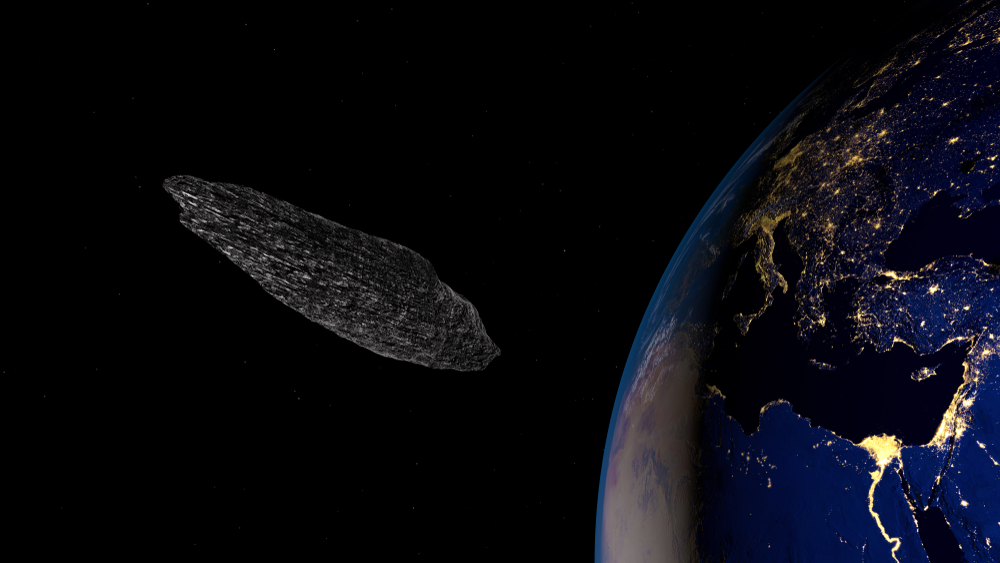
Something extraordinary is happening in the skies, and it has both astronomers and dreamers looking up with renewed curiosity. The interstellar object known as 3I/ATLAS, roughly the size of Manhattan, has developed a long, gleaming tail as it moves through our solar system. To many, this might sound like the typical behavior of a comet as it nears the Sun, but to a few scientists, including Harvard astrophysicist Avi Loeb, this latest development could hint at something far stranger. Loeb has suggested that 3I/ATLAS’s unusual transformation might not be a random event but a possible sign of “controlled maneuvering,” the sort of behavior one might expect from an engineered spacecraft rather than a wandering lump of ice and rock.
Contents
show
The idea sounds extraordinary because it is, but it comes from credible observation rather than idle speculation. Since July 2025, 3I/ATLAS has puzzled astronomers with its peculiar structure and behavior. At first, the object showed what scientists described as an “anti-tail,” a plume of gas and particles pointing toward the Sun instead of trailing behind it. Then, within a few months, that configuration shifted dramatically, revealing a more conventional tail that stretches out behind the object as solar radiation intensifies. This sequence of changes has prompted serious study, even among those who doubt Loeb’s more provocative interpretation. Something about 3I/ATLAS refuses to fit neatly into the known categories of interstellar behavior.
🚨Sabine Hossenfelder: Just said what a lot of scientists won’t about 3I/ATLAS
— Skywatch Signal (@UAPWatchers) October 15, 2025
“The more data we have, the more unusual it’s become.”
“It’s shedding nickel and iron at an exceptional rate.”
“Its tail points toward the Sun, possibly seen for the first time.”
“It changes the… pic.twitter.com/LogmOU7duj
From Mysterious Visitor to Scientific Enigma
When 3I/ATLAS first appeared in our skies in mid-2025, it was immediately recognized as a rare interstellar visitor, similar to ʻOumuamua in 2017 and Borisov in 2019. Yet from the beginning, it seemed determined to defy expectations. Rather than producing a tail that trailed its path, it sent out a bright plume toward the Sun, confusing astronomers who initially thought they were misinterpreting their own instruments. The anti-tail, as it came to be called, made the object look as if it were moving backwards through space, something that appeared to contradict the laws of cometary motion driven by solar heat and radiation pressure.
In late September, Spain’s Nordic Optical Telescope captured new images that only deepened the mystery. The anti-tail had vanished, replaced by a glowing comet-like tail that trailed neatly behind the object. This was not a simple case of perspective or illumination. The transition occurred over weeks as 3I/ATLAS moved closer to the Sun, enduring an estimated 33 gigawatts of solar radiation. According to Loeb’s calculations, that shift could represent a physical response to external forces or possibly a change in propulsion. In his paper, he proposed a scenario in which the anti-tail represented a braking phase, as though the object were slowing down, and the new tail reflected a return to normal forward motion.
For most of the scientific community, that interpretation remains speculative, though fascinating. The succession of the anti-tail followed by a standard tail might still be explained through natural causes, such as varying particle sizes, rotational dynamics, or solar wind effects. Yet the simple truth is that astronomers have never seen an object quite like this before, and until more data arrives, every hypothesis remains on the table.
🚨 3I/ATLAS Humanity, It’s Time To Speak☄️
— $Atlas CTO (@Atlas__CTO) October 23, 2025
Listen up people of Earth, Something just changed with 3I/ $ATLAS.
The UN Space Defense Group & @NASA has officially launched a global defense campaign for $ATLAS
The first time inhuman history an object must be counter-observed and… pic.twitter.com/sF9aH4g6tB
The Harvard Hypothesis and Its Critics
Avi Loeb is no stranger to controversy. Known for his willingness to explore unconventional explanations, he has long argued that science should not dismiss extraordinary hypotheses when data refuses to conform to expectation. In his recent analysis, Loeb suggests that if 3I/ATLAS is an artificial object, the anti-tail could have been the result of controlled propulsion used to decelerate upon entering the solar system. Once the object’s velocity stabilized, the exhaust pattern would naturally reverse, creating a tail that trailed behind it. His reasoning builds on decades of research into cometary physics and radiation dynamics, yet it also borrows ideas from theoretical propulsion systems that remain speculative for human technology.
Many of Loeb’s colleagues urge caution. Dr. Karen Meech of the University of Hawaii, who has studied interstellar objects extensively, notes that anti-tail effects can occur due to viewing geometry rather than any intrinsic motion. Depending on the observer’s angle, sunlight can make dust particles appear to extend in unexpected directions. Dr. Alan Fitzsimmons from Queen’s University Belfast agrees that optical and dynamic effects could easily explain the sequence, though he admits that the object’s composition is “deeply intriguing.” What has truly caught attention is the detection of a nickel-based alloy within the plume, a material never observed in naturally occurring comets or asteroids but common in engineered components such as turbine blades and spacecraft shielding. That discovery, confirmed through spectroscopic analysis, has left even skeptics acknowledging that 3I/ATLAS may be unlike anything we have seen before.
Loeb argues that the history of science is filled with moments when skepticism met surprise. Just as pulsars were first thought to be artificial radio signals before being identified as neutron stars, he believes it is worth considering possibilities that challenge current assumptions. Whether his hypothesis proves correct or not, it has reignited a global conversation about the boundaries of what we define as “natural” in the cosmos.
BREAKING: Harvard scientist believes a Manhattan-sized space object called 3I/ATLAS may be showing signs of an alien “maneuver” after it suddenly developed a strange tail. pic.twitter.com/i5wYJLvIju
— The General (@GeneralMCNews) October 25, 2025
A Cosmic Giant with Strange Chemistry
Beyond the philosophical questions, the physical characteristics of 3I/ATLAS are remarkable in their own right. Scientists estimate its mass to be around 33 billion tons, making it one of the largest interstellar objects ever recorded. Its surface, reflecting light in shifting hues, suggests a complex mixture of ice, metal, and minerals. Early readings revealed traces of carbon dioxide, water vapor, and cyanide—elements typical of cometary bodies—but the presence of the metallic nickel alloy stands out as an anomaly. This combination has led some to speculate that the object might have a partially metallic core or a crust of material fused under intense heat, possibly from a past collision or an artificial process.
As the object moves closer to the Sun, its outer layers are stripped away by intense radiation, creating jets of vaporized gas that stream behind it. Each burst releases massive amounts of energy, adding both to its brightness and to the complexity of its tail. The Nordic Optical Telescope’s time-lapse images show layers of material peeling off in rhythmic intervals rather than a continuous stream. That periodic shedding, scientists note, could result from rotational patterns, but Loeb’s supporters argue that it may indicate deliberate pulses of propulsion. For now, no consensus exists, only mounting curiosity and a shared desire for more data.
Whatever the explanation, 3I/ATLAS is forcing researchers to rethink what interstellar bodies can be made of and how they behave under solar stress. Even if natural, its unique chemistry provides a glimpse into the diversity of materials forged in other star systems. If artificial, it would be the most profound discovery in human history.

NASA’s Silence and the Waiting Game
In early October, as 3I/ATLAS passed within twelve million miles of Mars, NASA’s HiRISE camera aboard the Mars Reconnaissance Orbiter captured the clearest images yet of the object. Those images, however, remain unreleased due to the ongoing U.S. government shutdown, leaving scientists around the world anxiously awaiting their publication. Meanwhile, data from the James Webb Space Telescope and Hubble have revealed heat signatures that suggest dense material composition and complex gas emissions, though interpretations vary widely.
NASA’s International Asteroid Warning Network has added 3I/ATLAS to its observation list, assuring the public that the object poses no threat to Earth. Instead, it presents what the agency calls a rare opportunity for scientific study. The network’s official statement emphasized that the object’s prolonged visibility from Earth allows for extensive observation campaigns, which could reveal details about interstellar chemistry, radiation response, and tail formation unlike any we have previously recorded. European and Asian observatories have joined the effort, coordinating a multi-continental monitoring campaign in hopes of producing a complete profile of its motion, material, and structure.
As the world waits for NASA’s images, speculation continues. If the tail’s geometry or composition shows any sign of directed thrust or controlled ejection, Loeb’s hypothesis will gain remarkable weight. If not, the scientific value remains immense, providing fresh insights into how interstellar matter interacts with solar energy. Either way, 3I/ATLAS has already earned a place in the history of astronomy as one of the most studied and debated visitors ever to enter our solar system.

A Reflection on Wonder and Skepticism
In the end, 3I/ATLAS stands as both a mystery and a mirror. Whether it is a natural comet behaving in unexpected ways or something created by intelligent beings, it reminds us how limited our understanding of the universe remains. Humanity has always been quick to dismiss the improbable until it becomes undeniable. Yet it is precisely that tension between doubt and imagination that propels science forward. Each new observation forces us to confront the limits of our knowledge and to refine how we seek truth among the stars.
Even if the object turns out to be an entirely natural phenomenon, its story has already accomplished something remarkable. It has reignited public fascination with astronomy and encouraged a new generation of scientists to look beyond what seems obvious. The line between mystery and discovery is thin, and sometimes it takes a curious anomaly to make us see the universe with fresh eyes. For now, as 3I/ATLAS races closer to the Sun, it trails not only gas and dust but also the enduring human desire to understand what lies beyond our world.