
Your cart is currently empty!
The Man Who Refused Millions To Save A Forgotten Island
A British journalist bought a tiny abandoned island in the Seychelles for around $11,000 in the 1960s. There was no electricity, no fresh water, and barely any wildlife left.
Contents
show
Decades later, developers offered him up to $50 million for the land. He refused every single offer.
The Island Nobody Wanted
When Brendon Grimshaw first arrived in the Seychelles in 1962, the tropical archipelago had not yet become the luxury travel destination the world knows today.
The islands were quiet, isolated, and still largely untouched by mass tourism. Grimshaw had traveled there while working as a newspaper editor in East Africa, and the moment he saw the region, something changed.
He was searching for a different kind of life.
Near the end of his trip, a local man approached him in the capital city of Victoria and casually asked if he wanted to buy an island.
That island was Moyenne.
At the time, Moyenne Island was almost completely abandoned. Thick invasive vegetation covered the land. There were no roads, buildings, utilities, or infrastructure. Birds had largely disappeared from the island, rats roamed the undergrowth, and much of the native ecosystem had collapsed.
Most people would have seen a useless patch of land.
Grimshaw saw potential.
He bought the 24-acre island for £8,000, which would equal roughly $11,000 at the time.
The decision would shape the rest of his life.
He Left Comfort Behind For A Purpose
Grimshaw did not buy the island to build a private resort.
He did not buy it to become rich.
He certainly did not buy it because life there was easy.
Living on Moyenne meant surviving with very few modern comforts. Fresh water had to be carefully collected and managed. Food often had to be brought from nearby islands. The terrain was rough, heavily overgrown, and difficult to navigate.
Yet Grimshaw stayed.
He later described the island as the place he had been searching for.
“It was totally different. It was a special feeling,” he said during a documentary interview years later.
The island quickly became more than a home. It became a mission.
Grimshaw teamed up with a local Seychellois man named Rene Antoine Lafortune, the son of a fisherman who understood the local environment better than anyone. The two men formed a close friendship and spent years transforming the neglected island together.
The work was brutal.
There were no large machines tearing through the landscape. No wealthy investors funding the project. No grand development plans.
Everything happened slowly, by hand.
Planting 16,000 Trees One By One

The first task was clearing invasive plants that had smothered much of the island.
Grimshaw and Lafortune cut narrow walking paths through the dense vegetation so they could move around the island. Cars were never allowed there. Even today, visitors explore Moyenne on foot.
Then came the trees.
Over several decades, the pair planted around 16,000 trees across the island.
The effort included native species that had disappeared from parts of the Seychelles because of human activity and development. As the trees matured, the environment slowly began healing itself.
Shade cooled the soil.
Moisture returned to the ground.
Native plants started growing again.
Birds returned.
The island that once felt silent slowly came back to life.
According to people who later visited Moyenne, the transformation was astonishing. What had once been an overgrown wasteland became a dense green sanctuary filled with tropical vegetation.
Today, the island contains mahogany trees, mango trees, palms, pawpaw plants, and dozens of other species.
Some estimates even suggest Moyenne now has one of the highest concentrations of plant species per square meter of any national park on Earth.
The Giant Tortoises That Became The Island’s Symbol
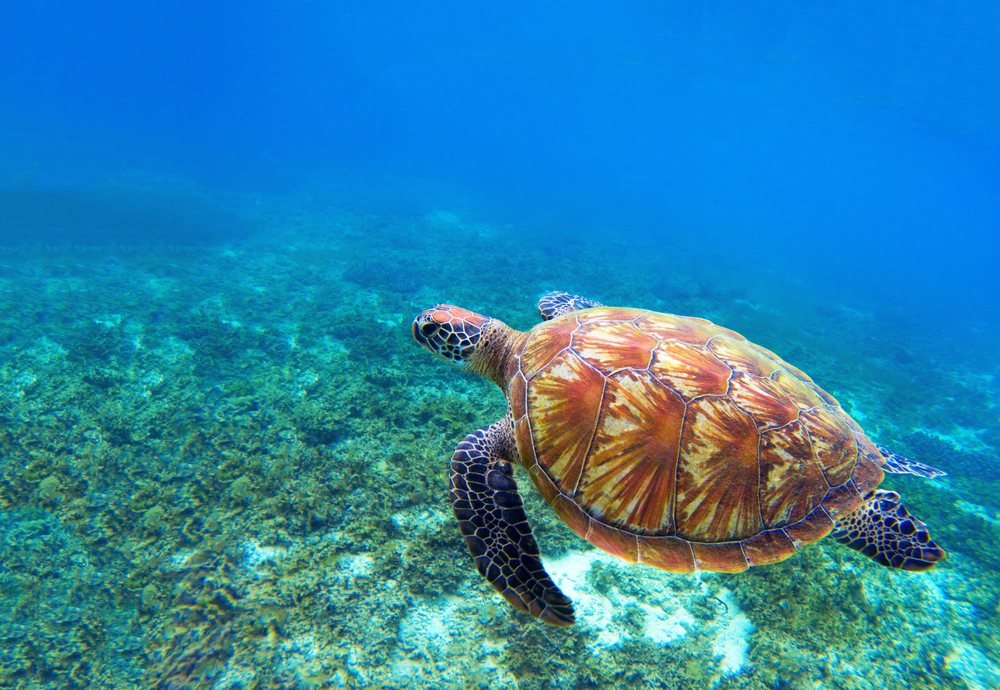
One of Grimshaw’s most famous conservation efforts involved giant Aldabra tortoises.
The enormous reptiles are native to the Seychelles region but have been pushed close to extinction after centuries of exploitation.
Grimshaw began introducing the tortoises to Moyenne, giving them a protected environment where they could live safely.
The animals thrived.
Today, giant tortoises roam freely across the island, often wandering directly across walking paths while tourists wait patiently for them to pass.
The tortoises became one of the island’s defining images.
But they were not the only animals to return.
As the ecosystem recovered, seabirds began nesting there again. Marine life around the coastline improved as vegetation stabilized the island’s soil and reduced erosion.
Moyenne gradually evolved into a functioning ecosystem rather than a carefully managed attraction.
That difference mattered deeply to Grimshaw.
He never wanted the island to become a zoo or a commercial spectacle.
Nature was supposed to exist there on its own terms.
Tourism Was Changing The Seychelles Fast
While Grimshaw was restoring Moyenne, the rest of the Seychelles was changing rapidly.
By the 1980s and 1990s, the islands had become one of the world’s most glamorous tourist destinations.
Luxury resorts spread across the archipelago.
Private villas appeared along beaches once surrounded only by jungle.
Developers recognized the enormous financial potential of isolated tropical islands, especially in a destination known for crystal-clear water and white sand beaches.
Moyenne attracted attention almost immediately.
Investors saw the island’s location near Mahé, the Seychelles’ main island, and realized it could become an ultra-exclusive luxury escape.
Offers started arriving.
Some proposed partnerships.
Others promised enormous cash payouts.
One rumored offer from Saudi Arabia reportedly reached $50 million.
For most people, that kind of money would end the conversation instantly.
Grimshaw never seriously considered selling.
Friends who knew him said he viewed large-scale resort development as destructive greed. Selling the island would have erased decades of conservation work and turned Moyenne into exactly the kind of project he had spent his life resisting.
Instead, he kept protecting it.
The Island Had Strange Legends Of Its Own
Moyenne was not only known for its wildlife.
The island also carried old pirate legends that fascinated Grimshaw for years.
During restoration work, he discovered two graves marked with the words “Unhappily Unknown.”
Stories circulated that pirates had once buried treasure somewhere on the island and killed two men to guard it in death.
According to local legends, their spirits would protect the hidden riches forever.
Whether Grimshaw truly believed the stories remains unclear.
People close to him later said he simply enjoyed the mystery.
He occasionally searched parts of the island for treasure with friends, although nothing valuable was ever found.
Some maps of Moyenne still include skull-and-crossbones symbols marking areas where searches took place.
The pirate stories only added to the island’s unusual reputation.
Visitors arrived expecting a tropical paradise and discovered a place filled with wildlife, silence, hidden trails, and stories that sounded like they belonged in an adventure novel.
He Wanted The Island To Survive After Him
As Grimshaw grew older, he became increasingly concerned about what would happen to Moyenne after his death.
He had no children.
His longtime friend Rene Lafortune died in 2007, leaving Grimshaw alone on the island he had spent decades restoring.
He understood that if legal protections were not put in place, developers could eventually take control.
So he acted.
Working alongside friends and environmental supporters, Grimshaw helped create a perpetual trust designed to protect the island permanently.
Then, in 2009, his biggest goal finally became reality.
Moyenne Island officially became part of the Saint Anne Marine National Park system and received special protected status from the Seychelles government.
It became the world’s smallest national park.
The recognition meant the island would remain protected from large-scale development long after Grimshaw was gone.
For him, that mattered far more than money.
Visitors Still Experience The Island Differently
Even today, Moyenne feels very different from much of the modern Seychelles tourism industry.
There are no massive hotels covering the coastline.
No luxury villas dominate the landscape.
No roads cut through the forest.
Visitor numbers remain tightly controlled to protect the environment.
At peak times, only small groups are allowed onto the island, and daily visitor limits are carefully monitored.
People arriving there often step directly from boats into shallow water because the island still has no major jetty.
The experience feels intentionally simple.
Walking through Moyenne means following narrow forest trails under thick tree cover while giant tortoises move slowly through the undergrowth.
Many visitors describe the island as strangely peaceful.
Suketu Patel, one of Grimshaw’s longtime friends and supporters, once explained the feeling this way:
“If you think you have a big problem, when you’re on the island you realize that it’s not a problem after all. Moyenne is what life should be like.”
That atmosphere was exactly what Grimshaw hoped to preserve.
In his final wishes, he said the island should remain “a venue for prayer, peace, tranquillity, relaxation and knowledge for Seychellois and visitors from overseas of all nationalities, colours and creeds.”
A Different Definition Of Success
Stories about wealth usually end with bigger houses, larger businesses, or massive payouts.
Brendon Grimshaw’s story moved in the opposite direction.
He spent decades doing physically exhausting work on a remote island with very little comfort. He planted trees slowly, protected wildlife patiently, and rejected life-changing amounts of money.
From a financial perspective, the decision makes almost no sense.
Yet more than a decade after his death in 2012, Moyenne still exists exactly because he refused to treat it like a business opportunity.
The island now stands as one of the clearest examples of what a single person can accomplish through long-term environmental restoration.
Grimshaw did not lead a giant conservation organization.
He did not have billionaire funding.
He simply committed himself to one small place and never gave up on it.
His work transformed an abandoned island into a protected sanctuary filled with forests, birds, marine life, and giant tortoises.
That legacy continues long after the offers, the investors, and the development plans disappeared.
The Story Continues To Fascinate People Around The World
Years after his death, Brendon Grimshaw’s story still spreads widely online because it feels almost impossible in the modern world.
A man buys a neglected island for a relatively small amount of money.
He spends half a century restoring it instead of exploiting it.
Then he refuses millions because he believes protecting nature matters more.
The story cuts directly against the way people often think about success.
Many tropical islands became symbols of extreme wealth and exclusivity over the last few decades. Moyenne became something else entirely.
It became proof that conservation does not always begin with governments or giant corporations.
Sometimes it begins with one stubborn person deciding that a damaged place deserves another chance.
That decision changed an entire island forever.
And because Brendon Grimshaw protected it when he had every financial reason not to, Moyenne remains one of the last undeveloped islands in the Seychelles today.