
Your cart is currently empty!
More Bible in Texas Public Schools? The State Board of Education Debates

Inside a hearing room in Austin, nearly 500 people had signed up to speak, and tempers were running high. At stake was a decision that could reshape what more than 5 million Texas schoolchildren read in their classrooms and how they learn the story of their own country. By the time the day was over, at least one person had been removed for getting out of order, and the State Board of Education had taken a consequential first step.
Contents
show
The proposals on the table would weave Christian stories more deeply into public school reading lists while simultaneously rewriting how Texas teaches history. To supporters, this represents a long-sought correction, a return to the values they believe built the nation. To opponents, it amounts to something closer to a constitutional breach, one that elevates a single faith and sidelines the millions of Texans who do not share it. What the board actually approved, and what it would mean for classrooms across the state, sits at the center of one of the most contentious education fights Texas has seen in years.
What The Board Approved And When
The majority-Republican State Board of Education granted preliminary approval on Tuesday afternoon to a statewide reading list for all public schools, one that includes the teaching of Christian stories. Having cleared that first hurdle, board members then turned to a separate and equally significant matter, a proposed rewrite of the state’s social studies lessons, with an initial vote on those changes expected to follow.
Final votes on both proposals were anticipated on Friday. Should the board grant final approval, the changes would take effect during the 2030-31 school year. The decisions fall under the Texas Essential Knowledge and Skills framework, the set of standards that governs instruction for the state’s more than 5 million public school students, which is precisely why the outcome carries such weight far beyond the Austin hearing room.
The Bible Stories Headed For Classrooms
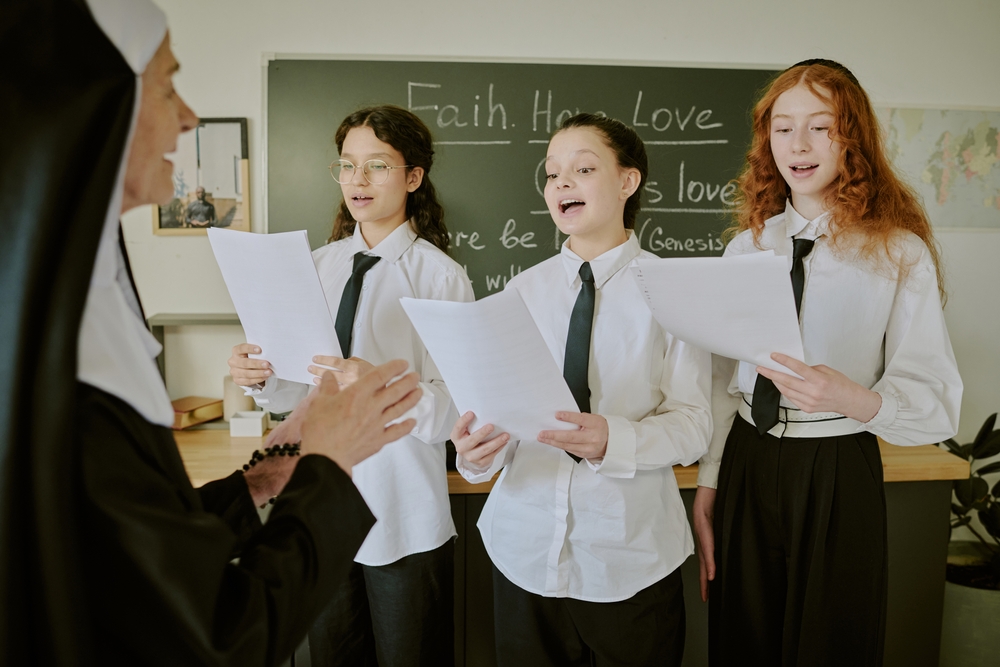
At the heart of the debate is a reading list that would require schools to teach biblical material to children as young as 6, all the way up to high school seniors preparing to graduate. The religious selections amount to roughly a dozen passages drawn from a larger pool of about 200 required readings spanning kindergarten through high school.
The specific choices reveal the scope of the proposal. Young children would encounter stories with titles like “Noah’s Ark,” “David and Goliath,” and “Daniel and the Lion’s Den,” with some meant to be read aloud from picture books. The story of Daniel is to be supplied by the Christian Broadcasting Network, the media company founded by televangelist Pat Robertson in the 1960s. Older students would read more substantial passages, including the second chapter of Genesis recounting the creation of Adam and Eve, the Eight Beatitudes, the Parable of the Prodigal Son, the famous meditation on love in 1 Corinthians 13, and more than a dozen chapters from the book of Job. Two readings are drawn from the Hebrew Bible, while Catholic-approved translations and the sacred texts of non-Christian faiths are largely absent.
Why The Choice Of Translation Matters
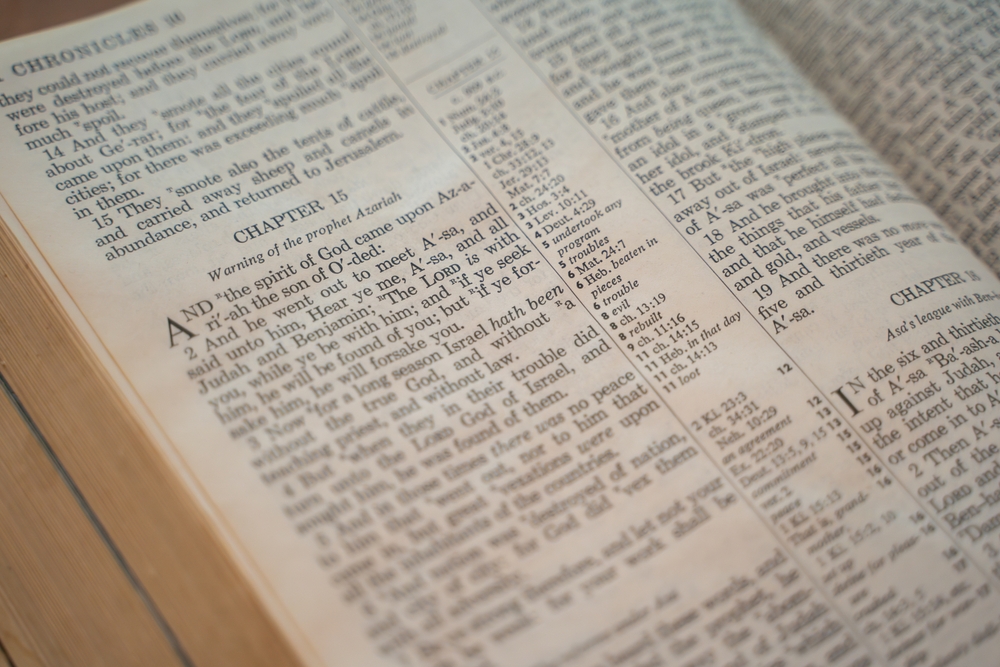
A more subtle dimension of the proposal lies in a detail that might otherwise escape notice: the requirement that schools use specific Bible translations. Because Christian scripture was originally written in Greek and Hebrew, any rendering into English involves choices that can shape the tone and message of a passage, and the proposal’s selections lean heavily toward particular Christian traditions.
The point becomes concrete in the treatment of Eve. The required New International Reader’s Version, simplified to a third-grade reading level, describes Eve as the “helper that was just right” for Adam. Other translations word it quite differently, with the academically favored New Revised Standard Version describing “a helper as his partner,” and the Catholic New American Bible offering “a helper suited to the man.” David Holland, a professor of church history at Harvard Divinity School, explained the significance of such choices.
“The minute you use a textual translation of a book that is shared across religious traditions, as the Hebrew Bible is — but you’re choosing a translation that was created in a particular religious context — you’re inevitably going to privilege certain kinds of Christian understandings of that text,” he said.
That observation cuts to a core concern of the proposal’s critics, that the very texts chosen, and the versions in which they appear, tilt the classroom toward one faith’s reading of stories that many religions hold in common.
The Contentious Public Hearing
The Monday hearing that preceded the votes laid bare just how divided Texans are over the proposals. Nearly 500 people signed up to testify, and the proceedings turned heated at several points, with sharp exchanges between speakers and the removal of at least one person whom the board chair deemed out of order.
Teachers, students, and community members came forward both in support of and in opposition to the suggested lessons, and the testimony reflected a genuine clash of values rather than a one-sided affair. The intensity of the hearing underscored that this was no routine curriculum update, but a fight over questions, religion, history, and identity that many Texans clearly regard as fundamental.
The Case For The Changes
Those who back the proposals see them as a necessary corrective. Conservative Republican leaders and activists have championed the new lessons, framing them as part of a broader effort to rid Texas schools of instruction they believe paints America in a negative light and, in their view, trains students to resent their own country. For these supporters, the readings restore something they feel has been lost.
Julie Pickren, a Republican member of the education board, articulated the supporters’ rationale in terms of educational value rather than religious promotion. She argued that the readings are meant to provide insight into the moral and philosophical traditions that have shaped Western civilization, and that engaging directly with primary historical documents strengthens students’ reasoning. By studying original writings, speeches, and foundational texts, she contended, students learn to evaluate ideas and grasp the principles that shaped both the United States and Texas. In this telling, the Bible passages are not devotional material but cultural and historical bedrock that students ought to understand.
Why Supporters Back The Changes

Opponents see the matter very differently, objecting both to the prominence given to Christianity and to what they describe as the exclusion of other voices. Students, educators, and progressive activists spoke out against the lack of racial, ethnic, and gender inclusion in the proposed books and lessons, as well as the state’s emphasis on Christianity over other religions.
Rebecca Bell-Metereau, a Democrat on the education board who had voted against the reading list in April, pointed to the diversity of the student population itself. She noted that Texas is home to a healthy proportion of people of other religions or no religion at all, and questioned the justification for the approach.
“So there really isn’t, in my view, a good justification for trying to turn our public schools into Sunday schools,” she said.
The scholarly perspective complicates any simple framing of the debate as religion versus secularism. Chad Seales, an associate professor of religious studies at the University of Texas at Austin, observed that compulsory religion in public education has historically bred division, noting that the teaching of Protestant scripture in public schools through the 1950s helped drive Catholic and Jewish families to create their own schools. Yet Seales, who grew up in the evangelical Christian tradition, also believes biblical literature has a legitimate place in public education, since a complete ignorance of religion leaves students unable to fully understand American history or the many biblical allusions woven through Western literature. His distinction, that the problem lies not in teaching about religion but in compulsory forms of it, captures a nuance often lost in the broader argument.
The Islamophobia Controversy
A distinct and especially charged thread ran through the proceedings, centered on the treatment of Islam. The concern did not emerge in isolation. During the board’s April meetings, members eliminated a social studies standard that would have required students to learn about Muslim contributions to algebra and astronomy.
At the Monday hearing, the rhetoric grew pointed. Sen. Bob Hall, a Republican from Edgewood, testified that Islam is “not a religion” but rather a “totalitarian theocracy,” likening it to communism and Nazism. Asked whether he had ever visited a Muslim-majority country, Hall said he had not. A speaker who identified herself as a Texas school board trustee made a contested claim linking slavery to Sharia, the set of moral codes that Muslims follow, though Sharia carries no single uniform meaning and is interpreted differently among Muslims. For months, Muslim Texans have denounced such statements at board meetings as misinformation harmful to the hundreds of thousands of Texans who practice the faith. Among those speaking out was Ruth Nasrullah, a Muslim resident, who told board members that the proposed standards single out one group of Americans as the nation’s founders to the exclusion of others.
The Parallel Rewrite Of History Lessons

Running alongside the Bible debate is a sweeping overhaul of how Texas teaches social studies, a change educators describe as a dramatic transformation. The proposal would eliminate the current sixth-grade world cultures course, deemphasize world history outside the European tradition, and dedicate greater focus to Texas and the United States. A sociology standard that currently requires students to understand the impact of race and ethnicity on society would no longer exist under the new plan.
Educators and historians have raised serious objections, arguing that the proposal prioritizes memorization over critical thinking and simplification over accuracy, with some warning of outright factual errors. Particular passages have drawn alarm. One lesson describes the forced relocation and imprisonment of Japanese families during World War II as among the “contributions” to America’s military effort. Another specifies that high school students should know the significance of Civil Rights leaders such as Thurgood Marshall, Barbara Jordan, and Hector P. Garcia, while omitting Martin Luther King Jr. The overhaul was guided by a panel of nine advisers, almost none of whom hold Texas K-12 classroom experience and several of whom have ties to conservative activism.
Concerns And Unresolved Questions

Beyond the larger philosophical battles, the proposals raised practical questions that remained unsettled. English teachers stressed that many of the books on the proposed reading list do not align with what the state otherwise requires them to teach, even though the readings would consume most of the roughly 36 weeks of instruction in a school year.
Board members also wrestled with procedural details. They debated whether to prohibit teachers from assigning non-mandated books without first posting them online for parental review, an idea that prompted concerns about micromanaging educators. They weighed granting charter schools flexibility over which grades would receive the required readings, though some warned this could allow lower-performing campuses to reduce rigor. Neither measure passed, but members retained the option to revive such suggestions before Friday’s final vote.
A Decision Still Hanging In The Balance
What the board ultimately decides will shape the education of millions of Texas children for years to come, reaching into the long-running national debate over religion’s place in public schools and over how the country’s history ought to be told. As of the hearing, public input periods remained open, and the final votes had yet to be cast.
The two visions at the heart of the fight could hardly be further apart. One sees the proposals as a restoration of foundational values and a more rigorous, document-driven education. The other sees them as a narrowing of the curriculum that privileges one faith and one story at the expense of accuracy and inclusion. Which vision prevails was, at the time of the hearing, still very much undecided, leaving Texas families, educators, and students to await an outcome that would define their classrooms well into the next decade.
Bible in public schools, Bob Hall, Christianity in education, church and state, curriculum controversy, public education, public school reading list, Rebecca Bell-Metereau, religion in schools, religious education debate, religious freedom, school curriculum, separation of church and state, social studies curriculum, State Board of Education, TEKS standards, Texas curriculum, Texas education, Texas Essential Knowledge and Skills, Texas schools