
Your cart is currently empty!
Trump Considers Two Week Military Offensive Against Iran
The United States could be on the verge of its most significant military escalation against Iran since the conflict erupted earlier this year. Following a surprise Iranian missile attack on American forces in Jordan, senior military leaders have presented President Donald Trump with options that extend far beyond the limited retaliatory strikes carried out so far.
Contents
show
At the center of those discussions is a proposal that would see American forces launch up to two weeks of sustained airstrikes targeting Iran’s missile infrastructure. While the plan has not yet been approved, it reflects growing concern inside the Pentagon that smaller operations have failed to stop Tehran from threatening U.S. personnel, allies, and commercial shipping across the Middle East.
A Two-Week Air Campaign Is Under Consideration
The proposed operation was developed by Admiral Brad Cooper, commander of U.S. Central Command (Centcom), who has overseen military operations throughout the conflict from his headquarters in Tampa, Florida.
According to reports, Cooper’s proposal would involve between 10 and 14 days of intensive bombing aimed at crippling Iran’s missile capability and reducing its ability to launch further attacks against American forces and regional allies.
The proposal represents one of several military options currently under review by the White House. President Trump could authorize the larger campaign or instead opt for a narrower military response while leaving room for diplomatic negotiations.
At the time the reports were published, no final decision had been announced.
The deliberations intensified after Iran launched what Centcom described as a surprise missile attack against American bases in Jordan. Although U.S. officials said every incoming missile was intercepted, the strike marked another significant escalation in an increasingly volatile conflict.
Within hours, American forces responded.
Centcom announced that it had “successfully completed a heavy wave of strikes against Iran,” targeting dozens of facilities associated with Iran’s Islamic Revolutionary Guard Corps (IRGC), including military command centers along with missile and drone infrastructure.
Iranian state media confirmed strikes across several locations in the country’s southwest.
IRNA, Iran’s official news agency, reported explosions in Khuzestan province as well as on Qeshm Island in the Strait of Hormuz. Provincial authorities cited by the agency said areas surrounding Abadan, Shadegan, Arvandkenar, and Ahvaz had all been struck.
Officials also reported that three people were killed on Qeshm Island during the overnight attacks.
Trump Signals He Is Prepared to Escalate
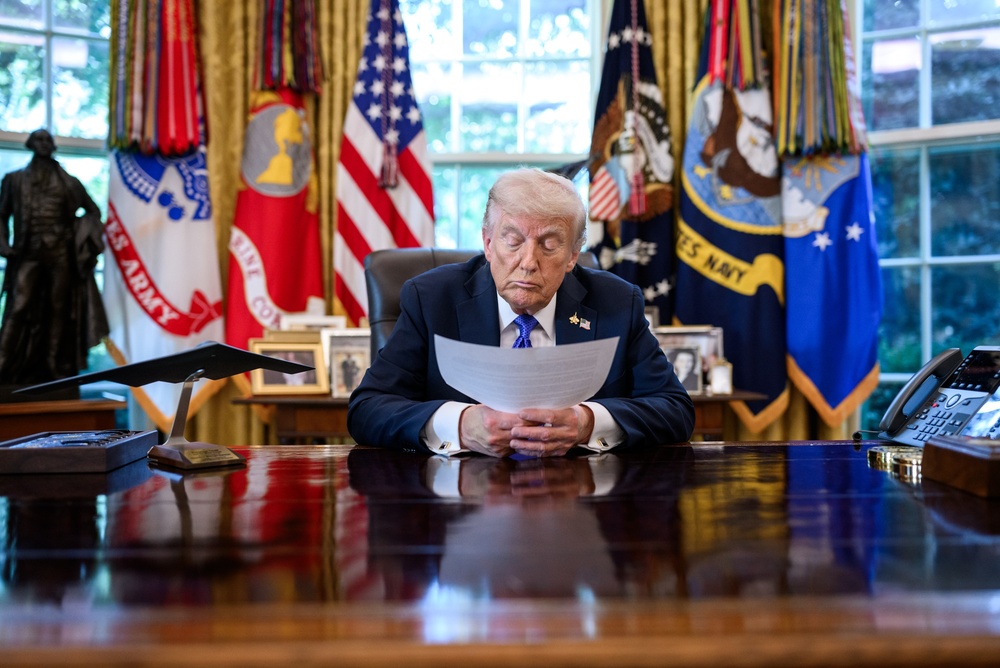
President Trump has publicly indicated that further military action remains firmly on the table.
Following Iran’s latest missile attack, he suggested Washington was prepared to respond with overwhelming force while simultaneously leaving open the possibility of continued negotiations.
“We’re going to beat the f—ing sh– out of them,” Trump told Fox News when discussing Iran’s attacks.
Moments later, he added another message that highlighted the administration’s balancing act.
“We’re going to let them keep talking.”
Those comments appear consistent with accounts from administration officials familiar with internal discussions.
According to one senior official quoted in reporting on the deliberations, Trump was in an “escalatory mood” while continuing to evaluate “the depth of that response.”
That uncertainty has become one of the defining features of the administration’s handling of the conflict.
Over recent weeks, the White House has alternated between signaling support for renewed diplomacy and threatening expanded military operations. Each new Iranian strike has shifted the conversation further toward military action, even as officials continue to insist negotiations remain possible.
The latest attack on Jordan appears to have accelerated those discussions considerably.
Admiral Brad Cooper Believes Limited Strikes Have Failed
The proposed campaign reflects Cooper’s long-held belief that Iran’s missile network cannot be neutralized through isolated retaliatory attacks alone.
Instead, the Centcom commander has argued for a broader offensive designed to significantly weaken Tehran’s ability to threaten American forces across the region.
According to people familiar with his thinking, Cooper believes previous retaliatory strikes have done little to deter Iran from launching missiles or threatening commercial vessels operating through the Strait of Hormuz.
His proposed strategy has become known inside military discussions as the “go big” approach.
Rather than responding to each individual Iranian attack, Cooper argues that the United States should focus on destroying enough missile launchers, command centers, and supporting infrastructure to dramatically reduce Iran’s offensive capabilities.
Supporters of the proposal believe such an operation could eventually decrease the number of expensive defensive interceptors the United States needs to fire because Iran would possess fewer missiles capable of reaching American targets.
That argument has reportedly gained support from Defense Secretary Pete Hegseth, who is said to favor Cooper’s assessment of the battlefield.
The proposal does not suggest an open-ended war.
Instead, military planners envision a concentrated campaign lasting roughly two weeks before reassessing Iran’s remaining capabilities.
Whether such a timetable would prove sufficient remains uncertain.
Inside the Pentagon, Officials Are Weighing Serious Risks

Not everyone involved in the military planning shares Cooper’s confidence.
General Dan Caine, chairman of the Joint Chiefs of Staff, has reportedly taken a more cautious approach while evaluating possible responses.
Unlike Cooper, whose responsibility centers on military operations in the Middle East, Caine must consider the broader global picture.
His concerns extend beyond Iran.
According to multiple reports, Caine has repeatedly warned that America’s supply of air defense interceptors has declined significantly after months of sustained combat operations.
Those missile interceptors protect American military bases, allies, and strategic assets around the world. They also form an essential part of Washington’s preparations for potential crises involving China, Russia, or North Korea.
Rather than arguing against military action altogether, Caine has reportedly focused on the risks associated with committing additional resources while inventories remain under pressure.
People familiar with the discussions said he believes low interceptor stocks would not prevent further operations against Iran but would increase military risk if another international crisis emerged simultaneously.
His concerns have been reinforced by recent assessments of America’s defensive missile inventory.
One report cited estimates from the Center for Strategic and International Studies suggesting the United States entered the conflict with approximately 2,330 Patriot interceptors.
Months of combat have significantly reduced that figure.
The same assessment estimated inventories may now have fallen to as few as 759 missiles.
Analysts warned that extending the conflict could place additional strain on U.S. readiness, particularly if military planners were forced to prepare for potential confrontations elsewhere.
Supporters of Cooper’s strategy counter that argument by insisting a decisive offensive now could reduce future demands on America’s interceptor stockpile.
If Iran’s missile infrastructure were substantially degraded, they argue, fewer defensive missiles would ultimately be required.
The disagreement illustrates the difficult balance facing senior military leaders.
One side believes a stronger offensive now may shorten the conflict.
The other emphasizes preserving resources for future global contingencies while avoiding deeper involvement in a war whose ultimate outcome remains uncertain.
Iran Continues To Demonstrate Its Remaining Capabilities
The debate over military strategy has unfolded against the backdrop of repeated Iranian attacks that suggest Tehran retains significant offensive capabilities despite months of airstrikes.
Earlier this month, an Iranian missile attack killed three U.S. soldiers stationed at a military base in Jordan.
The latest surprise missile barrage targeted American forces in the same country, although Centcom reported that all incoming missiles were intercepted before reaching their intended targets.
Military officials have also pointed to continuing threats against commercial shipping in the Strait of Hormuz, one of the world’s most strategically important waterways.
Those concerns were reinforced after drones struck both a U.S.-owned gas storage tanker and a Greek-owned carrier ship while docked at Egypt’s Port of Damietta.
Security sources cited in reporting by The New York Times suggested the drones had been launched from Iran, describing the incident as another demonstration of Tehran’s ability to project force beyond its borders.
Iran has continued to deny responsibility for several attacks carried out by allied militia groups throughout the region.
However, recent military operations have increasingly expanded beyond direct U.S.-Iran exchanges, drawing additional countries and armed groups deeper into the conflict.
Saudi Arabia recently joined the fighting publicly for the first time by participating alongside the United States in strikes against Iraqi militias that Riyadh described as “terrorist militias loyal to Iran.”
The widening geographic scope has raised fresh concerns that what began as a confrontation between Washington and Tehran could evolve into an even broader regional conflict.
The Debate Over Air Power And Military Strategy

The proposed two-week campaign also reflects a broader debate that has existed throughout the conflict over whether air power alone can achieve Washington’s objectives.
Cooper has argued for months that sustained military pressure could deal a severe blow to Iran’s missile network if commanders were given enough time to complete the operation.
Before the joint U.S. and Israeli campaign began on February 28, Cooper reportedly estimated that six weeks or more would be required to carry out the mission effectively. As the campaign progressed, he continued to believe additional time was necessary to destroy Iran’s remaining missile infrastructure.
By the end of March, Cooper reportedly believed the military still needed roughly 20 more days to finish the job.
Events on the battlefield, however, overtook those plans.
On April 3, an American F-15E fighter jet was shot down over southwestern Iran, forcing a dangerous rescue mission to recover both crew members. Although the operation succeeded and both airmen survived, the incident highlighted the growing risks facing American forces as the campaign continued.
Shortly afterward, President Trump agreed to a ceasefire.
At the time, Defense Secretary Pete Hegseth declared that Iran’s missile program had been “functionally destroyed,” saying its launchers and missiles had been “depleted and decimated.”
Subsequent intelligence assessments painted a more complicated picture.
According to U.S. intelligence estimates cited in multiple reports, Iran’s missile arsenal had been significantly weakened but not eliminated. During an interview earlier this year, Trump himself suggested Iran may still possess roughly one-fifth of its original missile inventory, while other analysts estimated the surviving arsenal could be even larger.
Recent events appear to support those concerns.
Iran has continued launching missiles despite months of sustained airstrikes, convincing some military planners that previous operations failed to permanently disable its offensive capability.
Critics, however, argue that even a larger bombing campaign may not deliver the decisive outcome Cooper envisions.
Several defense analysts have noted that Iran has repeatedly demonstrated an ability to move launchers, protect underground facilities, and resume attacks after previous strikes.
Some have questioned whether another extended air campaign would fundamentally alter that pattern.
Regional Tensions Continue To Expand
As Washington weighs its next move, the conflict is becoming increasingly regional.
Military operations are no longer confined to direct exchanges between the United States and Iran. Allied governments, militia groups, and commercial shipping have all become part of an increasingly complex battlefield stretching across the Middle East.
Saudi Arabia publicly joined military operations alongside the United States for the first time during strikes targeting logistics and weapons facilities belonging to Iraq’s Iran-backed Popular Mobilization Forces.
Riyadh said the operation followed attacks on Saudi oil infrastructure carried out by what it described as militias loyal to Tehran.
The Popular Mobilization Forces later claimed at least 20 of their members had been killed during the strikes.
Iran denied directing attacks on Saudi facilities, but Iranian newspaper Hamshahri reported that four advisers from the Islamic Revolutionary Guard Corps had also died during the operation.
The strikes drew a sharp response from Baghdad.
Iraq’s ministerial council for national security condemned the attacks, declaring that it rejected “all acts of aggression, regardless of the party responsible or the justifications presented.”
The council also pledged to “confront any violation of Iraq’s sovereignty, and prevent any source from using Iraqi territory to threaten neighbouring states.”
President Trump later told Fox News the military operation had been coordinated with the Iraqi government, illustrating the competing narratives surrounding the expanding conflict.
Meanwhile, commercial shipping remains vulnerable.
The Strait of Hormuz continues to be viewed as one of the world’s most sensitive maritime chokepoints, carrying a significant share of global oil exports. Continued threats against vessels operating in and around the waterway have added another layer of pressure on policymakers attempting to prevent further disruption to international energy markets.
Internal Discussions Continue At The White House
While military planners prepare operational options, the final decision remains with President Trump.
Reports suggest the president has received differing assessments from his senior advisers as they weigh military necessity against broader strategic risks.
Much of that discussion has centered on meetings involving Trump, Hegseth, Cooper, and General Caine.
One notable meeting reportedly took place aboard Air Force One following the dignified transfer of four American service members killed during the conflict.
While military leaders discussed possible next steps, the families of fallen soldiers were also onboard the aircraft after attending the ceremony.
The moment underscored the human cost already associated with the conflict and the consequences attached to any decision to expand military operations.
Although reports have highlighted differences in emphasis between Cooper and Caine, Pentagon officials have rejected suggestions of internal division.
Chief Pentagon spokesman Sean Parnell issued a statement insisting the department’s senior leadership remained united.
“Secretary Hegseth, CENTCOM Commander Admiral Cooper, and Chairman Caine stand completely aligned and are united in mission, strategy, and resolve regarding overseas operations involving Iran,” Parnell said.
“The Department of War is locked and loaded, ready to execute the President’s directives at a moment’s notice.”
That statement sought to counter reports portraying competing factions inside the administration.
Instead, officials have characterized the debate as part of the normal process of evaluating military options before presenting recommendations to the commander in chief.
Israel Watches Washington’s Next Move
Another important question surrounding Cooper’s proposal is whether Israel would participate in any expanded military campaign.
Israeli Prime Minister Benjamin Netanyahu met Defense Secretary Pete Hegseth following earlier talks with President Trump, fueling speculation that military coordination remains active between the two allies.
Officials cited in reports said Israeli forces could be involved if Washington chooses to resume major combat operations against Iran.
No formal announcement has confirmed such participation.
The meetings nevertheless highlighted the close military relationship between both countries during the conflict.
At the same time, reports indicate diplomatic and political tensions continue behind closed doors.
According to reporting referenced in one of the source articles, Vice President JD Vance recently held what Israeli officials described as a “frank and candid conversation” with Netanyahu following previous disagreements over the direction of the war.
Those discussions reportedly reflected differing assessments about both military strategy and the broader political consequences of an extended regional conflict.
Despite those differences, the United States and Israel continue coordinating closely as the security situation evolves.
Trump Faces One Of The Biggest Military Decisions Of His Presidency
The proposed 10 to 14-day campaign now represents one of the most consequential military options before the White House since fighting with Iran intensified.
Supporters believe a concentrated offensive could significantly weaken Tehran’s remaining missile force, reduce future attacks on American troops, and restore deterrence after months of escalating violence.
Others warn that expanding the campaign risks drawing the United States deeper into a conflict that may become increasingly difficult to contain.
Those concerns extend beyond battlefield casualties.
Military planners must also consider strained weapons inventories, global force readiness, commercial shipping, regional allies, and the possibility that Iran could continue adapting despite additional airstrikes.
For now, Cooper’s proposal remains exactly that: a military option awaiting presidential approval.
Trump has made clear that military action remains firmly under consideration while also leaving open the possibility of negotiations.
Whether Washington proceeds with an intensive two-week bombing campaign or chooses a more restrained response could shape not only the next phase of the conflict with Iran but also the broader security landscape across the Middle East in the weeks ahead.