
Your cart is currently empty!
Scientists Discover Ancient Genes That Could Help Humans Regrow Lost Limbs
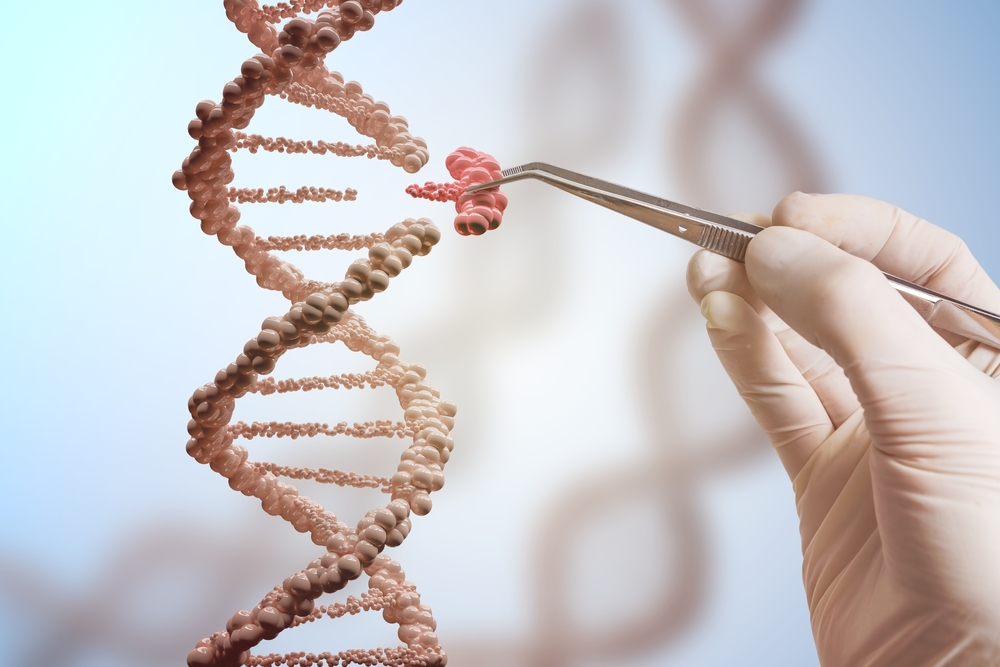
A tiny pink salamander with feathery gills may have just pushed science closer to something that once sounded impossible.
Contents
show
Researchers studying axolotls, zebrafish, and mice say they have uncovered a group of genes that appear to control regeneration itself. The discovery has sparked serious excitement inside the medical world because scientists believe it could eventually help humans regrow damaged tissue, bones, fingers, and perhaps one day even entire limbs.
For decades, the idea belonged almost entirely to science fiction. Now, several major studies suggest the blueprint for regeneration may have been hiding inside the human body all along.
The latest breakthrough came from a team of researchers working across three very different animals known for their unusual healing abilities.
Axolotls can regrow entire arms, legs, tails, spinal cord tissue, and even parts of organs. Zebrafish can repeatedly regenerate damaged fins and repair organs including the heart and pancreas. Mice cannot regrow full limbs, but they can regenerate damaged fingertip tissue under certain conditions.
Scientists wanted to understand whether these very different creatures shared a common biological system.
According to the study published in the Proceedings of the National Academy of Sciences, they do.
Wake Forest University biologist Josh Currie said the project revealed “universal, unifying genetic programs” that appear to drive regeneration across species.
The stars of the study were two genes called SP6 and SP8.
Researchers discovered that when regeneration begins, skin tissue around the wound activates these genes. That process appears to trigger a chain reaction that tells the body how to rebuild damaged structures.
The findings immediately stood out because the same genes appeared in salamanders, fish, and mammals.
That overlap matters.
For years, scientists feared that humans may have completely lost the biological machinery needed for major regeneration somewhere along the evolutionary timeline. This research suggests the system may still exist in mammals, even if it remains mostly inactive.
Axolotls Became The Unexpected Heroes Of Regenerative Medicine
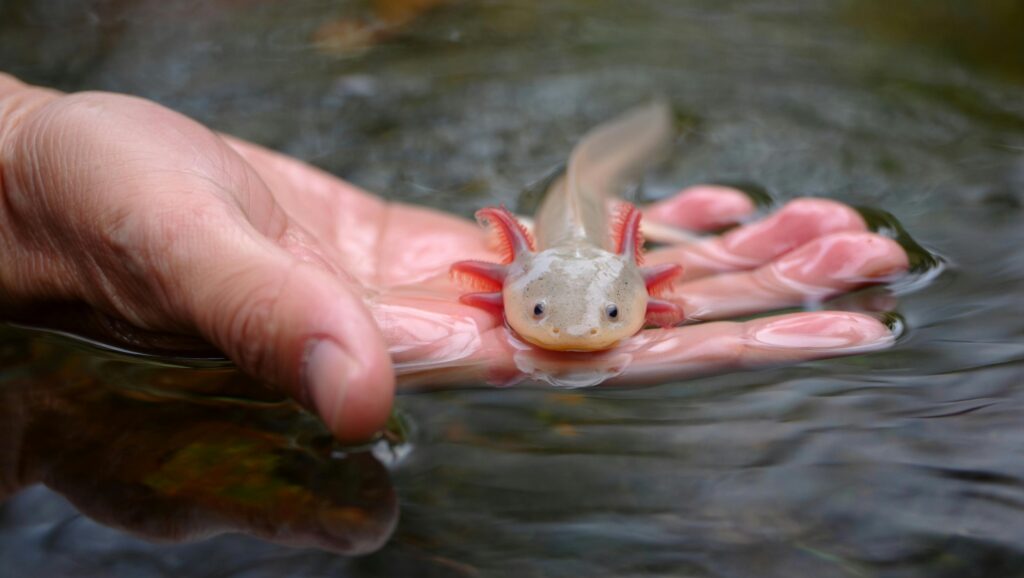
The strange-looking axolotl has quietly become one of the most important animals in modern biology.
Native to Mexico, the amphibian is critically endangered in the wild. In laboratories, however, it has become famous for surviving injuries that would permanently disable most animals.
If an axolotl loses a limb in a predator attack, the missing arm slowly grows back.
Not scar tissue.
Not a rough replacement.
A fully functional limb with muscles, nerves, bones, joints, and blood vessels.
Scientists have spent years trying to understand how the animal manages this process with such precision.
James Monaghan, chair of biology at Northeastern University, has studied axolotl regeneration for decades. His recent work focused on a substance called retinoic acid, which also exists naturally in humans.
Researchers discovered that the amount of retinoic acid present at an injury site helps determine what body part gets rebuilt.
Higher levels may signal the regeneration of an entire arm.
Lower levels may signal only a hand or finger.
An enzyme called CYP26B1 acts almost like a biological control dial. Instead of producing retinoic acid, it carefully reduces the amount to the exact level needed for the missing structure.
Monaghan said understanding this process solved one of the field’s biggest mysteries.
“The paper gives us insight into how a limb knows what to grow back,” he explained.
That question has puzzled scientists for years.
When an axolotl loses a hand, how does the body know not to regrow an entire arm? When it loses only a finger, how does it avoid producing extra tissue?
Researchers now believe the answer lies in chemical signaling systems combined with gene activation.
CRISPR Experiments Produced A Major Shock

Scientists did more than simply observe regeneration.
They also tried turning it off.
Using CRISPR gene-editing technology, researchers removed the SP8 gene from axolotls.
The result was dramatic.
Without SP8, the salamanders could no longer properly regrow limb bones.
The same thing happened in mice.
Researchers found that when SP6 and SP8 were missing, regeneration failed or became severely disrupted.
That finding strengthened the idea that these genes are central players in the rebuilding process.
The team then pushed the experiment further.
David A. Brown’s lab at Duke University developed a gene therapy designed to restore part of the lost regenerative ability. The treatment delivered a signaling molecule called FGF8, which normally becomes activated through SP8.
In mice, the therapy partially restored bone regrowth in damaged digits.
That moment became one of the most important developments in the research.
Scientists were no longer just studying regeneration in animals naturally capable of it.
They had started manipulating the process inside mammals.
Why This Matters To Human Medicine

More than one million amputations occur worldwide every year due to diabetes complications, infections, traumatic injuries, and cancer.
Modern prosthetics have advanced dramatically, but they still cannot fully recreate natural sensation, movement, or biological repair.
Researchers hope regenerative medicine could eventually change that.
The long-term dream is not simply building robotic replacements.
It is convincing the human body to rebuild itself.
Currie described the research as a “proof of principle” that regenerative therapies may eventually substitute for the natural healing systems humans lost millions of years ago.
Scientists remain careful about overpromising results, but the tone surrounding this research has noticeably changed.
A few decades ago, limb regeneration in humans sounded impossible.
Now researchers are openly discussing how future gene therapies could activate dormant biological pathways already hiding inside human tissue.
Humans May Still Carry Ancient Regeneration Abilities
One reason this research has captured so much attention is the possibility that humans never fully lost regenerative potential.
Scientists believe mammals may still retain fragments of the same biological programs seen in salamanders and fish.
Those systems simply became less accessible over time.
Thomas Rando, director of the Broad Stem Cell Research Center at UCLA, believes regeneration may still exist in human biology in a limited form.
Human babies, for example, can sometimes regrow fingertips if the nail bed remains intact.
That ability disappears later in life.
Researchers think this could be evidence that the body still contains ancient regenerative instructions, but only under very narrow conditions.
Rando believes future therapies could eventually reactivate some of those dormant systems.
“If so, we can learn to unlock them,” he said.
That idea has become one of the central goals of regenerative medicine.
Scientists are now exploring several possible approaches:
- Gene therapy that activates regeneration-related genes
- Stem cell treatments that rebuild damaged tissue
- Bioengineered scaffolds that guide tissue growth
- Chemical signaling systems that mimic salamander healing
- Anti-inflammatory therapies that prevent destructive scar formation
Researchers increasingly believe the future solution may combine several of these methods together.
One major challenge is that human healing works very differently from salamander healing.
When humans suffer major injuries, the body rushes to seal the wound quickly through scar formation.
That process prevents infection and blood loss, but it also blocks large-scale regeneration.
Axolotls take another route.
Instead of rapidly sealing damage with scars, their bodies create a structure called a blastema. This mass of cells behaves almost like a biological construction zone, rebuilding tissue layer by layer.
Scientists are trying to understand how to encourage similar behavior in human cells.
The Naked Mole Rat Discovery Added Another Twist
The regeneration story became even stranger after separate research involving naked mole rats.
These wrinkled rodents already fascinate scientists because they can survive for more than 40 years while showing unusually strong resistance to cancer and age-related disease.
Researchers at the University of Rochester focused on a substance called high molecular weight hyaluronic acid, often shortened to HMW-HA.
Naked mole rats carry extremely high levels of it.
Scientists discovered that transferring the rodent’s version of a key gene into mice produced several surprising effects:
- Better resistance to tumors
- Reduced inflammation
- Improved tissue protection
- Better overall health during aging
- A modest lifespan increase
The findings did not directly involve limb regeneration, but researchers believe they may still connect to the broader field of tissue repair.
Hyaluronic acid already plays a major role in wound healing and cellular protection.
Scientists now suspect that combining anti-inflammatory systems, stem cell activation, and regeneration genes could eventually form part of future therapies.
The research also reinforced a growing belief inside biology.
Nature may have already solved many of the problems scientists are trying to fix.
Animals like axolotls, zebrafish, and naked mole rats evolved extraordinary repair systems over millions of years.
Researchers are now racing to understand how those systems work before adapting them for human medicine.
Why Scientists Suddenly Sound More Optimistic
For years, regeneration research moved slowly.
Many scientists believed the gap between salamanders and humans was simply too large.
Axolotls can regrow entire limbs. Humans cannot even repair severe spinal cord injuries effectively.
But several recent advances have changed the mood in the field.
Gene Editing Became Far More Precise
CRISPR technology gave researchers the ability to activate, remove, and manipulate genes with a level of precision that was impossible just a generation ago.
Instead of merely observing regeneration, scientists can now experimentally control parts of the process.
That shift transformed the field.
Researchers can test what happens when certain genes disappear, become enhanced, or activate in different tissues.
The SP8 experiments became especially important because they clearly demonstrated cause and effect.
Remove the gene, regeneration collapses.
Restore the signaling pathway, healing improves.
Scientists Are Finally Mapping The Regeneration Process
Researchers also know far more about how regeneration unfolds step by step.
Earlier studies treated regeneration almost like biological magic.
Now scientists are identifying the chemical signals, genetic instructions, and cellular communication systems involved.
That includes:
- Retinoic acid signaling
- SP gene activation
- Stem cell recruitment
- Blastema formation
- Bone growth pathways
- Inflammation control
Each discovery fills another gap in the puzzle.
Monaghan said researchers now effectively possess a blueprint for limb regeneration.
The remaining challenge is figuring out how to apply that blueprint safely in humans.
The Biggest Obstacles Still Standing In The Way
Despite the excitement, scientists repeatedly stress that human limb regeneration remains far away.
Several major barriers still exist.
The first problem involves complexity.
An arm is not just bone.
A functioning limb contains nerves, muscles, blood vessels, skin, tendons, cartilage, and immune cells that must all regrow in perfect coordination.
Even small mistakes could create dangerous complications.
The second challenge is cancer risk.
Regeneration requires cells to divide rapidly.
Cancer also involves uncontrolled cell growth.
Scientists must learn how to activate rebuilding systems without accidentally triggering tumors.
The third issue is timing.
Some regenerative abilities appear strongest during early development.
Human infants can sometimes regenerate fingertips, but adults lose most of that capacity.
Researchers still do not fully understand why.
There is also the problem of scar tissue.
Human wounds heal aggressively through inflammation and scarring.
That process blocks regeneration before it can even begin.
Scientists may need to partially redesign how the human body responds to injury.
Even optimistic researchers admit the path ahead could take decades.
Still, the tone surrounding the field feels dramatically different from even ten years ago.
Scientists are no longer debating whether regeneration biology exists.
They are debating how to control it.

Regeneration Research Could Change More Than Limb Loss
The implications of this work extend far beyond amputations.
If researchers learn how to control regeneration safely, the same systems could potentially transform treatment for burns, organ damage, spinal injuries, and degenerative disease.
Doctors already see enormous potential in wound care.
Sam Arbabi, a burn surgeon at the University of Washington, called modern wound treatment a “major disappointment in medicine.”
Current treatments often focus on limiting damage rather than fully restoring tissue.
Regenerative therapies could eventually change that equation.
Scientists believe future applications might include:
- Repairing spinal cord injuries
- Restoring damaged heart tissue after heart attacks
- Improving severe burn recovery
- Rebuilding cartilage and joints
- Enhancing nerve repair
- Treating degenerative diseases linked to aging
Some researchers even believe regeneration science may eventually overlap with anti-aging medicine.
Many animals with strong regenerative abilities also show unusual resistance to age-related decline.
That connection has fueled growing interest in how tissue repair, inflammation, stem cells, and longevity interact.
The field is still young.
But discoveries that once sounded absurd are now appearing in peer-reviewed scientific journals.
Scientists Believe Nature Already Wrote The Instructions
One of the most striking parts of the research is that scientists do not think they need to invent regeneration from scratch.
The genes involved already exist in humans.
That reality has completely shifted how many researchers think about the problem.
Monaghan believes the difference between humans and axolotls may not be the presence of regeneration genes, but whether the body can still access them after injury.
That possibility changes everything.
Instead of engineering entirely artificial systems, future medicine may focus on reactivating ancient biological programs buried deep inside human cells.
Scientists are still far from regrowing full human limbs.
Nobody expects hospitals to begin offering regeneration therapy anytime soon.
But for the first time, researchers are beginning to outline a believable biological path toward something that once belonged entirely to fiction.
A pink salamander floating in a laboratory tank may have just handed medicine one of its biggest clues yet.
Sources:
- Brown, D. A., Koll, K. K., Brush, E., Darner, G., Curtis, T., Dvergsten, T., Tran, M., Milligan, C., Wolfson, D. W., Gonzalez, T. J., Jeffs, S., Ehrhardt, A., Bitolas, R., Landau, M., Reitz, K., Salven, D. S., Slota-Burtt, L. A., Snee, I., Singer-Freeman, E., . . . Poss, K. D. (2025). Enhancer-directed gene delivery for digit regeneration based on conserved epidermal factors. Proceedings of the National Academy of Sciences, 123(17), e2532804123. https://doi.org/10.1073/pnas.2532804123
- Wong, V. W., Levi, B., Rajadas, J., Longaker, M. T., & Gurtner, G. C. (2012). Stem cell niches for skin regeneration. International Journal of Biomaterials, 2012, 1–8. https://doi.org/10.1155/2012/926059