
Your cart is currently empty!
Scientists Found Something Surprisingly Different Happening In Your Brain When You Write By Hand

For years, typing has quietly replaced handwriting in classrooms, offices, and everyday life. It is faster, easier to edit, and far more convenient when there is a lot of information to record. But researchers comparing the two activities found something happening inside the brain that could make people think twice before abandoning pen and paper completely.
Contents
show
When university students wrote words by hand, researchers detected broader patterns of communication between different regions of their brains than when they typed the same words. The finding does not prove that handwriting automatically makes someone smarter or guarantees better memory, but it does suggest that the physical act of forming letters gives the brain a more complicated stream of information to process.

The Experiment Put Handwriting And Typing Head To Head
Researchers at the Norwegian University of Science and Technology tested 36 university students using a high-density EEG system fitted with 256 sensors across the scalp. The students were shown words on a screen and asked to reproduce them under two different conditions. During one task, they wrote the words using a digital pen. During the other, they typed them on a keyboard. Because the words and testing environment remained consistent, researchers could focus on what changed when the physical method of producing the letters changed.
The results showed a clear difference between the two conditions. The handwriting task produced 32 statistically significant cluster differences, representing 16 distinct neural connections. Researchers observed widespread theta and alpha connectivity involving network hubs and regions toward the central and parietal areas of the brain. These patterns suggested that handwriting was bringing different areas into communication in a way that was less pronounced during the typing task.
Theta and alpha rhythms are associated with several forms of brain activity, and the researchers specifically noted that theta connectivity appears to be related to working memory and the ability to process new information. That does not mean the experiment proved that students learned more from handwriting. It means the researchers observed a pattern of brain activity that could help explain why handwriting has sometimes been associated with learning and memory benefits in other research.

Every Letter Forces Your Brain To Do Something Different
There is a surprisingly simple physical difference between writing a word and typing one. When someone writes by hand, every letter requires a slightly different sequence of movements, and the hand has to continuously adjust its position and direction. Typing removes much of that variation because the same basic finger movement can produce completely different letters. From the brain’s perspective, the physical experience of producing an A is therefore very different from producing an R when writing, while the keyboard action can remain almost identical.
“When you are typing, the same simple movement of your fingers is involved in producing every letter, whereas when you’re writing by hand, you immediately feel that the bodily feeling of producing A is entirely different from producing a B,” researcher Audrey van der Meer explained. The physical difference means handwriting combines several forms of information at once. Your eyes follow the emerging shape, your hand adjusts its movement, and your brain coordinates the intended letter with the physical motion required to create it.
That creates a richer sensory experience while information is being processed. The researchers believe this additional interaction may help establish stronger communication between brain regions because the person is receiving information through movement, vision, and touch at the same time. A keyboard can produce the same written word far more quickly, but the physical experience of creating each individual letter is considerably more repetitive.

Typing Is Not Turning Your Brain Off
The viral version of this finding can easily go too far. The researchers did not discover that people’s brains somehow switch off when they start typing, and they did not demonstrate that keyboard users are mentally passive. Typing still requires attention, language processing, visual recognition, motor control, and decision-making. The difference observed in the experiment was that handwriting produced stronger synchronization across certain brain networks.
The researchers found that some of the slow brain rhythms that synchronized during handwriting tended to become less synchronized during typing. That distinction matters because desynchronization does not mean inactivity. The brain remains busy during typing, but the pattern of activity appears to involve different forms of communication between regions.
There is another limitation that deserves attention. The typing condition required participants to use a single index finger, rather than the two-handed technique most people use when typing normally. That makes the experiment useful for isolating the difference between specific hand movements, but it also means the results cannot automatically be treated as a perfect representation of everyday keyboard use.
The Handwriting Advantage Has Been Studied Before
The brain recordings were not the first reason scientists became interested in handwriting. In 2014, psychologists Pam Mueller and Daniel Oppenheimer conducted three experiments in which students watched lectures and took notes either by hand or on laptops. The laptop users generally recorded more words, yet they performed worse when they were later tested on conceptual questions. The researchers suggested that typing encouraged students to capture lectures almost word for word instead of processing the information and putting it into their own language.
That difference may come down partly to speed. Someone typing can often capture far more of what a lecturer says, while handwriting is physically slower and forces the student to make decisions about what deserves space on the page. Instead of recording every sentence, the student has to select important ideas, shorten explanations, and sometimes reorganize information before writing it down. That extra mental processing may help explain why having fewer notes can sometimes produce better understanding.
The evidence has become more complicated since that original research. Later attempts to reproduce the findings produced more mixed results, and a 2024 analysis combining 24 studies involving 3,005 college students found that the advantage associated with handwritten notes was modest rather than overwhelming. The effect also became stronger when students reviewed their notes afterwards, suggesting that the way notes are used may matter just as much as the method used to create them.

The Strongest Result Came From Young Children
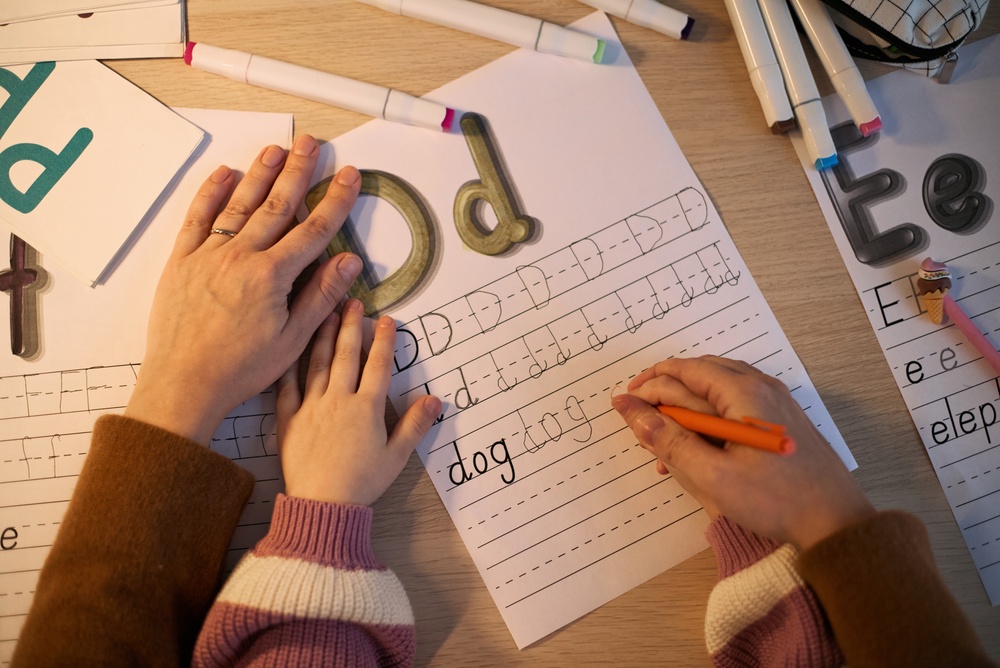
One of the more striking pieces of evidence came from children who were still learning to read. Researchers at the University of the Basque Country studied 50 prereaders who were taught nine letters along with 16 invented words constructed from those letters. Some children copied the letters by hand, some traced them, and others typed them on a computer. The researchers then tested what the children had learned using several different tasks.
The children who trained by writing the letters by hand performed better across the post-test tasks. They identified the newly learned letters roughly nine times out of 10, compared with about three out of four among the keyboard groups. When the children were asked to read the invented words, the gap became wider, with the handwriting group approaching three quarters correct while the keyboard groups remained below half.
The results are difficult to apply directly to university students or adults because young children learning unfamiliar symbols are dealing with a very different task. Still, the experiment is significant because early literacy is precisely the stage when the brain is building connections between visual symbols, sounds, language, and physical movements. The findings suggest that physically producing a letter may provide an additional learning signal during that process.
What The Researchers Actually Know
The most important limitation is also the easiest one to miss. The 2024 EEG study measured differences in brain connectivity, but it did not directly measure learning or memory. The students wrote words they already knew, rather than learning unfamiliar information, and researchers did not give them a memory test after the experiment. That means the study can show that handwriting and typing produce different patterns of brain activity, but it cannot establish that one method produces better learning.
A commentary published in 2025 raised several concerns about the study and its interpretation. One of the key points was that researchers have not clearly established that increased theta and alpha connectivity automatically creates the right conditions for learning. More communication between brain regions may be meaningful, but neural connectivity alone cannot tell researchers exactly what someone has learned or how long they will remember it.
The wider research also does not support an extreme conclusion. The larger body of note-taking research suggests that handwriting can provide a modest advantage in certain circumstances, particularly when students later review their notes, but the evidence does not show that typing is inherently harmful. The sensible interpretation is narrower: handwriting changes the way the brain processes information, and that difference may sometimes be useful when the goal is learning rather than simply recording information.
The Keyboard Still Has A Job To Do
None of this means people should throw away their keyboards. Typing remains faster and more efficient for many tasks, especially when large amounts of information need to be entered, edited, shared, or stored. It is also essential across modern education and workplaces. The research does not identify typing as a harmful activity, and the researchers themselves argue that children should learn both handwriting and keyboard skills.
Handwriting appears to offer something different rather than simply replacing what a keyboard does. The slower physical process forces the hand, eyes, and brain to coordinate in a more varied way, while the limited speed of writing can encourage people to select and reorganize information. That may make pen and paper particularly useful when the purpose is understanding, studying, brainstorming, or remembering rather than producing the largest possible volume of text.
For anyone deciding when handwriting might be worth choosing, the research points toward several situations where the slower approach could be useful:
- Learning something new: Physically forming information may provide additional sensory and motor cues while the brain processes unfamiliar material.
- Taking selective notes: Writing by hand naturally limits how much can be recorded, forcing the writer to decide which information deserves attention.
- Teaching young children: Early letter formation may provide useful support as children connect unfamiliar symbols with sounds, words, and movements.
- Reviewing information: Research suggests that revisiting handwritten notes can strengthen the potential learning benefit.
- Working through ideas: The slower pace can create more time to select, organize, shorten, and rephrase information before committing it to the page.
The Missing Experiment Could Change The Story
There is still one major question the research has not answered. Scientists need to compare handwriting with realistic keyboard use while participants are given genuinely new information to learn, then test what they remember afterwards. That would connect the unusual brain activity observed in EEG recordings with the outcome people actually care about.
If handwriting produces different neural patterns and those patterns consistently predict stronger memory, the argument for handwriting would become considerably stronger. If the memory advantage disappears under controlled testing, researchers would have a different explanation for the brain connectivity differences. Either result would tell us more than the current evidence can.
For now, the evidence supports a more measured conclusion. Writing by hand engages the brain differently from typing, and that difference may have consequences for learning in certain situations, particularly during early education and tasks that require active processing.
The keyboard may help you capture more information in less time. The pen forces you to slow down, and that extra effort may be exactly what makes some information worth remembering.
Sources:
- Pubmed.ncbi.nlm.nih.gov. (n.d.-f). https://pubmed.ncbi.nlm.nih.gov/24760141/
- Pinet, S., & Longcamp, M. (2025). Commentary: Handwriting but not typewriting leads to widespread brain connectivity: a high-density EEG study with implications for the classroom. Frontiers in Psychology, 15, 1517235. https://doi.org/10.3389/fpsyg.2024.1517235