
Your cart is currently empty!
A Scientist Says Heaven May Exist Beyond the Edge of the Universe

Is Heaven real, and if so, where is it? This question has echoed through human history, shaping religions, philosophies, and cultures across the globe. For most of that history, Heaven has existed outside the reach of measurement, belonging to theology, myth, and personal belief rather than laboratories or telescopes. In recent years, however, a surprising voice has entered the discussion, not from a pulpit, but from the world of theoretical physics.
Contents
show
A former Harvard physics professor has suggested that the structure of the universe itself may point toward a specific cosmic boundary that aligns uncannily with ancient descriptions of Heaven. His argument does not claim to prove the existence of God or the afterlife, but instead proposes that modern cosmology has uncovered a region of reality where time, causality, and physical access break down entirely. This region, known to science as the cosmic horizon, may represent something far more profound than an observational limit.
The idea has captivated believers, unsettled skeptics, and sparked renewed debate about whether science and spirituality are truly incompatible, or whether they are simply exploring the same mystery from different sides.
The Scientist Behind the Claim
The theory has gained traction largely because of the credentials of the man proposing it, Michael Guillen. Guillen holds doctoral degrees in physics, mathematics, and astronomy, and previously lectured at Harvard University. Over the course of his career, he has worked at the intersection of science, philosophy, and faith, often focusing on the limits of scientific knowledge and what those limits imply about reality itself.
Guillen does not argue that science can measure Heaven directly, nor does he claim experimental proof of divine realms. Instead, his position is more subtle. He suggests that when modern cosmology is taken seriously, it leads to a boundary beyond which our familiar concepts of space and time no longer apply. According to him, this boundary bears a striking resemblance to how Heaven has been described in religious texts for thousands of years.
It is this combination of rigorous scientific language and theological interpretation that has made his argument both compelling and controversial.
The Expanding Universe and the Discovery That Changed Everything

To understand the foundation of Guillen’s theory, it is necessary to revisit one of the most important discoveries in modern science, the expansion of the universe.
In 1929, American astronomer Edwin Hubble discovered that distant galaxies are moving away from Earth, and that the farther away a galaxy is, the faster it appears to be receding. This observation revolutionized astronomy and led directly to the development of the Big Bang theory. Rather than existing in a static, eternal state, the universe appeared to be dynamic, evolving, and expanding.
Importantly, this expansion is not like galaxies flying through space as objects move through air. Instead, space itself is stretching, increasing the distance between large cosmic structures over time. This subtle distinction becomes critical when discussing cosmic limits, because it means that some regions of the universe are being carried away from us faster than light can traverse the expanding space between us and them.
The Speed of Light and the Limits of Observation

One of the most counterintuitive aspects of modern physics is the role of the speed of light. According to Einstein’s theory of relativity, nothing with mass can travel faster than light, and light itself moves at a fixed speed through space. This speed limit places a fundamental constraint on what can be observed, measured, or influenced.
Guillen uses a numerical example to illustrate this limit. A galaxy located roughly 273 billion trillion miles away from Earth would be receding from us at the speed of light due to cosmic expansion. At that distance, light emitted by the galaxy would never reach us, not because it is blocked, but because space itself expands too quickly for the light to close the gap.
This distance marks what cosmologists call the cosmic horizon, a boundary defined not by matter or walls, but by the limits of causality itself.
What Exactly Is the Cosmic Horizon?
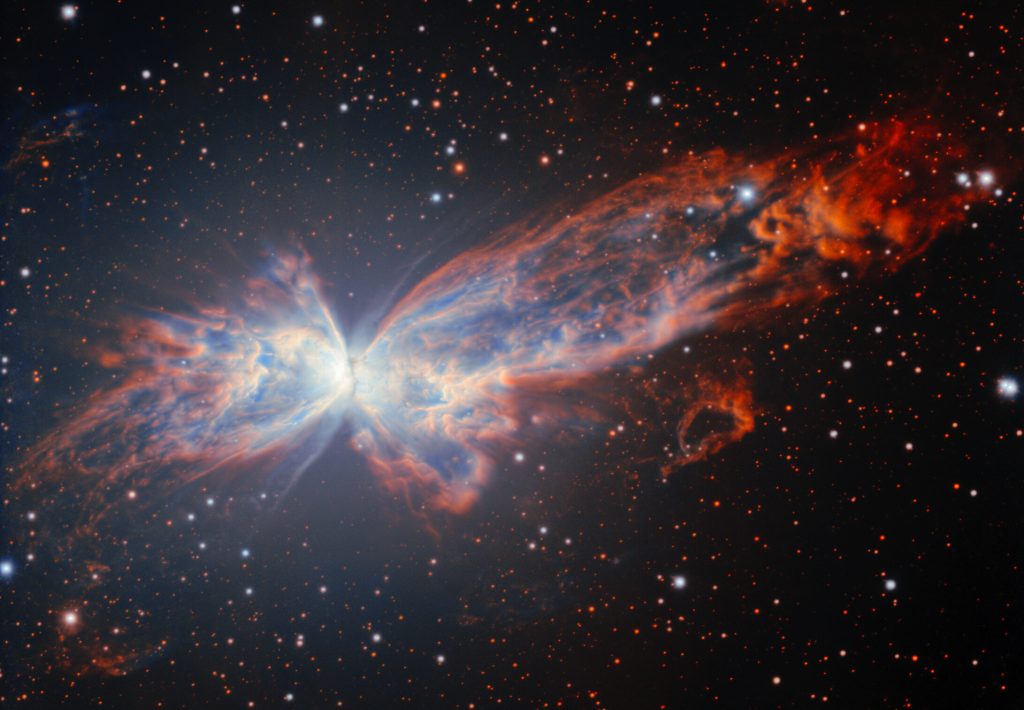
The cosmic horizon is often misunderstood as the edge of the universe, but this is not how scientists define it. It is better described as the edge of the observable universe, the farthest distance from which light has had time to reach Earth since the beginning of cosmic expansion.
Beyond this horizon, there may be countless galaxies, stars, and entire cosmic structures, but they are permanently inaccessible to us. No telescope, no spacecraft, and no future technology could ever retrieve information from these regions, because the expansion of space prevents any signal from crossing the boundary.
For most astronomers, the cosmic horizon is a practical limit rather than a metaphysical one. It tells us where our observations must stop, not where existence itself ends. Guillen, however, believes this boundary carries deeper implications.
When Time Itself Breaks Down

The most provocative aspect of Guillen’s theory involves the nature of time at the cosmic horizon. Drawing on Einstein’s theories of special and general relativity, he argues that time behaves in extreme and unintuitive ways near this boundary.
From the perspective of an observer on Earth, objects at the cosmic horizon appear to be frozen in time. Their clocks, if they could be observed, would appear to slow to a halt. In a relativistic sense, time stretches infinitely as one approaches the horizon.
Guillen interprets this not merely as a mathematical artifact, but as a sign that conventional time ceases to exist at the cosmic horizon. Beyond it, there is no meaningful distinction between past, present, and future. There is only timelessness.
This claim is where physics begins to blur into philosophy, and where his theory becomes deeply controversial.
Timelessness and Ancient Descriptions of Heaven
Many religious traditions describe Heaven as eternal, outside of time, and unchanging. In Christian theology, Heaven is often portrayed as a realm where time as humans experience it no longer applies. There is no aging, decay, or sequence of events in the ordinary sense.
Guillen argues that the cosmic horizon provides a scientific analog to this idea. A region of reality where time effectively stops would, by definition, be eternal. It would not be bound by cause and effect in the way physical processes within the universe are.
In this sense, the cosmic horizon appears to match the ancient idea of a divine realm that exists beyond time itself.
The Biblical Concept of Multiple Heavens
Another key element of Guillen’s argument comes from biblical cosmology. Ancient Hebrew texts often refer to multiple levels of Heaven. The lowest level corresponds to the sky or atmosphere, the domain of birds and clouds. A higher level refers to outer space, the realm of stars and celestial bodies. The highest level is described as the dwelling place of God, completely beyond human reach.
Guillen suggests that modern cosmology mirrors this ancient hierarchy in an unexpected way. Earth’s atmosphere is clearly distinct from outer space, and outer space is governed by physical laws that differ from those on Earth. Beyond the observable universe, however, lies a region that is fundamentally inaccessible and governed by conditions unlike anything we can experience.
From this perspective, the highest Heaven described in scripture may correspond symbolically, or even structurally, to what physics identifies as the cosmic horizon and beyond.
The Big Bang and the Oldest Light in the Universe
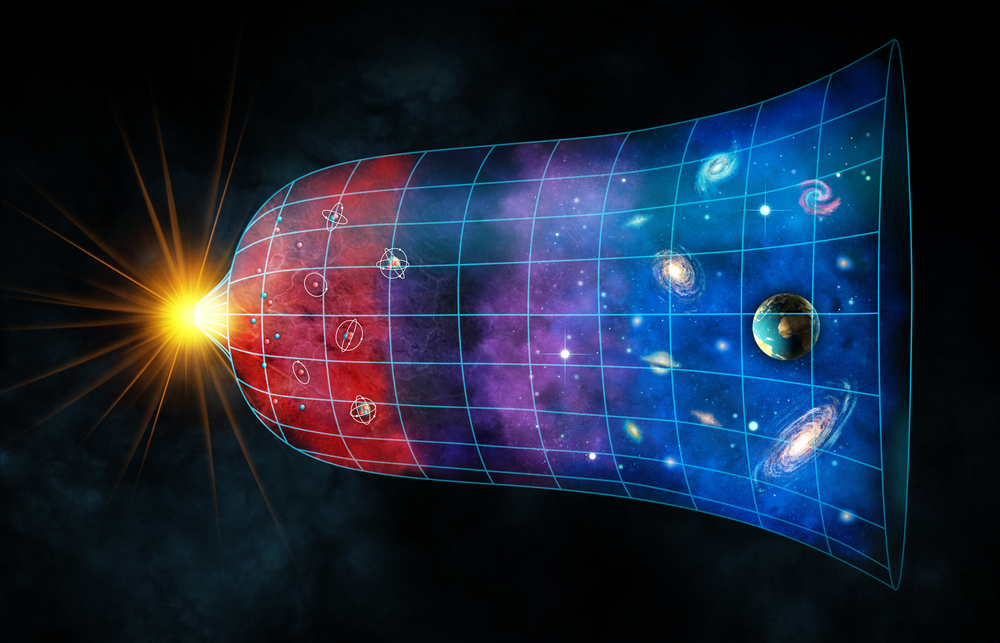
To understand why the cosmic horizon exists at all, it is necessary to look back to the earliest moments of the universe. According to the Big Bang theory, the universe began approximately 13.8 billion years ago in an extremely hot and dense state.
In the first few hundred thousand years, the universe was opaque. Light could not travel freely because it was constantly scattered by charged particles. As the universe expanded and cooled, atoms formed and light was finally able to move through space. That ancient light has been traveling ever since, stretched by cosmic expansion into what we now observe as the cosmic microwave background radiation.
This faint afterglow represents the oldest light we can detect, and it marks a kind of observational wall. Beyond it, we cannot see further back in time or deeper into space.
Dark Energy and the Future of Cosmic Isolation
Modern observations suggest that the expansion of the universe is accelerating due to a mysterious force known as dark energy. As a result, more and more regions of the universe are crossing beyond our cosmic horizon over time.
In the distant future, galaxies that are visible today will gradually disappear from view as their light can no longer reach us. Eventually, observers in our local region of space may see only a handful of nearby galaxies, surrounded by an otherwise dark sky.
Guillen interprets this scenario symbolically, suggesting that the cosmic horizon could be seen as an expanding boundary, continuously enclosing new regions beyond observational reach. For critics, this is where metaphor begins to overshadow physics.
Where Mainstream Science Pushes Back
Most cosmologists reject the idea that the cosmic horizon has any special metaphysical significance. From their perspective, it is simply a consequence of finite light speed and cosmic expansion. There is no evidence that time literally stops at the horizon, only that our models describe extreme relativistic effects from our point of view.
Critics argue that interpreting an observational limit as a literal place where Heaven exists goes beyond what science can justify. The leap from “we cannot observe beyond this point” to “this is where a divine realm exists” is philosophical rather than empirical.
This distinction is crucial. Science describes what can be measured and predicted, not what lies forever beyond measurement.
The Psychological Power of a Cosmic Address

Despite these criticisms, Guillen’s theory resonates deeply with many people. One reason is that it provides a concrete image of Heaven, a place that is “up there,” beyond reach, yet rooted in the structure of the universe itself.
For believers, this can feel like a reconciliation of faith and reason. Heaven is no longer an abstract concept floating outside reality, but something woven into the cosmic fabric. For skeptics, however, this concreteness is precisely the problem, as it risks mistaking metaphor for mechanism.
The theory’s appeal highlights a deeper human desire to locate meaning within the universe rather than outside it.
The Boundary Between Science and Interpretation
At its core, the debate surrounding this theory is not about cosmology, but about interpretation. The facts of cosmic expansion, the speed of light, and the existence of a cosmic horizon are well established. What remains contested is what those facts mean.
Does a boundary to observation imply a boundary to existence? Does timelessness in mathematical models correspond to experiential eternity? These questions cannot be answered by equations alone.
Guillen’s argument sits at this boundary, using scientific language to explore questions that science itself cannot resolve.

Ancient Wisdom and Modern Limits
Interestingly, many ancient spiritual traditions emphasized limits to human knowledge. Mystical teachings often speak of veils, thresholds, or horizons that separate the known world from the divine. In this sense, the cosmic horizon may be less a discovery than a modern expression of an ancient insight.
Physics, like mysticism, eventually encounters questions it cannot answer, not because it has failed, but because it has reached the edge of its domain.
A Theory That Reveals More Than It Proves
Whether or not Heaven exists beyond the cosmic horizon is ultimately a question that science cannot answer. What Guillen’s theory does accomplish is something arguably just as important. It reminds us that the universe contains genuine limits, places where our models break down and our certainty fades.
In those limits, humanity has always found room for meaning, wonder, and faith. The cosmic horizon may not be Heaven, but it is undeniably a frontier, one that challenges our assumptions about reality, time, and existence itself.
Perhaps the true value of this theory lies not in locating Heaven, but in revealing that even in an age of advanced science, mystery remains woven into the fabric of the cosmos.