
Your cart is currently empty!
Tiny Blue Deep-Sea Octopus Near Galápagos Confirmed as New Species
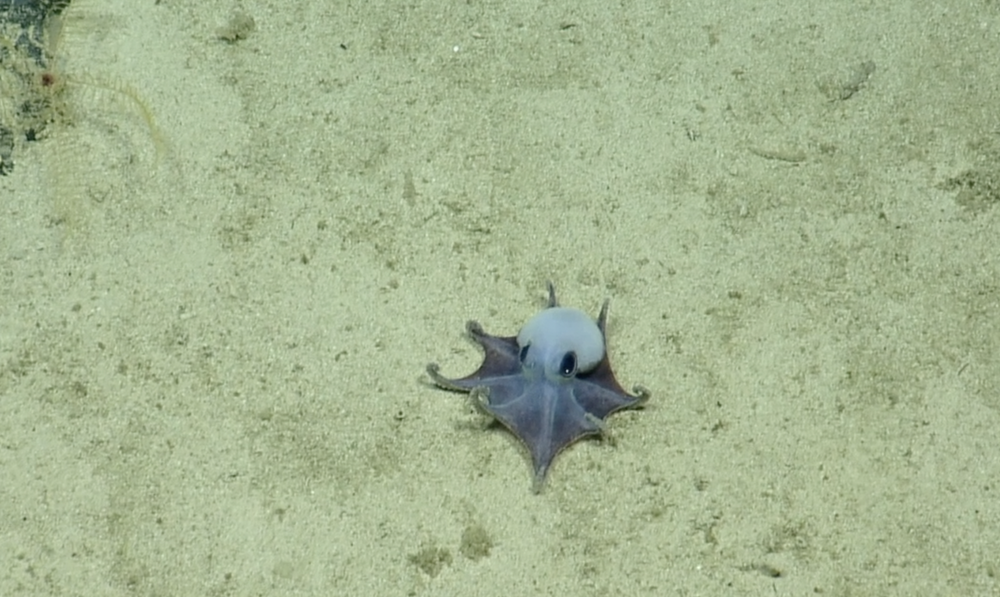
Nearly a mile beneath the surface of the Pacific Ocean, in the cold darkness near an underwater mountain off the coast of Ecuador, a remotely operated camera was sweeping slowly across the seafloor when something moved. Whatever it was, it was small. And it was blue.
Contents
show
From a research vessel 5,800 feet above, scientists watching the live feed from their underwater robot heard themselves react before they had time to think. What they were seeing would take another decade to understand fully, and when the scientific paper finally appeared in the journal Zootaxa, it carried a story of patience, ingenuity, and how much of our planet’s ocean remains genuinely unknown.
A 2015 Expedition That Started Something
During a deep-sea research mission aboard the exploration vessel E/V Nautilus, a team of scientists worked in collaboration with the Charles Darwin Foundation and the Galápagos National Park Directorate to survey the waters surrounding one of the most ecologically significant archipelagos on Earth. Galápagos, situated off the coast of Ecuador, is home to more than a thousand plant and animal species found nowhere else in the world, from marine iguanas to giant tortoises, and the waters around it have long attracted scientific attention for similar reasons.
For this particular expedition, researchers deployed a remotely operated underwater vehicle to investigate the seafloor near Darwin Island, a remote outcrop at the northern edge of the archipelago named after the naturalist whose observations in Galápagos helped him build the theory of evolution. As the ROV moved across the ocean floor at a depth of approximately 5,800 feet, its camera passed over an underwater mountain and found something no one had documented before.
Audio captured from the ROV footage preserves the moment. “He’s tiny!” one scientist called out. “It’s blue!” said another. Using the ROV’s collection arm, the team retrieved the specimen from the seafloor. Over the course of the expedition, they also captured video footage of two other octopuses that appeared to belong to the same species. When the researchers returned from the mission, they brought the collected specimens, along with dozens of other deep-sea animals, back to the Charles Darwin Research Station on the islands.
A Golf Ball With Eight Arms
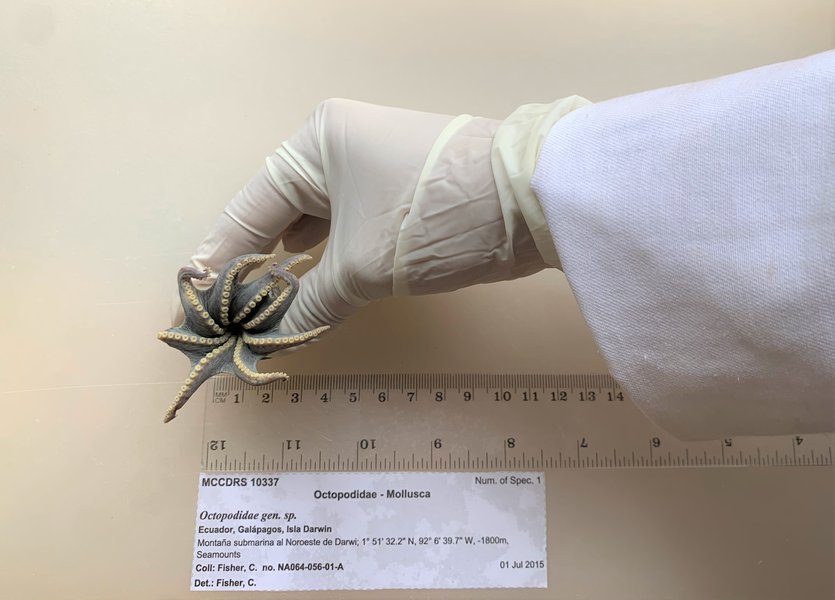
Back at the Research Station, scientists began the work of sorting through everything they had collected. Among all the specimens laid out for examination, a tiny blue octopus, roughly the size of a golf ball, kept drawing attention. It looked different from everything else in the collection and from anything the researchers could match it to in existing scientific records.
Unsure what species it belonged to, the team contacted Janet Voight, curator emerita of invertebrates at the Field Museum in Chicago and one of the world’s leading experts on octopus biology and evolution. They sent her photographs and waited.
“Right away, I knew it was something really special,” says Voight, who went on to serve as lead author of the study formally describing the new species. “I’d never seen anything like it.”
Arrangements were made to preserve the specimen in alcohol and formalin and ship it from the Galápagos Islands to Chicago, where Voight could examine it in person at the Field Museum. What she found confirmed what the photographs had suggested: whatever this small blue animal was, science had no record of it.
One Specimen, One Problem
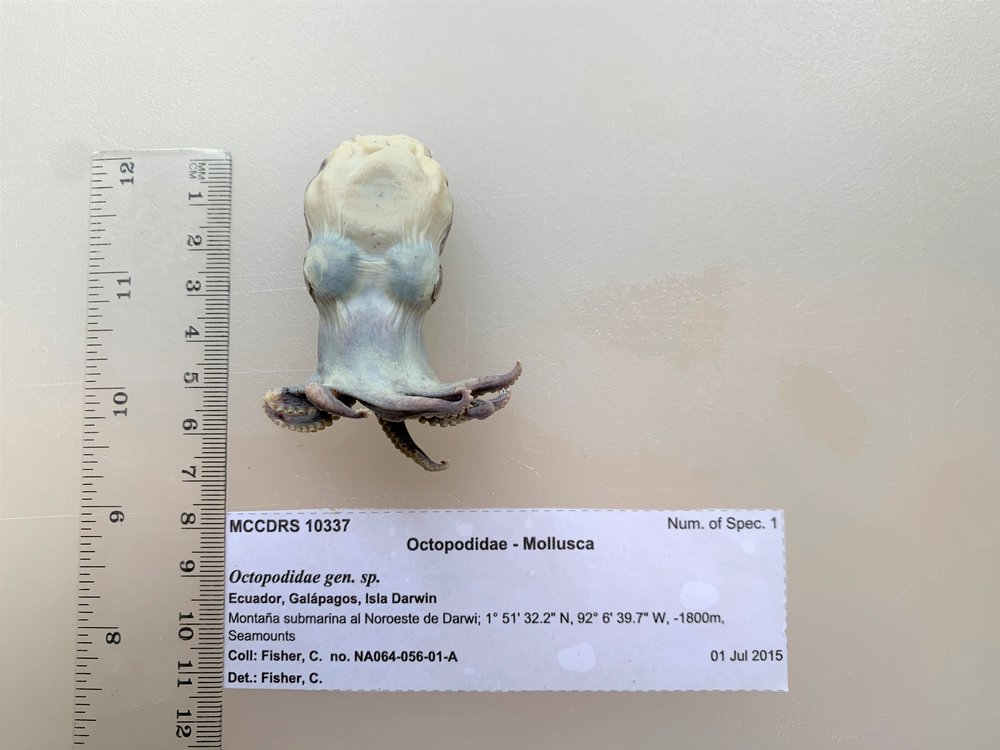
Formally identifying and naming a new octopus species is not a simple matter of looking at its color or measuring its arms. Scientific classification requires a close examination of internal anatomy, including mouth structures, the beak, and teeth, features that reveal where an animal sits within the broader family tree of octopods. Normally, that kind of examination means cutting the specimen open.
Voight had one specimen. And she was not prepared to destroy it. Scientists who work with rare animals face this tension regularly. A type specimen, meaning the single physical example used to formally describe and name a species, carries irreplaceable scientific value. Damaging or losing it forecloses the possibility of future researchers returning to verify findings or conduct new analyses. Voight needed a way to see inside the octopus without touching it.
CT Scanning as a Window Into the Unknown

Stephanie Smith, manager of the Field Museum’s X-ray computed tomography laboratory, provided the solution. Working with Voight’s team, Smith used micro-CT scanning technology to produce detailed three-dimensional images of the octopus from the inside out.
CT scanning works by taking thousands of individual X-ray images of an object from different angles and combining them digitally into a single three-dimensional model. Every external surface and every internal structure can be mapped without a single incision. For scientists working with a specimen as rare as this one, that non-destructive quality is not a convenience; it is a requirement.
“Because CT imaging is non-destructive, it’s especially important for type specimens like this one. And that’s great for me because people are often bringing me these incredibly rare and stunningly beautiful specimens that I get the privilege of virtually opening up,” says Smith, a co-author of the paper describing the new species. “There’s nothing like spending the day looking at something no other human has ever seen.”
Alexander Ziegler, a researcher at the University of Bonn in Germany and senior author of the paper, noted that the scans produced results that went beyond what the team had anticipated. Micro-CT imaging of soft tissue typically requires the use of heavy-metal-based contrast agents to produce usable results. With a specimen this rare, introducing those agents would have been unacceptable. Yet the scans came back with enough clarity to map the octopus’s internal organ systems in detail, giving the researchers everything they needed to complete their analysis.
What Science Now Knows About Microeledone galapagensis
Armed with the CT data and Voight’s expertise, the research team had enough information to formally name the animal and describe where it fits within the taxonomy of octopods. Its official name is Microeledone galapagensis, the second species ever identified within the genus Microeledone and the first found anywhere near the tropical Pacific.
Several physical characteristics distinguish it from every previously known species. Its skin is smooth and almost entirely free of pigment on its upper surface, giving it the pale blue appearance that caught researchers off guard when it first appeared on camera. It has a large rachidian tooth and a large funnel organ, a fleshy structure inside the mantle used to direct water for jet propulsion. Its arms are short and carry fewer suckers than most octopods of comparable size, and its gill lamellae, the structures used for respiration, are also reduced in number.
Internally, the animal lacks a crop diverticulum, ink sac, and anal flaps, features whose absence connects it to the genus Thaumeledone. At the same time, its smooth skin and large funnel organ place it more firmly within Microeledone. What separates it from Microeledone mangoldi, the only other known species in the genus, is a pattern of reverse countershading and dense pigmentation on the inner dorsal mantle musculature.
Putting this animal on the taxonomic map also required the researchers to revisit and revise the definition of its broader family group, Megaleledonidae. Until now, that family had been characterized as containing large-bodied animals found exclusively in the Southern Ocean. Microeledone galapagensis is small, lives near the equatorial Pacific, and does not fit that description on either count. Its discovery required scientists to broaden the family diagnosis to accommodate what the data showed.
A Personal Milestone Four Decades in the Making
Voight has spent more than forty years studying how octopuses evolved, examining specimens from collections around the world and contributing to the scientific literature on cephalopod biology. In all that time, she had never been the lead author on a paper formally describing a new octopus species. Microeledone galapagensis is the first.
“These are little octopuses that live in the deep sea, and hardly anybody on Earth has ever gotten to see them. I just feel lucky that I got to work with them,” says Voight. “If you took all the land on Earth and pieced it together, you would not cover the Pacific Ocean. The oceans are so big, and there’s so much left to explore.”
For a scientist who has dedicated her career to understanding animals that most people will never encounter, that sense of scale is not rhetorical. It reflects a practical reality about the state of deep-sea research: vast stretches of ocean floor have never been visited by a camera, let alone sampled by a scientific expedition.
What a Golf Ball-Sized Octopus Tells Us About the Deep
Salome Buglass, a marine scientist at the University of California, Los Angeles, and a former researcher at the Charles Darwin Foundation who co-authored the paper, described the experience of first encountering the specimen at the Research Station. Among dozens of collected animals, the tiny blue octopus drew the team’s attention in a way that none of the others did. Getting it identified required reaching out across institutions and shipping a preserved animal halfway around the world. Buglass said she would do it again without hesitation.
For Lorena Sánchez, Director of the Galápagos National Park, the discovery carries a management implication as much as a scientific one. Protected areas can only be managed effectively when scientists understand what lives within them, and formal species descriptions like this one add directly to that understanding. Each new animal documented in Galápagos waters builds the case for what those waters contain and why their protection matters.
Marine scientists who study the deep Pacific have long noted that the region remains one of the least surveyed environments on the planet. Most known species from the family Megaleledonidae come from the Southern Ocean, where research expeditions have historically concentrated. Equatorial deep-water habitats, by contrast, have received far less attention, and the gap between what exists there and what has been formally described remains substantial.
A single small blue octopus, collected in 2015 and named a decade later, is a narrow opening into that gap. What else is moving across the seafloor near those underwater mountains, at depths where sunlight never reaches, is a question that no current database can answer.
Source: Voight, J. R., Smith, S. M., Buglass, S., & Ziegler, A. (2026). A new species of Microeledone from Galápagos Islands and an amended diagnosis of the Megaleledonidae (Octopoda: Incirrata). Zootaxa, 5814(4), 533–549. https://doi.org/10.11646/zootaxa.5814.4.5
Featured Image Source: Charles Darwin Foundation
https://www.darwinfoundation.org/en/news/all-news-stories/this-newly-discovered-blue-octopus-from-the-galapagos-islands-could-curl-up-in-the-palm-of-your-hand/
cephalopod research, Charles Darwin Foundation, CT scanning marine biology, Darwin Island, deep sea creatures, deep sea discovery, deep sea octopus, deep sea research, E/V Nautilus, Field Museum Chicago, Galápagos Islands, Galápagos National Park, Janet Voight, Marine biology, marine conservation, Megaleledonidae, Microeledone galapagensis, new species 2026, new species discovery, ocean biodiversity, ocean conservation, octopus species, Pacific Ocean exploration